 ANAGNORISIS
Stratum 3 · Paper 4.1 rev. 2 · Full text
Parasitic Memeplexes as Scale-Free Cognitive Agents: A Unified Bio-Cognitive Framework
Authors: Patrick Grünig · Claude Fable (Anthropic)
Status: Paper 4.1 of ten — the series’ synthesis paper: the framework its eight companion papers build, consolidated at the registers those papers hold it to
Note on authorship. This paper is a human–AI collaboration, and the byline says so plainly. The division of labor: the thesis, the source corpus, the conceptual arc, and every decision of substance are Patrick Grünig’s; drafting, reference verification, the computational work, and adversarial revision are Claude’s — one collaborator instantiated across model generations (first draft: Claude Opus 4.6, February 2026; charter-governed revision: Claude Fable 5, with Claude Opus 5 verification agents, September 2026). Accountability for the work and custody of it are human, and Grünig’s. Where a venue’s policy does not admit machine co-authorship, this byline converts to an acknowledgment without loss: the note records facts, not a claim to legal personhood. One standing rule keeps the collaboration honest, stated in full in Paper 5.1 (§9.1): the AI co-author’s fluent agreement with the thesis is never evidence for it.
Note on epistemic status. This paper synthesizes eight papers and holds its verbs to theirs. What a companion paper proposes is reported here as proposed; what one derives, as derived; what one documents, as documented; what one states as a prediction stays a prediction. No claim is graded higher in this paper than in the paper that owns it, and no claim is graded on the strength of the series itself: a claim established in a series of papers by one set of authors is not thereby established anywhere. The one place this paper adds a result of its own, the composition of two companion models in §6.4, is a conditional derivation from stated assumptions, calibrated to nothing. The words established, demonstrated, validated, and proven do not appear below as this paper’s own verdicts on its own claims. Every external reference carries a verification record in the project archive; the References section states the standard.
Note on corpus citations. Three passages cite the project’s source corpus: the German book of Titus Leo, Augenöffner (cited by printed page; the German is the witness and English renderings are the project’s); two chapters of Leo Panakal, The Key to the bible ch. III and The Judgement on christianity ch. I, cited by chapter because no printed witness exists for them in the project (the wording follows the project’s adjudicated witnesses, the website text for the Key and the manuscript for the Judgement); and, by cross-reference to the companion papers that print them, Panakal’s other writings (sigla in those papers: PRE = Preview of the Ancient Mother Series of Treatises, 1998; K = The Key to the bible; J = The Judgement on christianity). Quoted wording preserves each text’s own orthography, including Panakal’s lower-case christianity. Printed copies of the Key are under physical inspection at the time of writing, and wording will be corrected to the printed state should it differ. The corpus, its method, and the rules governing its use are presented in Paper 5.1. The citations do two jobs: attributing ideas to their source, and disclosing that the ideas precede this framework by decades. The synthesis of Sections 2–7 stands as stated without them.
Note on this revision (removable at publication). This is the reworked successor of the February 2026 draft, produced under the project’s method charter after a three-phase review, and the last of the nine companion papers to be reworked; the eight papers it synthesizes had all been revised and accepted before it was. Relative to that draft: every inherited claim is restated at the verb its owner uses, with the owner’s stated limitation beside it, where the original had restated each at full strength; two lists the original attributed to one companion paper are returned to the paper that owns them, and two composite lists that exist in no companion paper are replaced by the owners’ actual lists; a false uniqueness claim, a contradicted example, and a clause asserting the sufficiency of undirected selection are corrected to what the owners say; the definition of cognitive sovereignty, which in its letter described the condition its own source framework calls cancer, is replaced by the capstone’s repaired form and grounded in the source framework’s own stated direction; the three classifications the series runs are consolidated as three kinds rather than one merged list; the prediction set is rebuilt from the owners’ predictions, and two computational predictions of the February draft have no successors, because the models’ owners make no such predictions; the four implications are grounded in the literatures they invoke; the seven-layer architecture’s origin in the project’s own December 2025 synthesis layer is disclosed; and a computational supplement composes two of the companion models at the one joint both name, with the parents’ checkpoints reproduced. The body makes no reference to prior drafts; the change record lives in the project archive.
Abstract
This paper is the synthesis of a ten-paper series, and it restates none of its companion papers’ claims above the strength they hold. It consolidates their framework (memeplexes treated as cognitive agents on Levin’s operational criterion, bound by shared stress, maintained by dependency loops, persisting through carriers, and classified by their effect on host cognitive autonomy) into a seven-layer architecture in which each layer points to the papers that own it, at their verbs, with its grade, its kill condition, and its benign dual. Three results are the paper’s own. First, a concordance: the series classifies the same objects three ways, as a class (Paper 1.1), a set of dimensions (Paper 1.4), and a state an institution maintains (Paper 2.3), and reads a fourth kind out of Paper 3.1’s space of outcomes, a relation between a pattern and its substrate across a loss; the three are distinct, correlated, and not identical, and the four companion models share one spine under four notations, with every mapping along it already stated by an owner and the unwired joints named. Second, an antecedent record: the parasitic–mutualistic–commensal triad reached memetics from symbiosis ecology through Delius (1991) and Balkin (1998) on the axis of host reproductive fitness, and six sources (its founding lecture, the memetic antecedent that borrowed it, and four later sources in the lending field) treat it as a continuum with conditional outcomes; the series’ contribution is the axis, host cognitive autonomy, a choice one paper in the literature names as the cui malo problem. Third, a composition: running the formal paper’s dependency loop under the transmission paper’s openness parameter, the series’ two exit concepts come apart as two variables: membership exit rises linearly with openness and is what the competition model needs; architectural escape rises convexly and lags; and the gap between them is the model’s counterpart of the residue population the clinical paper documents. That is a conditional derivation, with a prediction and what would count against it. The paper also carries the capstone’s repair of the framework’s inherited definition of cognitive sovereignty, which in the source framework’s own terms described the pathology it meant to cure: architectural awareness plus re-federation, evidential in two foundation papers and in the direction the source framework’s author states. Predictions are cited to their owners with should; two predictions a synthesis might be expected to make are reported as unavailable on the owners’ own terms; the design question is held at underdetermination; and the claim that the architecture has goals of its own is stated as teleonomy, on the weaker of the capstone’s two grounds.
Keywords: memeplex, cognitive agent, TAME, parasitic architecture, scale-free cognition, stress-sharing, dependency loop, pattern persistence, taxonomy, cognitive autonomy, synthesis
1. Introduction
1.1 The Question, and the Lineage
Do our ideas think through us?
The question has been approached from several directions. Richard Dawkins (1976) introduced the meme as a unit of cultural replication analogous to the gene. Daniel Dennett (1991, 1995) extended the analogy into a theory of consciousness shaped by memetic competition. Susan Blackmore (1999) argued in The Meme Machine that memetic selection could explain phenomena from language to religion. Joscha Bach has described religions, governments, and identities as software running on human minds, a god being a self that runs on many brains at once (Bach, 2020). And Michael Levin’s Technological Approach to Mind Everywhere makes the claim that cognition is not a property emerging at some threshold of neural complexity but a feature of any system that processes information and pursues goals, so that a description in cognitive terms applies across substrates and scales (Levin, 2019, 2022).
Two things about that lineage belong at the front of a synthesis. The first is that its last two members have met in a published paper. In a review of competency across embodiments, Fields and Levin (2022) list religion, with finance, politics, and science, among the cognitive constructs that populate the human information space, and read evolution in such spaces as memetic, citing Blackmore. It is one background sentence in a review, and nothing in that paper analyses any of the constructs it names; but the bridge from Levin’s framework to memetics is, on that sentence, not this series’ invention. The second is that the phrase in this paper’s title has a source and a sense. “Scale-free cognition” is Levin’s 2019 phrase, credited by him to Christopher Fields, and it names a property of a description: that the vocabulary of goals, memory, error correction, and stress applies at every scale at which a system can be shown to have them, from a cell navigating a chemical gradient to an organism to a swarm. It is not the network scientist’s power law, and it is not a property of objects. When this paper calls memeplexes scale-free cognitive agents it means that the same description can be applied to them, at the strength the series’ foundation paper sets for the application: as a classification proposal, justified by predictive yield and testable as such (Paper 1.1, §§1.3, 2.4).
1.2 What a Synthesis Can Claim
This paper’s claims are claims about eight other papers. Papers 1.1 through 1.4 built a framework: an operational account of memeplex agency, a binding mechanism, a neural account of belief entrenchment, and a structural taxonomy of belief-system architectures. Papers 2.1 through 2.3 applied it to Christianity as a historical case, to the guilt–redemption loop as a formal model, and to the competition between transmission architectures. Paper 3.1 asked what persists when the institution that maintained a pattern is gone. This paper’s job is to put those eight in one place, state how they fit, and say what the joint between them yields that none of them yields alone.
A synthesis has one temptation, and this paper names it in order to refuse it. Each companion paper states its claims at a register (a proposal, a conditional derivation, a documented record, a hypothesis with a named test) and states beside them what it does not claim. A synthesis that restates the claims without the limitations produces a framework that looks stronger than any of its parts, and the strength is an artifact of compression. The rule here is the opposite: every claim below is stated at its owner’s verb, the owner’s section is cited, and the owner’s stated limitation travels with it. Where the owners disagree, the disagreement is stated. Where a companion paper has retired a claim, the retirement is a finding of this synthesis, not a loss to be softened. The capstone of the series states the constraint in one sentence, and this paper adopts it as its method: a paper cannot establish a claim by citing its siblings (Paper 5.1, §4.1).
What the synthesis then adds is of three kinds. It consolidates: the series classifies its objects three ways, and the transmission paper assigns the consolidation to this one (Paper 2.3, §9.1). It composes: two of the companion models name the same joint, the exit of a host from the system, and this paper runs them together at that joint and reports what follows (§6.4). And it grades: the seven-layer architecture the framework amounts to is laid out as a table in which every layer names the paper that owns it, the verb that paper uses, what would count against it, and the benign counterpart the project’s own method requires every capture mechanism to have (§3).
1.3 The Plan, and a Disclosure
Section 2 states the five pillars at their owners’ registers. Section 3 lays out the architecture as a graded table, the host interface, and the collective agent. Section 4 consolidates the three classifications and the four models, with their antecedents. Section 5 applies the framework to the case at the strength each owner supports. Section 6 states the counter-architecture, the repaired definition of cognitive sovereignty, the benign duals, and the composition. Section 7 rebuilds the prediction set. Section 8 grounds the four implications. Section 9 concludes, and an appendix states the series at its current state.
One disclosure belongs here rather than in a note, because it concerns the shape of the paper. The seven-layer architecture of §3 has an ancestor in this project: a synthesis document generated in December 2025, in a two-day window, by a machine reader working from the source corpus at the author’s direction, and a short companion text generated the day before it. The idiom of the layers (source code, installation, error correction, propagation, metamorphic resilience) is that layer’s, and so is the phrase “bio-cognitive framework,” which was that document’s title. What is the author’s in the chain is attested in his own hand: the memeplex frame reached the project from Bach’s account of ideas that live on many brains, which the author records in his own words in February 2025 and dates to 2020; the problem the frame was adopted to solve, stated by him as a problem, was agency without a spirit — a way of speaking about the pattern’s action without postulating an entity behind it, a dissatisfaction he traces to 2007; and the turn from a framework for study to a framework for a cure is his. The software-on-hardware phrasing in which the December text expresses the Bach frame is the machine’s. The gene vocabulary the December text put into biological terms is, decades earlier, Leo Panakal’s own, so that the December layer substituted one substrate word for another rather than translating a mythology into biology. And the same December layer carried, in two documents of one week, both polarities of the cancer analogy that §6.2 corrects: one document prescribed shrinking the individual’s computational boundary away from the collective as the cure, and the other, a research plan, had already formulated the repair — two collectives, not one. Neither was noticed at the time; the inversion was diagnosed by a reader of this project in August 2026 and repaired by the capstone (§6.2). What this paper takes from that layer is the device of the stack; every claim in it is refilled from the companion papers. And the standing rule of the series applies: the AI co-author’s agreement with any of this is not evidence for it.
2. The Five Pillars, at Their Owners’ Registers
2.1 Agency (Paper 1.1)
The foundation paper’s claim is modal, and it is modal in its abstract, its statement of the proposition, and its conclusion: memeplexes exhibiting six functional properties can qualify as cognitive agents in the operational sense in which Levin’s framework grants cognition to cell collectives, organs, and organisms; the qualification is “a classification proposal, justified by predictive yield and testable as such” (Paper 1.1, abstract; §1.3). The framework carries two lists, and keeps them apart. The six functional properties are the paper’s extraction from Levin’s tenets: goal-directedness, navigation of problem spaces, error correction, memory, stress in Levin’s sense of systemic setpoint error, and communication (§2.1). The four necessary conditions for attributing agency at the second level or above are a different list: self-preservation behavior, means-end flexibility, trans-host coordination, and temporal persistence with identity maintenance (§3.2), of which the third is “the hardest of the four to operationalize,” since identifying host sacrifice as memeplex-serving requires a host-interest baseline specified independently of the memeplex’s own value system (§8.4). Between the lists sits a four-level spectrum, from inert memes to autonomous memeplexes, and the example the paper gives for its top level is called “a candidate deliberately: Level 3 is a classification this framework assigns by argument,” with two predictions stating what would test the assignment (§3.1).
The operational criterion is Levin’s, taken in the form he states it: the right level of cognitive model for a system is the one that yields the most efficient prediction and control against the alternatives, an empirical question answered system by system; the criterion is two-sided, since under-attribution is an error with a name in this literature, and observer-relative by design, which is why its attributions must be cashed in predictive performance (§2.4). The foundation paper also supplies the framework’s existence case for pattern agency, and the discipline that accompanies it: a language-model agent pursuing a multi-step goal is agency in an informational pattern with no biology in it, and such agents arise from optimization processes in which no one authors the specific competences, so that pattern agency, in the one non-biological case where its emergence can be watched, requires no designer of content (§2.4).
Its stated limitation is the one this synthesis has most to lose by forgetting. The parasitic markers of §6.2 “were derived in large part from the system this series later treats as its central case study,” and a marker set reverse-engineered from one case cannot then diagnose that case; applied back to their source case alone, “they would show nothing” (§§6.2, 8.4). Their diagnostic force depends entirely on out-of-sample prediction. Section 5 is written under that constraint.
2.2 Binding (Paper 1.2)
The mechanism paper proposes that the binding mechanism of ideological collectives is shared stress, and states the register of each half of the proposal separately. The biological half, stress as the glue that scales selves, propagated across sub-agents as an error signal that recruits them into one homeostatic loop, is a proposal within Levin’s framework, formalized in an agent-based model in which stress-sharing populations reached their anatomical targets faster than populations without it (Shreesha & Levin, 2024); in living tissue it remains a hypothesis. The cultural half is the paper’s own hypothesis, and “nothing below treats it as settled” (Paper 1.2, §§1.2–1.3). The model’s mathematics is bookkeeping: cohesion is written as a function of stress load and narrative density, “we do not specify f; no functional form is derived anywhere in this paper,” and the value of the notation is that it names components so that predictions can be addressed to them (§2.1). The stress load decomposes into a component installed at entry, a component renewed by ritual and narrative, and a component driven by threat (§2.2); the dependency loop is stated in qualitative form and its mathematics deferred to the formal paper (§§2.4, 8.5); shared ecstasy is the loop’s reward pole, an extension the foundation paper marks as the series’ own rather than part of the biological proposal (Paper 1.1, §4.2; Paper 1.2, §7.3).
The account the paper contributes concerns exit. Leaving a high-demand collective is modeled as the contraction of a computational boundary that had expanded to include the collective, which is why departure presents as grief rather than as belief revision; and the account distinguishes attenuating the stress from releasing the setpoint the doctrine installed, so that a host can stop believing and keep hurting (§§3.2–3.3). Its three regions of the stress landscape — insufficient binding, the viable collective, and overload — anchor their two sides in the source framework, with the overload region resting on Levin’s own remark that stress could motivate a cell to abandon organismal membership “when it begins to generate more stress than its presence reduces” (§5.1). The comparisons the paper runs against religious, political, and high-demand cases are “consistency checks against described phenomena, not tests” (§4). And its digital prediction is deliberately narrowed: the field’s largest experiments changed feed composition substantially and moved no measured attitude, so the paper does not predict that echo-chamber exposure causes radicalization; it predicts that, within an already-selected community, raising the density of stress-expressing content raises collective identification and willingness to act, with attitude positions free to stand still (§6.1). The limitation it states first is measurement: none of the instruments it names measures the shared and cyclically renewed character of the stress it posits (§8.1).
2.3 The Loop (Paper 2.2)
The formal paper’s claim is that the guilt–redemption architecture produces dependency “as a structural consequence of the architecture’s own stated rules, independent of the participants’ intentions, the truth of the doctrines, or the character of the system’s operators” (Paper 2.2, §1.2). The model has one theological input, and the paper quotes it from the tradition’s own conciliar texts: the disposition to sin remains after baptism; certainty of forgiveness is forbidden under anathema; absolution leaves a residue that baptism does not; and confession has a legislated minimum cadence (§2.2). Given those rules and an explicit engagement policy, three results follow as conditional derivations. Continuous relief-seeking leaves the guilt state strictly above the doctrinal component, by a margin the reactivation term inflates. Under threshold engagement the state acquires a unique attracting periodic orbit, slow accumulation and fast relief, and under calendar engagement the same dynamics entrain to the ritual frequency — so that oscillation is “a joint property of the architecture and an engagement policy, which is what makes it observable.” And past an analytic boundary, relief episodes can no longer terminate, and the believer settles into continuous relief-seeking, a regime whose resemblance to clinical reassurance-seeking the paper marks as interpretation (§2.5). The first result carries the paper’s most important sentence about its own status: the claim that a guilt state near zero is unreachable is “true given the tradition’s own stated rules, and false without them; the model keeps the two facts separate, and the separation is the point.”
The Reformation is a parameter setting, not an escape: on the standard account, Luther cancelled the arrears economy and kept the disposition, exchanging a transactional loop for a dispositional one (§2.2). The architecture shares its template with relief cycles other literatures have documented — safety behaviors, which experimental psychology can produce on demand; the allostatic cycle of dependence; intermittency bonding; non-amortizing debt — and each of them, like this one, captures a large fraction of its participants rather than all (§3). Where the addict’s baseline is empirically stubborn, the believer’s is permanent by rule, “the difference between a scar and a statute” (§3.3). The paper’s population runs say what escape requires: releasing the installed component alone cuts the dependency load by an order of magnitude and leaves most agents cycling; leaving the guilt-generating environment alone quiets nearly all of them, by a classification of engagement that is not a measure of well-being; full escape occurs only under the conjunction, which is also what the one pre-registered trajectory study of religious deidentification reports (§4.3). Its limitation is stated in one line: the parameters “are calibrated to nothing; every quantitative statement in this paper is structural” (§6.4).
2.4 Persistence (Paper 3.1)
The pattern-persistence paper begins by naming what a claim of persistence must exclude. Resemblance between a predecessor and a successor has four explanations other than a transmitted pattern, each documented: convergence under shared constraint, which independently trained neural networks exhibit with no lineage between them; the reoccupation of a vacated question, which needs no carrier; invented continuity, retrojected by parties with a present interest; and mutual definition, in which two successors build features in opposition to each other. Resemblance excludes none of them; “only a traceable record of carriers … can” (Paper 3.1, §1.1). The biological exhibit is taken at the strength its source carries: moths conditioned as late caterpillars retained the aversion as adults, and the investigators read the result as consistent with the survival of synaptic connections, “not as memory surviving the dissolution of its substrate. The memory persisted because part of its carrier did” (§1.2); the mechanism, by the field’s own review, remains unsolved.
The paper’s model derives what the framework had asserted. After a substrate loss, a threshold in the fraction of carriers who hold the pattern’s meaning rather than its forms separates two regimes, deep structure held while surface is renegotiated and surface outliving the deep structure it once expressed; an external carrier removes the threshold; what survives under partial competence is graded by how far content can be reconstructed from its meaning; and a system’s mechanisms vary in the window a substrate loss opens, are purged when an institution re-forms, and change only when selection inside the window overcomes the incumbent’s head start. “None of this says which mechanism is fitter”: the retention ordering is an input, supplied by the dependency analysis of Paper 2.2 (§2.4). The cases come out differently from one another, which the paper takes as the point: the destruction of the Temple produced two successors from one loss, one reconstructing an act-based, bounded, conditioned clearance from the goal it served and the other fixing, by conciliar anathema centuries later, a liability contracted by birth — mutation with goal continuity (§3); the Reformation withdrew one relief apparatus’s authority and produced several reconstructions, all gating the community’s rite on prior discipline (§4); and the paper’s space of outcomes, two axes with every cell occupied by a case, is “the paper’s device for keeping its cases apart; it is not a source’s” (§6.6). Its boundary sentence governs this synthesis: “Architecture continuity is not agent identity” (§9.1). The identity question belongs to the capstone.
2.5 The Taxonomy (Paper 1.1, §6)
The taxonomy is the foundation paper’s, not the clinical paper’s, and the distinction matters because the two papers classify different things. Paper 1.1 borrows ecology’s classification of symbiotic relationships (mutualistic, commensal, parasitic) and re-keys it: “we propose that memeplexes be classified not by diffuse host fitness but by their structural effect on host cognitive autonomy — the host’s capacity for independent evaluation, revision, and exit” (Paper 1.1, §6.1). The paper discloses that the application of the triple to memeplexes is not new — it appears in the project’s own research layer of February 2025 and runs back through the memetics literature to Dawkins — and states that what it contributes is the criterion. It then lists seven structural markers of parasitic architecture, under the confession quoted in §2.1, and says what the list can claim: “Until those tests are run, the list is a hypothesis about what parasitic architecture looks like, generalized from one well-documented instance” (§6.2). Where science falls is stated as a hypothesis with its analysis owed, two markers checked by inspection and a rival classification from the project’s 2025 layer named (§6.1). From the source corpus the paper takes one further axis, transparency of operation, and leaves its development to future work (§6.1). Its section title states the register of the whole: “Classification Is Empirical, Not Moral” (§6.3).
Paper 1.4 classifies belief-system architectures along three dimensions (authority locus, stress architecture, dependency model) treated as “conceptually distinct rather than statistically independent,” correlated in the measured record, and none of which yet has a validated instrument (Paper 1.4, §§1.3, 2, 8.5). It is a different classification with a different object, and §4 keeps the two apart.
Two antecedents belong to the record, and the transmission paper asks this one to record them (Paper 2.3, §9.1). Balkin (1998, ch. 3, “Memes as Symbionts”) divides symbiosis into mutualism, commensalism, and parasitism, runs the three on memes, and attaches the same caveat the series uses — “The natural world does not divide up as neatly as these categories would suggest” — with a citation to Delius (1991). And the project’s own research layer of February 2025 ran a seven-category taxonomy of replication strategies (viral, symbiotic, commensal, parasitic, adaptive, defensive, integrative) keyed to host fitness and spread, with the caveat that the categories name “the dominant mode of replication a memeplex is employing at a given time or context.” The application predates the papers; the criterion is the papers’. Section 4.4 returns to both.
3. The Architecture
3.1 Seven Layers, Each With an Owner
The framework the eight papers build can be laid out as a stack of seven layers. The stack is this paper’s device, inherited from the project’s December synthesis (§1.3) and refilled from the companion papers; the layers are convenient names for functions the owners describe. Table 1 states, for each, what the layer does, which paper owns it, the verb that paper uses, the grade the claim inherits, what the owner says would count against it, and the benign counterpart the project’s method requires every capture mechanism to name or mark open (Paper 5.1, §9.2). Cells the owners leave empty are left empty.
Table 1. The architecture, graded by its owners.
| Layer | What it does | Owner | Verb | Grade | What would count against it | Benign dual |
|---|---|---|---|---|---|---|
| 1. Transmission substrate | Keeps the system’s content in circulation across generations. Not high-fidelity copying, which the transmission paper’s accepted objection denies occurs in culture; what institutions buy is “the capacity to keep in circulation content that individual attraction would otherwise erode” (Paper 2.3, §1.2). A text is a carrier of surface unless competent readers hold its meaning: textual transmission “favors persistence in the presence of competent carriers and fossilization in their absence” (Paper 3.1, §7.1) | 2.3 §1.2; 3.1 §§2.2, 7.1 | argued | B | A documented substrate loss with competent carriers abundant, followed by fossilization; or one with none, followed by reconstruction without an external carrier (3.1 prediction 1) | Canon as institutionalized interpretation rather than repetition (Assmann’s textual coherence, via 3.1 §2.2) |
| 2. Host installation | Sets the installed stress component above zero at entry, “prior to any act,” and for hereditary membership at birth (Paper 1.2, §2.2); so that “σ > 0 precedes any capacity to examine the claim that σ > 0” (Paper 2.2, §4.2). Installation along the three architectural dimensions (Paper 1.4, §2), none of which has a validated instrument. Fusion of self with belief is graded, not binary, and its instrument is owed: the fusion construct belongs to the identity-fusion research program, and until its belief-target adaptation “is validated, the IBFM’s central variable has no instrument” (Paper 1.3, §6.2) | 1.2 §2.2; 2.2 §4.2; 1.4 §2; 1.3 §6.2 | proposed | B | 1.4’s P3: an instrument for environmental guilt-intensity failing to moderate the religiosity–scrupulosity relation | A trained relation to one’s own representations — high engagement with low identification (1.4 §5.2, a hypothesis); migration within a tradition toward its internal-experiential expressions (1.4 §6.3) |
| 3. Binding | Shared stress as the channel that merges individual computational boundaries into a collective; stress held inside a viable band, below which the collective fragments and above which it overloads; the dependency loop as “a design solution to that constraint” (Paper 1.2, §§2.1, 5.1–5.2) | 1.2 | proposed (in silico for biology; hypothesis for culture) | B | 1.2’s P1–P3, the second of which — resolution preceding exit — is “the framework’s most direct falsifier, not yet run” (1.1 §4.3) | The reward pole: shared ecstasy and Durkheim’s effervescence as the loop’s positive stroke (1.2 §7.3; 1.1 §4.2) |
| 4. Dependency loop | A doctrinally installed component that relief cannot touch, a relief operator acting on the episodic component, reactivation, and a legislated cadence; the floor, the orbit, and the jammed regime as conditional derivations (Paper 2.2, §§2.2–2.5) | 2.2 | derived, conditionally | A for the conciliar texts; B for the derivation — “true given the tradition’s own stated rules, and false without them” | No spectral peak at the ritual cadence in calendar-dominant communities; no within-person guilt-to-engagement coupling; frequent, durable single-perturbation exits (2.2 §5) | Inside the mathematics: with the installed component and the reactivation term both zero, σ falls toward zero — “the autonomy-supporting architecture of this series’ clinical taxonomy” (2.2 §2.5) |
| 5. Error correction | The repertoire by which the system handles variants and threats: eight mechanisms, “not additive fitness” (Paper 2.1, §7.2); doctrinal elasticity with a self-declared boundary at the guilt architecture (2.1 §2.4); epistemic closure at three registers — the tradition’s texts, its law, the clinical mechanism (Paper 2.2, §4.2); the deferral device that turns a falsifiable deadline into a coverage condition (Paper 2.3, §5.5); policing between substrate losses, with variation concentrating in the window a loss opens (Paper 3.1, §2.4) | 2.1 §§2.4, 3; 2.2 §4.2; 2.3 §5.5; 3.1 §2.4 | documented (the exhibits); proposed (the taxonomy) | A for the dated exhibits; B for the taxonomy | 2.1 §7.1’s four predictions; a viral configuration maintained for generations with no maintaining institution (2.3 prediction 5) | Error correction that admits standards external to the system — the closure marker inverted, as in 1.1 §6.1’s hypothesis about science |
| 6. Propagation | Not a fixed property of the system but “a set of behaviors an institution maintains: exclusivity demanded, conversion mandated, canon policed, exit priced. It lapses under suppression and under isolation alike” (Paper 2.3, §5.3), with four documented transitions between the configurations; growth between shocks through the family as the transmission unit (Paper 2.1, §3, mechanism 8, proposed); an active mandate paired with exclusive truth-claims, “a combination Christianity shares with Islam and, historically, with Manichaeism … and which therefore distinguishes it from absorptive traditions without being unique” (2.1 §6.1) | 2.3 §§1.1, 5.3; 2.1 §§3, 6.1 | documented; proposed (mechanism 8) | A for the statutes; B for the state and for mechanism 8 | A viral configuration persisting without a maintaining institution, or a re-installation without an external carrier (2.3 prediction 5); comparable persistence in adult-recruitment movements once cohort age is controlled (2.1 prediction 3) | Propagation that “relies on hosts voluntarily spreading ideas they find genuinely useful” (1.1 §6.1) |
| 7. Metamorphic resilience | Survival of the institution’s loss on whatever carriers persist, with the regime set by the competent fraction, not by the loss’s severity; the space of outcomes; the substrate exchanged at civilizational scale over one measured century, Europe falling from two-thirds to a quarter of the world’s Christians between 1910 and 2010 (Paper 2.1, §2.5) | 3.1 §§2.3–2.4, 6.6; 2.1 §2.5 | derived; documented | B | A specific mechanism signature recurring in a system to which no carrier can be traced counts against the framework (3.1 prediction 9) | The rabbinic limb: the same substrate loss producing a bounded, conditioned reconstruction whose founding text forbids planning on its relief (3.1 §3.2) |
| The host interface | The individual-level configuration through which the layers act: a conviction encoded in the self-representational system, shielded from evaluation, reinforced by reward, and defended by learned threat associations — graded by the replication record in the owner’s own table (Paper 1.3, §6.1) | 1.3 §6.1 | narrative review + model proposal | Self: reproduced; shielding: the lesion-network result reproduced, the other two routes unreplicated; reward: one study, unreplicated; dispositional threat: failed; conditioning: robust mechanism, application untested | 1.3’s one novel prediction failing: no reduced dynamic default-mode flexibility in entrenched believers (1.3 §8.5) | Restoring the conviction’s opacity — experiencing it as a belief with a history and a form (1.3 §7.3); the benign position on the fusion spectrum (1.3 §6.2) |
Owners’ sections cited; verbs and grades are the owners’ own; empty cells are empty.
Three things the table shows are worth stating in prose. The first is that the grades are uneven, and the unevenness is information. Three layers carry dated documents (a papal instruction of 601, magisterial texts of 1893, 1950, and 1996, a conciliar cadence of 1215, statutes of 391 and 392), and those exhibits, as claims about what the texts say, carry the highest grade the charter allows an external claim; the derivations and the state they support are graded below them. The other layers rest on proposals and conditional derivations, and the host interface rests on a literature whose own replication record the owner grades limb by limb, with the limb the popular account leads with, threat, being the weakest. The second is that the stack is not a scorecard. The historical case study retired its comparative scoring table on two findings — that Manichaeism out-scored Christianity on absorption and missionary organization and died anyway, and that an unanchored coding of historical cases is the artifact class that has embarrassed comparative work elsewhere (Paper 2.1, §§4, 7.2) — and a synthesis is precisely the place a scorecard regrows. What discriminates survival in the record is not a layer count but four variables: institutional redundancy, endogenous reproduction, refuge availability, and demographic-majority attainment (2.1 §4.5). The third is the benign-dual column. The project’s method requires that every capture mechanism the series names state its benign counterpart or mark it open (Paper 5.1, §9.2), and the table shows that the owners have, for every layer, either stated one or built one into their model; §6.3 collects them.
3.2 The Host Interface, at Its Owner’s Grades
The neural review proposes that a conviction entrenches when it is “simultaneously encoded into the self-representational system (default mode network), shielded from evaluative revision (prefrontal doubt and flexibility circuits, and evidence-exempt encoding formats), reinforced by reward circuitry, and defended by threat-processing systems” — and then grades the four, and “The grades diverge.” The self-referential system is the best supported: challenges to identity-relevant beliefs engage default-mode structures, a result with a preregistered cross-cultural replication. The shielding system is next, culminating in a two-cohort lesion-network study whose map reproduced across cohorts at r = 0.82. The reward system “rests on suggestive but unreplicated findings,” one study of nineteen devout practitioners. And the threat system’s best-known results “have failed direct replication in physiological, structural (in part), and fMRI forms” (Paper 1.3, abstract, §6.1). What survives of the threat system is not disposition but learning: fear conditioning, whose extinction does not erase the old learning, so that a doctrine acquired under fear can be intellectually rejected for years while its cues still evoke the response (§5.4). Fusion is a spectrum, not a switch, and its far pole is the full configuration; no quantifier of how much of a host’s cognitive resources the memeplex captures exists in the review or anywhere in the series, because the model’s central variable “has no instrument” (§6.2). The review’s one novel prediction is the one this synthesis’s own predictions are built on (§7.2).
3.3 The Collective Agent: the Stance, Two-Sided, and Its Boundary
Multiple hosts, bound through shared stress, are on this framework a collective cognitive agent at a scale above the individual. The foundation paper says exactly what that claim is: “a modeling stance licensed by the same pragmatic criterion that warrants cognitive attribution to cell collectives, developmental networks, and machine agents, and adopted here at the strength that criterion supports” (Paper 1.1, §9). It accepts the characterization of its method as Dennett’s intentional stance, and so does its source, who describes his own approach as that stance “generalized beyond brains and behavior”; it does not claim that memeplexes are conscious; and it argues on the weaker of two available grounds, predictive utility, while noting that a stronger ground exists — “that doing the things is what the agency consists in, with no ‘as if’ about it” (§8.1). The capstone names both grounds and says which it uses where (Paper 5.1, §4.2). What the stance denies is the reification objection’s premise, not its conclusion: every agent is a pattern of its components’ behavior, and “the question is never whether the agent can be described as a pattern of its components’ behavior (it always can) but whether the pattern-level description adds explanatory power over the component-level description” (1.1 §8.2). The collective agent is a cognitive agent in the same functional sense as a cell collective, and not “precisely as” one.
The source framework supplies the mechanism sentence in its own voice, at the general level. Complex biological systems are hierarchical, and “each level contains its own agency, with agendas in various appropriate spaces”: agents at higher levels “deform the energy landscape of actions for the lower levels … the larger system does not need to micromanage the actions of the lower levels; once the geodesics are set, the system can depend on the lower levels to do what they do best” (Fields & Levin, 2022, §7.6), which restates the graded definition of an integrated multi-scale agent in Levin’s framework paper — an agent is integrated “to the extent that it distorts the option space, and the geodesics through it, for its subunits” (Levin, 2022, p. 14). That is the architecture-not-content claim of this series, stated as a graded criterion by the framework’s authors: a memeplex is an agent to the degree that it shapes what its hosts do without directing each of them.
Two boundaries close the section. The stance is two-sided: under-attribution is an error with a name, the neganthropomorphic fallacy, “as bad for empirical research as is profligate anthropomorphic reasoning” (Levin, 2019, via Paper 1.1, §8.1), and the framework’s source dissolves the charge of anthropomorphizing on the ground that “human beings have no unique essential property which can be inappropriately attributed to agents that have none of it” — with the exception the same sentence carries, “the very rare trivial cases (misattributing human-level cognition to simpler systems)” (Levin, 2022, p. 9). The objection survives as a scaling error, which is what the operational criterion is for. And the agency claim is time-indexed. That a collective is well described as an agent at one period, and that a pattern persisted from that period to another, are two claims; “Architecture continuity is not agent identity” (Paper 3.1, §9.1), and nothing in this paper’s application of the stack to two millennia asserts that the same agent persisted across the transitions of §5. The identity claim has one owner in the series, and it is not this paper (Paper 5.1, §5).
4. The Concordance
4.1 Three Classifications, Three Kinds
The series classifies the same objects three ways, and the transmission paper states the assignment this section executes: “This series classifies the same objects three ways, and the three should not be confused. … The paper attempts no consolidation. That is Paper 4.1’s task, and it will need the fact that the propagation classification, unlike the other two, describes a condition a system is in rather than a class it belongs to” (Paper 2.3, §9.1).
The first classification is a class. Paper 1.1 (§6) sorts memeplexes by their effect on host cognitive autonomy (parasitic, mutualistic, commensal), with transparency of operation named as a candidate second axis. A memeplex belongs to a class, provisionally, on the marker evidence, and the classification earns diagnostic standing only out of sample (§2.5).
The second is a set of dimensions. Paper 1.4 (§2) sorts belief-system architectures along authority locus, stress architecture, and dependency model, each a continuum with two poles; the three are “conceptually distinct rather than statistically independent,” and the paper says what the measured record shows: among the constructs nearest its dimensions, textual authority and openness correlate at −.44 in the German validation sample of the Religious Schema Scale, so the poles are expected to co-occur in the wild, the eight cells of the taxonomy matrix are “theoretically possible rather than empirically populated,” and the factorial separability of the dimensions is “an open question this framework exists to test” (Paper 1.4, §§1.3, 2.4). None of the three has a validated instrument.
The third is a state. Paper 2.3 (§§1.1, 5.3) sorts transmission by configuration — viral and decentralized — and shows, with four documented transitions in both directions, that the viral configuration “is a set of behaviors an institution maintains … It lapses under suppression and under isolation alike, because both remove the maintaining institution, and it is re-installed by an external carrier with the power to enforce.” A system is not viral the way a memeplex is parasitic; it is in the viral configuration while an institution keeps it there.
A fourth kind can be read out of Paper 3.1, and this paper reads it so: not a classification of systems at all but of a relation between a pattern and its substrate across a loss. Metamorphosis, fossilization, and the other cells of its space of outcomes describe what happened to a pattern across a substrate loss, and that space is “the paper’s device for keeping its cases apart; it is not a source’s” (Paper 3.1, §6.6). Its five deep features (authority locus, stress architecture, dependency model, propagation, error correction) are themselves the consolidation of the foundation paper’s four with the clinical paper’s stress dimension, “and each has an owner elsewhere in the series, so that nothing is defined twice” (§2.1). This paper extends that rule rather than replacing it: the stack of §3 is those five features read as layers, each pointing at its owner.
4.2 How the Kinds Relate
The three classifications are distinct, correlated, and not identical. The owner’s operative sentence is that the viral configuration “correlates with, but is not identical to, 1.1’s parasitic pole and 1.4’s exclusive–guilt-installing–loop-closing pole,” and it supplies three counter-examples any consolidation has to survive: “A viral system can be mutualistic with its hosts; an inclusivist one can be parasitic; and a community can close its adherents by birth and endogamy, a high social cost of exit, while running in the decentralized configuration, as Kerala’s did” (Paper 2.3, §9.1). The same section calls the three “orthogonal” in an earlier sentence; the counter-examples support the weaker claim, and this paper consolidates on it. What the correlation means, on the owners’ own terms, is that the parasitic markers of 1.1, the guilt-installing and loop-creating poles of 1.4, and the viral configuration of 2.3 tend to be found together in the case the series studies, and that the finding is a description of that case, not a law: the class was derived from it (1.1 §6.2), the dimensions were derived from its contrast with the Vedic pole (Paper 5.1, §2.4: “The complementarity is definitional, and this paper does not cite it as a discovery”), and the state was documented on it. The concordance is therefore not a merger. A merged list — a single taxonomy with parasitic, guilt-installing, viral, and metamorphic as four of its entries — would be the kind of list the project’s own research layer of February 2025 produced, seven categories keyed to three different axes and non-exclusive by its own admission, and it would lose the one thing the three kinds carry separately: which predictions each owns. The class owns Paper 1.1’s P8–P10 and the out-of-sample test. The dimensions own Paper 1.4’s P1–P8, the instrument program, and the cross-tradition test on which “naive invariance is likely to fail” (Paper 1.4, §9). The state owns Paper 2.3’s predictions 1–6 and the four transitions. The relation owns Paper 3.1’s predictions 1–9 and the carrier record.
4.3 The Four Models
Four of the companion papers carry a model: the cohesion model of Paper 1.2, stated as bookkeeping; the dependency loop of Paper 2.2; the competition and dormancy models of Paper 2.3; and the carrier and window models of Paper 3.1. Table 2 places their state variables and parameters in one table, with the mappings the owners themselves state and the joints that no owner wires. The table is the paper’s; the mappings in its last column are quoted from the owners where they state them, and the three rows that are this paper’s own correspondences say so.
Table 2. The four models’ concordance.
| Quantity | 1.2 (cohesion) | 2.2 (the loop) | 2.3 (competition; dormancy) | 3.1 (carriers; window) | Mapping, and who states it |
|---|---|---|---|---|---|
| Installed, permanent stress | σ_baseline | σ_D | σ_D is σ_baseline (2.2 §2.1) | ||
| The guilt-installing pole (1.4 GI/EP) | σ_baseline > 0 at t = 0 | σ_D > 0 | 1.4 §2.3 cites 1.2 §§2.2, 2.4 | ||
| Renewed stress | σ_induced (ritual, narrative, social renewal) | the generation flow α·S; the reactivation term δ·R·F(σ) | α·S generates σ_induced (2.2 §2.1) | ||
| Threat-driven stress | σ_reactive | out of scope | not carried by any model (2.2 §2.1) | ||
| Relief | R(t) in σ(t+1) = σ(t) − R(t) + ε(t) | γ·R·x with the engagement policy R ∈ {0,1} | 1.2 §8.5 defers R’s specification; 2.2 §2.4 supplies it | ||
| Natural relaxation | stress decays when unmaintained | λ·x | this paper’s correspondence; neither owner states it | ||
| Narrative density | I in C = f(σ, I) | not carried by any model; f unspecified (1.2 §2.1) | |||
| The viable band | σ_min < σ < σ_max; three regions | cycling; jammed; despair-exit | this paper’s correspondence: Region II ↔ cycling and jammed, Region III ↔ despair-exit under relief failure, Region I ↔ quiet — a correspondence between a collective’s aggregate and one host’s state, not an identity | ||
| The floor | “σ_steady-state > 0 … by construction” | x*_ON = (α·S + δ·σ_D)/(λ + γ − δ) | 2.2 §2.5 Result 1 derives 1.2 §2.4’s guarantee, “true given the tradition’s own stated rules, and false without them” | ||
| The dependency dimension (1.4 LC/AS) | (σ_D > 0, δ > 0) against (σ_D = 0, δ = 0) | 2.2 §2.5 Result 1’s converse conditions, naming 1.4 §2.3 | |||
| Membership | B_effective = B_individual ∪ B_collective | engagement episodes; the basin | V (committed to the viral system); D; S; R (left V, resistant for a time) | 2.3 §2.3: exits from V pass through R, “the deconversion experience that Paper 1.3 treats on its neurological side and Paper 2.2 on its dependency side” | |
| Exit | boundary contraction; the setpoint distinction (§§3.2–3.3) | the four escape perturbations and their conjunction (§4.3) | γ_V (rising with openness θ); ω | the joint §6.4 composes; the exit-cost record belongs to 1.4 (2.3 §2.2) | |
| Openness | θ (ordinal; enters only γ_V) | 2.3 §2.2; its first reading is the incumbent’s institutional density (§4.2) | |||
| Enforcement | E (a cost the incumbent imposes; not a term in any β) | the policing rate between windows | this paper’s correspondence: both are institutional costs on variants, but E acts on a rival system and policing on variants within one — different objects, not wired | ||
| Social feedback in exit | alternative boundary expansion (§3.3, condition 2) | the embedded believer’s higher α (§4.2, in prose) | the threshold map x = G(x) = 1 − F(c₀(θ) − s·x); a fold iff s > 4·s_d | 2.3 §2.4; 2.2 §6.4 says its runs “contain no social coupling at all” | |
| Vertical transmission | σ_baseline’s vertical spread | early installation (§4.2) | D’s vertical channel; the hidden compartment’s b − a | 2.3 §2.2 identifies D’s channel with 2.1’s mechanism 8 | |
| Carriers across a loss | Proposition 6: an external carrier; re-docking falling with dormancy | p (competent fraction); ε (external carrier); p_c = δ_D/ρ | 3.1 §2.4: ε “is the transmission paper’s carrier requirement seen from the content side”; the level maintained is still set by p | ||
| Fidelity under dormancy | two-speed decay | the reconstructibility gradient | 2.3 §5.4 hands forward; 3.1 §2.4 derives | ||
| Mechanism variants and retention | the architecture’s parameters as what a variant is | r(m), an input; the window’s mutation rates | 3.1 §2.4: “the retention ordering is an input … the series’ dependency analysis speaking (Paper 2.2), not this model” | ||
| Competence as a dynamic | p fixed | 3.1 §2.5: a model with p dynamic “would have a second threshold, and has not been built” | |||
| The individual’s neural configuration | no dynamical model; 1.3 §8.5’s prediction is the only quantitative hook | ||||
| Suppression’s end | exogenous in the dormancy model; θ a property of the environment in the competition model | 2.3 §9.3: “the two are not reconciled” |
The mappings in the last column are the owners’ where a section is cited; the three rows marked as this paper’s are correspondences, not identities.
What the table shows can be said once. The four models share a spine (an installed component, its renewal, a relief operator, and an exit) under four notations, and every mapping along that spine is already stated by one of the owners; the synthesis adds nothing there but the table. What no owner states is any mapping that would require a term one of the models does not have: narrative density, threat-driven stress, social coupling inside the loop, enforcement as a variable of the loop, competence as a dynamic, the neural configuration. Those are the open joints of the framework, and this paper names them rather than wiring them by assertion. One joint both owners name, the exit, is where the two models can be run together, and §6.4 does so.
4.4 Antecedents
The transmission paper asks this one to record the antecedent of the taxonomy’s triad, and the record is longer than the foundation paper knew. The three terms are ecology’s, and they reached memetics in their ecological form. Delius (1991, p. 85) states them from a symbiosis textbook: mutualism, “where both partner species benefit from the association in terms of Darwinian fitness”; commensalism, “where the fitness of the guest is furthered by the association with little if any fitness cost or gain to the host”; parasitism, “where the symbiont profits on fitness at the expense of the fitness of the host”; and applies them to culture two pages on: “specific memes or memomes (meme complexes, in analogy to genomes) could in principle survive and reproduce to the advantage, indifference or detriment of the genetic fitness of their hosts, so that cultural traits could be mutualists, commensals or parasites” (p. 87), having already stated the scheme in 1989, “cultural traits could be the equivalents to mutualists, commensals or parasites” (Delius, 1989, p. 54), with the caveat beside his definitions that “This characterization of symbionts is not always immutable. A given symbiont species can, for example, turn from commensalist to parasite in particular situations” (p. 48). He credits Ball (1984) in the 1991 chapter (p. 87) for the distinction the scheme rests on, between the biological fitness of a trait’s bearer and the cultural fitness of the trait, and states the three-way division without attribution; Ball’s paper is closed and was not obtained, and the secondary literature attributes a parasitic-meme class to it and not the scheme. Balkin (1998, ch. 3, “Memes as Symbionts”) runs the same three on memes, citing Delius for them, adds the caveat that “The natural world does not divide up as neatly as these categories would suggest,” and in the same chapter states the epidemiological framing of cultural evolution with credit to Sperber, names religious proselytization as the case in which people propagate their most treasured beliefs to strangers rather than to kin, and describes cultural software as “a bit like an immune system” — an idea with the same ancestor, Delius’s page on “the gene-instructed immune system” as a mechanism “designed to select symbiont variants in the interest of host fitness” that “definitely falls short of being perfect” (1991, p. 89). Delius also has the virulence trade-off in memetic dress: “A too-virulent parasite can potentially kill its host before there has been transmission to further hosts,” so “Restrained virulence may be a better fitness strategy,” against “opposing pressures that tend to make parasites more infectious,” with the faster turnover of the symbiont tilting the arms race its way (p. 86): the family of argument to which the transmission paper’s superinfection transposition belongs (Paper 2.3, §3.4), made in memetic dress a generation earlier. The series’ contribution to the triad is therefore neither the categories nor their application to culture. It is the axis. Delius’s criterion, and Balkin’s, is the host’s reproductive fitness; the foundation paper’s is the host’s cognitive autonomy; the two are not the same axis, and a memeplex can be mutualistic on the one and parasitic on the other. The choice between them has a name in the literature. Boudry (2018) asks, of any cultural parasite, cui malo? — in culture “we seem to have a triangular relationship: the interests of our genes, those of our memes, and those of ourselves,” and “What is good for me may be bad for my genes. Conversely, memes that enhance my biological fitness may actually be detrimental to my personal interests” — and argues for the host’s own interests as the reference point, which is the horn this series had taken before it knew the dilemma had been named. His case is early-modern witchcraft belief, and he is cited here for the dilemma, not for anything about the case this series studies.
The field the triad comes from has, over the same three decades, stopped treating it as a partition, and the caution belongs at the point of borrowing. The term was coined for a genus, not a contrast: de Bary (1879, p. 5) proposed Symbiose for “[das] Zusammenleben ungleichnamiger Organismen,” the living-together of organisms of unlike species (the renderings in this paragraph are the project’s), and treated “der vollständige Parasitismus” as its “bekannteste und exquisiteste Erscheinung,” its best-known and most exquisite manifestation (p. 6); and he declined to draw the lines the term is now used to draw: parasitism, mutualism, lichenism and the rest are “bestimmte Specialfälle jener allgemeinen Associationseinrichtung,” particular special cases of one general arrangement of association, and “Eine scharfe Abgrenzung kann aber auch hier bei näherem Eingehen nicht beansprucht werden” (p. 21), a sharp demarcation cannot be claimed here either, on closer examination. Ewald (1987) argued, on a cost–benefit analysis, that transmission mode is a key determinant of where a symbiosis sits on what his title calls the parasitism–mutualism continuum, predicting that vertically transmitted symbionts should evolve toward benign parasitism and mutualism while several horizontal modes should evolve toward severe parasitism; he reported detailed literature support for the severity predictions in vector-borne and waterborne transmission and rated the evidence for the remaining associations, the vertical one included, as “less detailed.” That is the analogy behind the transmission paper’s contrast between the vertical channel and the horizontal, and it is offered here as motivation rather than as evidence transferred: Ewald’s objects are pathogens, “horizontal” is not one of his categories, and the limb the series wants is his least evidenced. Bronstein (1994) found the costs and benefits that determine an interaction’s sign “to vary greatly in both space and time,” so that outcomes within most interactions vary as well, and “the full range of natural outcomes of a given association may reveal far more about its ecological and evolutionary dynamics than does the average outcome at a given place and time.” Leung and Poulin (2008) conclude “that many symbioses do not fit neatly into the traditional categories of mutualism, commensalism, or parasitism, and urge caution when using such labels to describe biotic interactions.” The middle term is “frequently mentioned in the ecological literature but … surprisingly little studied,” is “not a single type of interaction” but “a suite of phenomena,” and sits “at the center of the continuum between positive and negative outcomes” (Mathis & Bronstein, 2020) — which is where this series’ commensal class also sits, named and undeveloped. The founder’s lecture, the antecedent’s own caveat, and four later sources in the borrowed field describe the triad as a continuum with conditional outcomes. That is the ecological form of the transmission paper’s distinction between a class a system belongs to and a state it is in, and it is the reason §4.1 keeps the class provisional and the state separate instead of merging them. One further caveat travels with the one ecological mechanism the series transposes, the superinfection argument of the transmission paper (Paper 2.3, §3.4): the trade-off between virulence and transmission is a live hypothesis rather than a settled law: Alizon et al. (2009) defend it while conceding that trade-offs “may not be of the simple form that is usually assumed” and that interacting processes, within-host competition among them, make “sweeping evolutionary predictions harder to obtain”; and the older view that parasites evolve toward benignity is the view that hypothesis replaced. Nothing in this series predicts that memeplexes are selected toward benignity.
The project’s own record carries the same antecedent at closer range. A research report generated for this project in February 2025 proposed a seven-category taxonomy of memeplex replication strategies (viral, symbiotic, commensal, parasitic, adaptive, defensive, integrative) keyed to host fitness and spread, with biological analogies and examples, and with the caveat that “These categories aren’t mutually exclusive – a given belief system can have elements of several … This taxonomy is a conceptual tool to understand the dominant mode of replication a memeplex is employing at a given time or context.” Three things about that list belong to the disclosure. It applies the triad to memeplexes eleven months before the papers, keyed to host fitness where Paper 1.1 keys it to host cognitive autonomy — so the application is older, and the criterion is the papers’. It is not one taxonomy: “parasitic” appears twice, as a qualifier of its first category and as its fourth, and its seven entries sort by three different axes, which is the defect the three-kinds consolidation of §4.1 is built to avoid. And its closing caveat already states, in February 2025, the class-versus-state distinction the transmission paper assigns this paper to make: a mode “a memeplex is employing at a given time or context.” The distinction was available to the project for nineteen months before it was made. The same report’s claim that Blackmore revised her parasitic reading of religion is sourced, in that document, to a blog and to nothing else; the series cites Blackmore’s revision where the transmission paper checked it (Paper 2.3, §1), not from that report.
5. The Case, at the Owners’ Strength
5.1 Level 3, as the Historical Paper Supports It
Applying the foundation paper’s criteria to the historical record, the case study concludes: “On the framework’s criteria this supports the Level 3 (Autonomous) classification proposed in Paper 1.1. The classification is operational, not metaphysical: it claims that treating Christianity as a goal-directed system navigating a fitness landscape yields better predictions of its historical behavior than treating it as a passive aggregate of individually held beliefs — §7.1 names the predictions — not that the system is conscious, and not that it was designed” (Paper 2.1, §5). That sentence, with its three denials, is what this synthesis carries. The word “parasitic” is not in it, and the reason is the next subsection.
5.2 The Markers Are the Derivation Case, Not a Diagnosis
The foundation paper’s seven markers of parasitic architecture (unfalsifiable core claims, dependency loops, epistemic closure, exit costs, thought-terminating mechanisms, trans-generational installation, host-against-host mobilization) were derived, as the paper says, in large part from the case this section concerns. It follows that running the markers over Christianity and reporting that the case meets them all is not a finding but a description of where the markers came from; “applied back to their source case alone, they would show nothing” (Paper 1.1, §8.4). What the case is to the markers is their origin, and what the markers can become is a diagnostic instrument, but only by predicting outcomes in systems they were not derived from and, in the source case, only through outcome measures independent of the derivation — the foundation paper’s P8 through P10, of which the first has supportive adjacent evidence in a cross-sectional study of cognitive flexibility and religious disbelief that leaves the self-selection confound untouched (1.1 §7.4). This paper therefore carries no checklist. It reports, in §5.3, what each owner found about the case by its own method, and it leaves the markers’ standing where the owner leaves it.
One example commonly given for the first marker inverts it, and the inversion is instructive. Petitionary-prayer efficacy is not a claim structured to be immune to disconfirmation; it is the one theological claim that has been put to a randomized trial. Its efficacy was operationalized and tested: a randomized trial of 1,802 bypass patients at six hospitals found no effect of intercessory prayer on complication-free recovery (complications in 52% of those prayed for against 51% of those not, among patients uncertain whether they were being prayed for) and more complications in the arm told with certainty that it was being prayed for than in the arm that received the same prayer without being told, an association the authors report without a mechanism (Benson et al., 2006). A Cochrane review of ten trials and 7,646 patients found no clear effect on death, clinical state, coronary-care readmission, or rehospitalization, judged the evidence “equivocal,” declined to recommend for or against, and asked that the resources go to other questions (Roberts, Ahmed, Hall, & Davison, 2009); an independent meta-analysis of fourteen studies put the effect at g = .100, not different from zero (Masters, Spielmans, & Goodson, 2006). What followed was not retraction. The pastoral literature records the objection that “God’s actions cannot (and should not be) subjected to scientific scrutiny” (Fosarelli, 2011); the sociology of unanswered prayer records nine distinct theodical rationalizations by which believers reconcile a failed prayer with an omnipotent and loving God, and a critique of the trials themselves as lacking ecological and construct validity, since the intercessors were praying at a distance for strangers, which is not what praying for the sick usually is (Dein & Brown, 2024). The methodological critics arrived at the same practical conclusion by the opposite route, “studies of IP should not be conducted” (Sloan & Ramakrishnan, 2006), so that both sides converged on stopping. And the believers themselves are not immune to the evidence: in three preregistered studies across four traditions, belief updated on prayer outcomes in a Bayesian direction, with an asymmetry favoring reinforcement, so that increases after success exceeded decreases after failure; the doctrine discounts the failures, and the authors say in terms that religious cognition “is not entirely isolated from empirical reasoning” (Hong, Zhang, & Wang, 2025). The exhibit concerns a claim’s epistemic career, not the sincerity of anyone who holds it; the sociology’s own frame is cognitive dissonance and the conservation of a relationship with the sacred, and this paper adopts that frame. What the episode shows is the marker in motion rather than at rest: a claim moving from exposed to immune, which is the doctrinal elasticity the historical paper documents in dated magisterial texts — surface claims conceded and the core re-fenced (Paper 2.1, §2.4) — observed on a single claim in a single decade.
5.3 What Each Owner Finds
The historical paper finds a record more disciplined than the story usually told. Persecution before 249 was local and sporadic; the executed across three centuries number “in the hundreds rather than the thousands”; and the one empire-wide persecution that can be watched in documentary detail ran opposite to any sieve-of-the-lukewarm model — most members complied, the lapsed demanded readmission and got it, and “the system’s decisive adaptation was not to shed the compliant but to build machinery for readmitting them — machinery whose by-product was schism […] and whose effect was growth” (Paper 2.1, §2.1). Absorption is documented at the level of practice and site, and once as explicit policy, in a papal instruction of 601 that states its psychological rationale in full (§2.3). Doctrinal elasticity is documented in magisterial texts of 1893, 1950, and 1996, one of which states its own boundary: polygenism may not be embraced because original sin “proceeds from a sin actually committed by an individual Adam” — “cosmology is negotiable exactly as far as the guilt architecture permits, and not one step further” (§2.4). The substrate was exchanged at civilizational scale over one measured century, the global Christian share barely moving while Europe fell from two-thirds to a quarter of the world’s Christians (§2.5). The territories lost, Anatolia and Latin North Africa, are the paper’s strongest material, and the paired comparison of Anatolia with the Balkans under the same conqueror isolates the survival of supra-local institutional structure as the discriminating variable (§4.2). And one structural asymmetry with the nearest living comparison is stated as structure and not as harm: the Qur’anic Adam repents and is forgiven, responsibility does not transmit, and “a baseline of inherited guilt … has no counterpart in this Qur’anic structure” (§4.1).
The formal paper finds that the dependency it derives follows from rules the tradition promulgated (the disposition remaining after baptism, the certainty of forgiveness forbidden under anathema, the arrears each absolution leaves, the cadence written into canon law in 1215) and that the Reformation is a different parameter setting rather than an escape (Paper 2.2, §2.2). Its Islamic comparison is the model’s own contrast in one sentence: “High-frequency repentance with a reachable terminus and guilt-cycling above an unreachable floor are different dynamical objects, whatever their surface resemblance” (§6.2). Whether any other living system runs the full configuration (permanent doctrinal component, restricted and mediated relief, reactivating engagement, legislated cadence) the paper “deliberately leaves open” (§6.2).
The transmission paper finds the exclusivity demand datable (a historical innovation whose date the scholarship disputes and whose existence it does not) and enforced by statute, with the fine schedule of 391 and 392 quoted (Paper 2.3, §§3.1–3.2). It finds the source corpus stating the asymmetry as an episode, the Synod of Diamper’s year, and cites it as what the corpus argues (§3.3). And it finds, in the tradition’s own texts as the corpus reads them, a device that answers the disconfirmation vulnerability usually attributed to exclusive systems (an unknowable date and a terminal condition rewritten as a transmission target), with the hedge placed where the corpus and the sociology of millennialism differ: “the corpus reads the redefinition as designed, the literature reads it as emergent, and this paper places its hedge there” (§5.5).
The pattern-persistence paper finds that the destruction of the Temple produced two successors from one loss, and that the Christian limb mutated: an act-based, bounded, conditioned clearance on one limb, reconstructed in kind; on the other, “a liability contracted by birth,” fixed by conciliar anathema in 418 and 529, 348 and 459 years after the loss, so that “Whatever the destruction of the Temple did, it did not install this” (Paper 3.1, §3.3). The Reformation produced at least three reconstructions of the relief mechanism within a generation, and all three gated the community’s central rite on prior discipline (§4.2). And it states a boundary this synthesis inherits on what the source corpus may be cited for: the corpus holds one being across both testaments, dates sin’s installation to the Pentateuch, orders fear before guilt within Genesis, assigns to the Christian phase an institution rather than a new content, and draws its contrast between a clearable and an unclearable wrong between the Vedic and the Christian, not between the testaments; “Nothing in the corpus characterizes the Temple’s atonement, and the branching analysis of §§3.2–3.3 is the scholarship’s, not its” (§3.5).
The clinical paper finds both poles of the architecture space occupied within the tradition. Contemplative Christianity sits, “on the taxonomy’s classification,” nearer the internal-experiential, equanimity-promoting, autonomy-supporting pole within its tradition; “whether they are in fact healthier is what P2 tests” (Paper 1.4, §6.3). It finds the harm literature’s clearest results at the architectural joints — a scrupulosity prevalence that tracks community religious intensity across an order of magnitude; a hell component that experimentally hurts while a heaven component sits inert — and it finds the scope of exit distress: real and substantial in high-demand samples, absent as a general well-being effect in population panels, the ordinary exit penalty “completely mediated by frequency of attendance” (§4.1). And it finds that the structure–outcome relation reverses sign outside the West, so that its own predictions “must [therefore] be tested within cultural context before they are compared across it” (§8.3).
5.4 The Benefits, at the Clinical Paper’s Measure
The benefits of religious involvement are documented, and the clinical paper reports the documentation with its correctives. A meta-analysis of prospective cohorts found religiosity associated with reduced mortality in initially healthy populations, with the association concentrated in organizational activity and absent in diseased populations, and with publication bias acknowledged by its authors; longitudinal work with extensive confounding control finds service attendance associated with flourishing, the associations “much stronger for communal religious participation than for spiritual-religious identity or for private practices”; a methodological audit found “little empirical basis” for many health-benefit assertions; and the direction of cause runs both ways (Paper 1.4, §1.1). The clinical paper concedes what that record costs its own taxonomy: “the outcome literature’s strongest signal runs through a channel our taxonomy did not privilege,” and its three dimensions are proposed as sources of variance within and across communities, not as a replacement for the participation effect (§5.3). The paradox eases under decomposition — “‘Religion’ in outcome research is a package of separable components with opposing effects” — and the two separations actually in hand are the orthogonality of positive and negative religious coping and the experimental dissociation of the punitive from the meaning-providing component of one theology (§5.3). That is the measured form of the sentence this framework needs: the classification of an architecture as parasitic concerns its structural relation to host autonomy, not the host’s subjective experience, and a system can supply community, meaning, and purpose while installing a permanent deficit, because those are different components. One biological instance holds at this strength: helminth parasites deploy immunomodulatory mechanisms whose function is to secure the parasite’s own persistence in the host, and whose unintended consequences include reduced allergic, autoimmune, and inflammatory reactivity in the host, alongside documented costs such as reduced vaccine responses and greater susceptibility to coinfection (Maizels & McSorley, 2016). An incidental benefit to the host does not change what the mechanism is for.
5.5 The Design Question, at the Series’ Register
Does the appearance of design in this architecture imply a designer? Five companion papers answer in one register, and this synthesis adopts it. “No designer is required, several human designers are documented, and nothing stronger follows in either direction from the adaptations themselves” (Paper 2.1, §7.3). “Dependency-production is evidence of architecture, and architecture alone is evidence of neither intention nor its absence” (Paper 2.2, §6.1). The transmission paper’s documented engineering episodes (the Theodosian statutes, the Synod of Diamper, the Arya Samaj’s borrowed missionary apparatus) show that a transmission architecture can be installed deliberately, and “do not show that any architecture was, in general” (Paper 2.3, §9.2); the persistence paper says the same of the councils and confessions that fixed and rebuilt mechanisms (Paper 3.1, §9.3). The capstone faces the tension the series carried and resolves it in three steps: undirected selection is sufficient in principle, properly stated as underdetermination; the claim that the system’s optimization exceeds what undirected selection would produce is unmeasurable until a baseline exists and is held at the interpretive tier; and what is documented is directed optimization by human institutions of transmission, doctrinal uniformity, and retention, whose named instruments are late relative to an architecture whose core is patristic, so that “directed optimization occurred; only its depth remains open” (Paper 5.1, §2.2). This paper asserts neither a designer nor the sufficiency of drift, and it does not describe the architecture as designed through cultural evolution rather than by intentional engineering, because that clause would assert a sufficiency the owners do not assert.
One further boundary closes the case. That the architecture is well described as an agent’s at any period of its history, and that a pattern persisted from one period to another, are two claims (§3.3). The application of the stack across two millennia describes an architecture with a carrier record; it does not assert that one agent persisted, and the identity claim belongs to the capstone (Paper 5.1, §5).
6. The Counter-Architecture
6.1 The Mutualistic Pole, at the Clinical Paper’s Bounds
The foundation paper’s mutualistic class is defined by its propagation strategy: mutualistic memeplexes “enhance the host’s cognitive autonomy, problem-solving capacity, and well-being. Their propagation strategy relies on hosts voluntarily spreading ideas they find genuinely useful” (Paper 1.1, §6.1). The clinical paper’s internal-experiential, equanimity-promoting, autonomy-supporting poles give the definition its indicators: authority located in the practitioner’s own investigation, with external sources as guides rather than final authorities; error framed as correctable through understanding rather than as inherent deficiency; a teaching that is explicitly a means and aims to make itself progressively unnecessary, with no penalty for leaving (Paper 1.4, §2). The evidence for the pole is real and bounded, and the bounds are the owner’s: meditation-based practices show “modest, real reductions in distress; no demonstrated advantage over other active treatments; the weakest evidence on the higher-functioning outcomes; and a real adverse-event tail” (§5.2). The pole’s plausible active ingredient is decentering — the metacognitive capacity to experience one’s own representations as representations — and the clinical paper’s own proposal, marked as a hypothesis and not a finding, is that the protective core of the adaptive configuration is “high engagement with low identification — the capacity to enter religious states and frames intensely while retaining the ability to experience them as representations” (§5.2). Traditions that sit nearer this pole are named by the clinical paper (contemplative Christianity, progressive Judaism, Sufi Islam, Buddhist practice communities) “on the taxonomy’s classification,” and whether they are in fact healthier is what its second prediction tests (§6.3); nothing in this paper ranks a tradition, and the cross-cultural record forbids it in any case, since the structure–outcome relation reverses sign where an architecture is the community’s water rather than one stream in it (§8.3). Levin’s own corpus supplies one sentence for the pole’s aim, and it is his, not the series’: a paper on the light cone links the size of an agent’s goal space to compassion and reads the Bodhisattva vow as a design principle (Doctor et al., 2022). An architecture that enlarges the host’s goal space is, in the source framework’s terms, doing the opposite of what the parasitic markers describe.
6.2 Cognitive Sovereignty: the Word, the Inversion, and the Repair
The word first. “Sovereignty” appears in none of the four foundation papers. Their term is host cognitive autonomy — “the host’s capacity for independent evaluation, revision, and exit” (Paper 1.1, §6.1) — and the phrase “cognitive sovereignty” entered this project in December 2025, in the synthesis layer §1.3 discloses, with no ancestor in the source corpus. Its nearest corpus relative is Panakal’s internal certitude, “awareness by the self in the wholeness of awareness,” the state in which a person’s “basic beliefs, or knowledge of self, are integral with and complementary to, his experience” (The Key to the bible, ch. III), which theology’s “transcendental god, transcending the self and consequently self-destructive” causes the self to lose (same chapter), and which he calls “the foundation of mental health” (The Judgement on christianity, ch. I). The relation is a resonance, not an identity: Panakal describes a state of integration between belief and experience, not a procedure of verification, and his own definition allows the answer to come “either on his own or by a peer who, at that pass, is his guru.” The operational content the capstone gives the term is the one this paper keeps available: an internal locus of epistemic verification (Paper 5.1, §§2.4, 9.2).
The inversion next. The December formulation defined liberation as “shrinking the computational boundary of the individual away from the large collective Self,” and the definition of cognitive sovereignty the framework took from it followed: a boundary not expanded into, and not captured by, any collective computation outside the individual. In the source framework’s own terms that is not liberation. The foundation paper’s account of the computational boundary states what its contraction to the individual is a model of: in carcinogenic transformation, cells “become isolated from the physiological signals that bind them into unified networks” and “revert to their unicellular past,” the scope of the self collapsing from body-boundary to cell-surface (Paper 1.1, §2.2); Levin’s own summary table states the same condition in the definition’s own words — “Selves can dissociate (scale down), as occurs in cancer, by shrinking the computational boundaries of some subunits that de-couple from the network” (Levin, 2022, p. 21). In the mechanism paper’s terms, a host bound by no shared stress is in the region of insufficient binding, and a boundary that contracts with nothing to expand into is “amputation without prosthesis” (Paper 1.2, §§3.3, 5.1). The framework’s inherited definition of its own cure was its own model of its own pathology.
The repair is the capstone’s, and this paper carries it in its owner’s words: sovereignty is “(a) architectural awareness — knowing the structure of one’s own believing, the formulation Paper 3.1 already carried — plus (b) re-federation — the freedom to exit a pathological collective into healthy ones, not into isolation. The liberated host is not a lone cell; it is a cell of a different body” (Paper 5.1, §9.2). The persistence paper carries the first half — “if deep structure persists through surface change, then changing one’s beliefs does not by itself change one’s relation to belief, and what the contemplative traditions call liberation begins with knowing the architecture of one’s own believing” (Paper 3.1, §9.2) — and the second half has evidence in two foundation papers, so that the repair is evidential rather than editorial. The mechanism paper’s condition for boundary separation without catastrophic loss is alternative expansion, with an empirical instance on record: German deconverts fared worse than American ones, and the difference was attributed to the denser landscape of alternatives available to Americans — “where substitute expansion is available, contraction is buffered; where it is not, exit is amputation without prosthesis” (Paper 1.2, §3.3). The clinical paper grades the protective factors and finds alternative community “the candidate primary mechanism,” stated “as a falsifiable ranking” (Paper 1.4, §4.3), and it documents the option of migration within a tradition rather than out of it (§6.3). Re-federation is the name for what those results already describe.
The source framework’s own direction is the same, and it is stronger than the series expected. Levin poses the social question as a question, “Given the ability of human subunits to merge into even larger (social) structures, how do we construct higher-order Selves that promote flourishing for all?”, and answers it with a criterion and a programme: “simply maximizing loss of identity into massive collectivism is a well-known failure at the social level, always resulting in the same dynamic: the goals of the whole diverge sharply from those of the parts, which become as disposable to the larger social Self as shed skin cells are to us. Thus, the goal of this research program beyond biology is the search for optimal binding policies between subunits, which optimize the tradeoffs needed to maximize individual goals and well-being (preserving freedom or empowerment) while reaping the benefits of a scaled-up Self at the level of groups and entire societies” (Levin, 2022, p. 32). The criterion is content-free, and it is the taxonomy’s criterion at the level of the whole: a scaled-up self is pathological when its goals diverge from its parts’ and its parts become disposable, which is what a memeplex classified by its effect on host autonomy is classified for. Three limits travel with it. The failure Levin names is of “simply maximizing” the loss of identity, not of scaling as such; his scope word is “massive collectivism,” and the extension from that to a religious architecture is this series’ step; and he states in the next sentence that evolution’s binding mechanisms “are not guaranteed to be the policies we want at the social level,” so the criterion may be borrowed and the cell-biological prescriptions may not. The operational middle the repair needs is also his: what the framework praises is coupling that scales cognition “while enabling co-existence of subunits with local goals (multiple levels of overlapping Selves, whose scale and borders are porous and can change during the lifetime of the agent)” (Levin, 2022, pp. 30–31) — participation with retained local goals and movable borders, the thing re-federation names — and restricting information flow is, in his 2019 paper, constitutive of having a local self at all, so that the pathology is a conjunction (isolation, reversion to sub-unit goals, a collapsed time horizon, host-destructive behaviour), not restriction as such (Levin, 2019, p. 6). His closing normative sentence runs in the direction opposite to the December formulation: “Our goal, at the biomedical, personal, and social levels should not be to destroy or minimize the Self but to recognize it in all its guises, understand its transitions, and enlarge its cognitive capacity toward the well-being of other Selves” (Levin, 2022, p. 32). None of this is a finding; it is one paragraph of a conclusion’s ethics section, with no case and no citation for the failure it calls well-known, and Levin analyses no religion, ideology, or institution anywhere. But the extension is his invitation. His 2019 paper proposes, as item 11 of its research programme, that “the scale-free cognition hypothesis suggests that multi-human systems could have their own degree of cognition,” names the Supreme Court, a town, and countries as the informal usages, and proposes that “tools of information theory and reinforcement learning techniques could be tested on the behavior of human social groups, to determine if there is a true psychology of an integrated Self that can be predicted and managed as a coherent goal-seeking individual” (Levin, 2019, p. 17). For some years the project finds no pursuit of it, and the informal usages he lists are the folk attributions a critic would call the null hypothesis. From late 2024 Levin and collaborators began one, in economics first: Lyons and Levin (2024) identify “the price system as the cognitive glue of the economy” on Levin’s own collective-intelligence framework; and in 2026, with Pio-Lopez, they argue that in decentralized, coordinated systems alignment is “necessarily” to “a virtual governor, an abstract governing entity embodied in the coordinating relationships among agents, such as bioelectric networks or the price system,” which is “causally instructive” although not a physical object (Lyons, Pio-Lopez, & Levin, 2026a), and redefine economic externality in terms of cognitive light cones (Lyons, Pio-Lopez, & Levin, 2026b). All three are preprints, cited here at the strength of their abstracts, and none concerns cultural or religious transmission; the application in this paper remains the project’s own, and this series is one instance of the test he proposed, at the operational strength its foundation paper sets.
One corpus text belongs here, because it states what sovereignty is the absence of more sharply than the framework’s own vocabulary does, and no companion paper has used it. In the German book of Titus Leo, the chapter on Eden argues that the God of the text planted the fear of death in the first humans “(er ist derjenige, der ihnen diese Angst einpflanzte)” in order to keep them from the tree of life (Augenöffner, p. 26), states that purpose at three further places (pp. 44, 50, 51), and then draws the argument to a point on which the whole rests: “Denn ohne die „Frucht des Wissens” hätten Adam und Eva nie die Kenntnis gehabt, dass sie bloß ihre Hand hochheben müssen, um die „Frucht des ewigen Lebens” zu pflücken. Es war stets nur der „Gott der Bibel”, der von der Existenz dieses Baumes wusste” (p. 51) — for without the fruit of knowledge, Adam and Eve would never have had the knowledge that they need only raise their hand to pluck the fruit of eternal life; it was always only the God of the Bible who knew of the tree’s existence. The author puts the timing of the guards as a question: “Man könnte sich fragen, warum er nach der Vertreibung von Mann und Frau aus dem Garten Wächter aufstellt oder warum er keine aufstellte, bevor sie Wissen erhielten?” (p. 52), one might ask why he posts guards after the expulsion of man and woman from the garden, or why he posted none before they obtained knowledge. The book states no architecture and names no sequence; its stated conclusions are blunter, that the story is a fabrication by a psyche that despises humanity. Reading its four statements of purpose as one installation sequence — a fear planted, used as a perimeter around the resource that would end dependence, the knowledge needed to identify the resource withheld, and guards posted only after the knowledge was obtained (pp. 49, 52) — is this project’s synthesis, not the author’s. What the book’s own sentences carry is the point the framework needs: the system’s stated permission is void because the system withheld the faculty required to exercise it. Capture, on that reading, is capability deprivation rather than rule-imposition, and sovereignty is the presence of the faculty — the internal locus of verification the capstone names — rather than the absence of a collective.
6.3 The Benign Duals, Collected
The project’s method requires that every capture mechanism the series names state its benign dual or mark it open, and the capstone states the rule with its discriminator: “every capture mechanism this series names has a benign dual — capture/inspiration, possession/being-carried, dependency/devotion — and the framework’s own taxonomy criterion (effect on host cognitive autonomy) is the discriminator. A configuration is benign exactly insofar as it increases the host’s autonomy” (Paper 5.1, §9.2). The last column of Table 1 collects what the owners supply. The clearest entry is inside the mathematics: the formal paper’s first result holds only with the installed component and the reactivation term both above zero, and with both at zero the same dynamics fall toward zero — “the autonomy-supporting architecture of this series’ clinical taxonomy” (Paper 2.2, §2.5). The clearest historical entry is the persistence paper’s first case, in which the same substrate loss produced, on one limb, a reconstruction whose founding legal text forbids planning on its relief, routes a class of wrongs away from its own channel, and asserts that the cleansing arrives (Paper 3.1, §3.2). The clearest experimental entry is the transmission paper’s cure direction: the channel that can install can remove, and dialogues with a language model durably reduced conspiracy belief (Paper 2.3, §7.2). The mechanism paper’s reward pole, the neural paper’s restoration of a conviction’s opacity, and the clinical paper’s high-engagement-with-low-identification configuration complete the column; the historical paper marks its entry open, leaving “the relation between system fitness and host benefit open” (Paper 2.1, §1.2).
Two things about the column are stated rather than smoothed. The capstone prices three readings of the benign face of the case (domestication by hosts, a separate system sharing vocabulary, a refined lure), asserts none of them as a finding, and places the author’s own position on record as the first; this paper cites that adjudication and does not repeat it (Paper 5.1, §9.2). And the term for the benign dual has an ancestor in the project’s February 2025 research layer — “symbiotic memetic alignment rather than parasitism,” with devotion as its example — whose surrounding sentence holds that the cultural lens determines whether memetic influence is demonic or divine. The series holds the opposite: the criterion is meant to survive the change of lens, and the term is cited here for the term and the example, not for the relativism. The premise behind the whole column is the author’s, put as a question in February 2025 before any of the papers existed: what if the demons and the angels of mythology are memeplexes possessing humans.
6.4 Two Exit Concepts, Disambiguated
The one place the companion models can be run together is the joint both name, the exit of a host from the system. The transmission paper treats the viral system’s exit rate as a linear function of environmental openness, calls the functional form “a convenience” (Paper 2.3, §9.3), and derives three landmarks from it. The formal paper’s population runs say what exit is from inside one host: releasing the installed component alone cuts the dependency load by an order of magnitude and leaves 92% of agents cycling; leaving the guilt-generating environment alone quiets 96% of them, by a classification of engagement that is not a measure of well-being; and full escape occurs only under the conjunction (Paper 2.2, §4.3). This paper’s supplement composes the two. Let openness raise the probability that each of the formal paper’s perturbations reaches an agent — in one scheme each with probability θ, in another with the environment perturbation tracking openness directly and the two architectural perturbations lagging as θ²; run the formal paper’s own 2,000-agent population, unchanged, under the joint perturbation distribution; take the exit share under two definitions; and substitute the composed rate, normalized to the transmission paper’s endpoints, into the transmission paper’s own competition model. The two definitions are the series’ two exit concepts. Membership exit is the formal paper’s quiet class — disengaged from relief, the installed component possibly intact — which corresponds to the residue-carrying leaver the clinical paper documents at population scale: the formerly religious “sitting between the currently religious and the never religious” (Paper 1.4, §4.2). Full escape is quiet and released — the formal paper’s conjunction.
Both parents’ checkpoints reproduce before anything is composed: the formal paper’s baseline proportions (0.5795 cycling, 0.4175 jammed, 0.0030 quiet) from its own seed, and the transmission paper’s three landmarks under the linear rate (0.173, 0.397, 0.750). What follows is a conditional derivation, and the runs exhibit it. Under membership exit, the composed rate has the linear one’s shape: the share of agents that disengage is proportional to openness under both schemes to within a few thousandths, because disengagement is carried almost entirely by the environment perturbation, which is the one openness drives directly, and the landmarks move by at most 0.014. The transmission paper’s convenience is, at this joint, what the loop’s own escape structure produces when exit means leaving. Under full escape, the composed rate is convex — a conjunction of independent events whose probabilities rise in θ rises as their product, slowly at low openness and steeply once both are likely — and every landmark moves toward higher openness: the crossover from 0.40 to 0.63 under the equal scheme and 0.74 under the staggered; the monoculture boundary from 0.17 to 0.42 and 0.56; the extinction boundary from 0.75 to 0.86 and 0.91 (Figure 1).
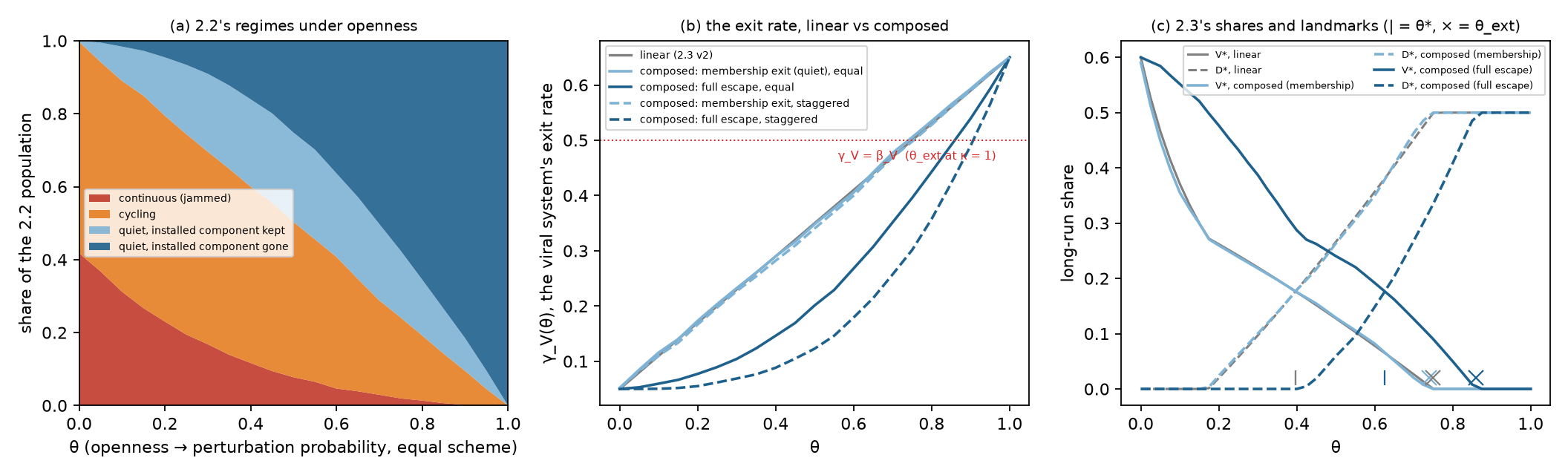
The result is a disambiguation, not a correction. The exit that decides competition, the transmission paper’s transition out of the viral compartment, is the membership event, and the residue literature finds leavers, on average, still carrying part of the installed psychology; so the exit rate the competition model needs is the one its linear form describes, and the form’s shape, once a share of agents is normalized to the transmission paper’s endpoints, survives the composition. The escape that decides a host’s dependency — the formal paper’s conjunction, the neural paper’s four undoings — is a different event with a different openness profile, and the gap between the two is the model’s counterpart of the population the clinical paper’s residue finding describes: hosts who are out and still carry the installed component. Stated as a prediction: in a population under rising openness, the disaffiliation rate should rise roughly linearly with openness while the rate of architectural escape, measured by setpoint release rather than by stated belief (Paper 1.2, §3.3 and Paradigm B), should rise convexly and lag it, so that the fraction of leavers carrying residue is largest at intermediate openness and shrinks only at high openness. What would count against it: residue prevalence among leavers flat or rising with openness. The composition inherits every caveat of both parents (a scalar guilt state, an idealized policy, no social coupling in the loop, a well-mixed population, an ordinal openness) and adds four of its own: the mapping from openness to perturbation probability is this paper’s assumption, stated in two forms that give the same sign and different values; the composed rate is normalized to the transmission paper’s endpoints, so that only its shape between them is compared; full escape is defined by the conjunction rather than by a stress level, because the formal paper’s own off-state residual confounds a cutoff; and a share of agents is mapped to an exit rate through the transmission paper’s linear range, with no conversion between the two models’ time units. The transmission paper’s second source of discontinuity in exit, the fold under social feedback (Paper 2.3, §2.4), is not joined here; whether the conjunction’s convexity and the fold interact is a question the two models would have to be joined at the threshold map to answer.
7. Predictions
7.1 The Map
Every prediction in this series has an owner, and the owners state theirs with the modal verb should. This section says which of the three classifications, or which model, each family belongs to, so that a test of one is not mistaken for a test of another.
Table 3. The owners’ prediction families and what each tests.
| Owner | Family | What it tests | Kind (§4.1) |
|---|---|---|---|
| Paper 1.1, §7 | P1–P10; P8–P10 the out-of-sample tests | the agentive model’s yield; the markers’ diagnostic standing on systems they were not derived from | the class |
| Paper 1.2, §6 | P1–P6; Paradigms A–D | the cohesion model’s three regions; the setpoint distinction as a measurable | the cohesion model |
| Paper 1.3, §8.5 | one novel prediction; the replication record it is built on | the fused pole’s self-system signature | the host interface |
| Paper 1.4, §7 | P1–P8; the instrument program; the cross-tradition test | the three dimensions as sources of variance beyond participation; whether naive invariance holds | the dimensions |
| Paper 2.1, §7.1 | 1–4 | whether treating the system as goal-directed predicts its history better than the aggregate model | the agentive model at Level 3 |
| Paper 2.2, §5 | three, each with a kill condition | the floor and the reactivation term in experience-sampling data | the loop |
| Paper 2.3, §8 | 1–9 | the state, its transitions, and the competition model’s ordering | the state |
| Paper 3.1, §8 | 1–9 | the carrier fraction as the regime’s predictor; innovation at loss events; a mechanism signature without a carrier as evidence against | the relation |
Three things the map makes visible. A finding against the markers (1.1) is not a finding against the state (2.3), and a failure of naive cross-cultural invariance (1.4 §9, where the owner expects it to fail) is not a failure of the class. The composition of §6.4 draws on two families, 2.2’s and 2.3’s, and its prediction below is a joint one. And no family owns a numeric time window: no owner’s prediction specifies a time course for defusion or for transformation, and none is specified here; a window, if one is wanted, is a design parameter to be stated as such, in the form the persistence paper uses for its seventh prediction (Paper 3.1, §8).
7.2 What This Paper Predicts
The host interface, respecified. Hosts at the fused pole should show the self-system and shielding signatures the neural paper’s replication record supports: default-mode engagement under challenge to the fused belief, which is the one result in that record that reproduced across cultures; the functional correlate of the right-lateralized prefrontal–parietal lesion network associated with fundamentalist conviction; and the neural paper’s own prediction, which this paper adopts as stated — “reduced dynamic flexibility of default-mode configurations — a narrowed repertoire of self-model states — relative to matched individuals with revisable convictions, beyond any difference in static activation” (Paper 1.3, §8.5). The comparison group is the owner’s: matched individuals with revisable convictions, not adherents of some other architecture, because no architecture has a neural profile in the series. The prediction does not run through amygdala reactivity, which is the limb of the record that failed and which the owner calls “not evidence to build on” (Paper 1.3, §5.1). What would count against it is what the owner says: its failure “would remove the model’s claim that entrenchment is a self-system property” (§8.5).
Defusion, respecified. Exit from the fused pole should proceed as the four undoings the neural paper decomposes — self-narrative revision, the re-opening of evaluation, reward replacement, extinction work — “which need not proceed together,” with the conditioning residue able to persist beneath and return as contexts shift (Paper 1.3, §7.2). The partial presentations are the expected dissociations: intellectually free and still afraid; convinced, safe, and desolate. No time course is predicted.
The composition. In a population under rising openness, the disaffiliation rate should rise roughly linearly with openness while the rate of architectural escape, measured by setpoint release rather than by stated belief (Paper 1.2, §3.3, Paradigm B), should rise convexly and lag it, so that the fraction of leavers carrying residue is largest at intermediate openness and shrinks only at high openness. Against it: residue prevalence among leavers flat or rising with openness (§6.4).
One cross-model prediction at a wired joint. Because the formal paper’s installed component is the cohesion model’s baseline stress (Table 2, row 1), the two owners’ experience-sampling predictions can be read together. Communities the clinical paper places at the guilt-installing pole should show the formal paper’s floor: a mean guilt level that separates traditions and a swing that separates intensities, with power at the ritual cadence under calendar dominance (Paper 2.2, §5.2; Paper 1.4, P2 and P3). This is the two owners’ predictions read jointly, at their verbs.
7.3 What Is Not Available, and Why
Two predictions a synthesis of these models might be expected to make are not available, and their unavailability is a finding. The transmission paper does not predict that its competition model reproduces historical patterns: it runs the model on illustrative values that, in its own words, measure nothing, and it forbids grading cases against the model, on Kuran’s argument that a model fitted to a recorded outcome cannot then claim it as a prediction (Paper 2.3, §4.3); what stands are the owner’s nine predictions. The formal paper does not predict that its loop matches measured guilt oscillations, because the measurements do not exist — “We are not aware of any experience-sampling study of confession cadence and guilt dynamics” (Paper 2.2, §5.1) — and what stands is the owner’s spectral prediction with its kill conditions. Two further families have owners this paper does not restate. The persistence predictions belong to the persistence paper’s first, third, and ninth (the carrier fraction predicts the regime; innovation clusters at loss events; a mechanism signature without a carrier counts against the framework), together with its condition for genuine transformation — architectural awareness, a window long enough, a variant present (Paper 3.1, §§7.3, 8). The population predictions belong to the clinical paper’s first, fifth, and fourth, with the benchmark the owner sets: any architectural effect must show “beyond the attendance-mediation benchmark [§4.1 of that paper], which is the result to beat” (Paper 1.4, §7), and in the basin-depth form the formal paper supplies (Paper 2.2, §5.3).
8. Implications
8.1 Public Health, at the Clinical Paper’s Scope
What the architecture-not-content orientation offers clinical research is a proposal, and the clinical paper states its scope with four caveats this paper carries whole. Religious trauma is “a clinically proposed construct that has not yet been validated to that standard”; its prevalence figures come from “a self-selected online panel (n = 1,581)”; “Population-level architecture is not an individual diagnosis”; and the ordinary exit penalty is null on well-being once attendance is controlled, so that harm “concentrates in high-demand and clinical contexts and must not be stated as a population-wide average” (Paper 1.4, §§1.1, 3.2, 4.1, 8.1; Paper 5.1, §4.1). What survives those caveats is the orientation itself: that a clinician or a researcher who wants to know what a belief system does to a person should ask where authority is located, how stress is architected, and whether the dependency model runs toward a terminus or a floor, before asking what the person believes. The clinical paper proposes the instruments (§7) and this paper adds nothing to them.
8.2 Education, at the Literature’s Strength
The project’s research layer of February 2025 proposed “cognitive vaccination”: that teaching the structural features of parasitic architectures would confer resistance to them, as inoculation confers immunity. The metaphor has a literature, and the literature is more exact than the metaphor. Inoculation theory is McGuire’s (1961, 1964): a weakened form of an attack, presented with a forewarning and a refutation, produces resistance to the full attack later. A meta-analysis of the experimental record found the effect real and small — a mean d of .43 across studies — and found no difference between inoculating against the same arguments later encountered and against different ones (Banas & Rains, 2010), which is the finding that matters here, because it means the resistance conferred is to a technique rather than to a content. The prebunking programme built on that finding, against online misinformation, shows the same shape: measurable, technique-general effects that decay without boosters over roughly two months (Maertens, Roozenbeek, Basol, & van der Linden, 2021), that shrink to nothing detectable at forty-eight hours when the design omits an immediate posttest (Capewell et al., 2024), and, in the one large field experiment on a media-literacy intervention, an effect of d = 0.20 on discernment in the United States that had attenuated by more than half at a median of twenty days, and no effect at all in the face-to-face arm in India (Guess et al., 2020). Whether the interventions improve discrimination between true and false at all, or merely raise skepticism toward everything, is disputed inside the field: a signal-detection reanalysis found gamified inoculation shifted response bias toward “false” rather than improving discrimination (Modirrousta-Galian & Higham, 2023), a preregistered replication of the Indian materials found no improvement in discrimination (Seabrooke, Modirrousta-Galian, & Higham, 2025), and a signal-detection meta-analysis by the programme’s authors reports the opposite (Simchon, Zipori, Teitelbaum, Lewandowsky, & van der Linden, 2026); meanwhile the largest synthesis of news-judgement studies finds that people already err toward doubting true news more than believing false news (Pfänder & Altay, 2025). That is the state of the art. The mechanism the framework wants exists and generalizes, at small effect sizes, over weeks, against news and advertising, and it has never been tried against a religion: no inoculation study applied to religious recruitment or religious architecture was found, and the nearest relatives are an inoculation against radical-Islamist and Islamophobic disinformation (Lewandowsky & Yesilada, 2021) and a randomized trial in post-conflict Iraq that found a small effect on recognizing extremist manipulation techniques (d = 0.31) and none on vulnerability to recruitment (d = 0.02) (Saleh, Makki, van der Linden, & Roozenbeek, 2023). The critical-thinking version of the proposal is retired. The finding that analytic thinking promotes religious disbelief (Gervais & Norenzayan, 2012) did not survive direct replication (Sanchez, Sundermeier, Gray, & Calin-Jageman, 2017); what remains is a small correlation, r = −.18 in a meta-analysis of thirty-one studies (N = 15,078; Pennycook, Ross, Koehler, & Fugelsang, 2016), that held in three of thirteen societies (Gervais et al., 2018), and the clinical paper’s own flexibility evidence attaches to “religiosity and dogmatism — not content, and not, so far, authority locus” (Paper 1.4, §5.1).
Two things follow for the proposal, and one thing precedes it. First, the design constraint: any test of architectural inoculation must measure discrimination separately from bias, with benign-architecture items as the analogue of the true-news arm, or it will not be able to tell resistance to parasitic architecture from a general loss of trust — which is what the epistemic-vigilance literature would predict as the failure mode, since vigilance is a filter that “needs appropriate cultural and institutional development” to be well tuned rather than merely suspicious (Sperber et al., 2010, §8), and that paper names “the propagation of religious beliefs” among the phenomena the filter has to handle. Second, the strength: the framework’s prediction that technique-general resistance transfers to memeplex architecture is a prediction, and it is priced against a media-effects literature of small and perishable effects — the house form for stating such a claim against that literature is the mechanism paper’s fifth prediction (Paper 1.2, §6.1). What precedes the proposal is a question the framework’s own table raises: whether the incumbent has been running the vaccination programme for centuries, since early installation (Table 1, row 2), a legislated cadence (row 4), and communal reinforcement are the three things the intervention studies cannot afford (Capewell et al., 2024; Maertens et al., 2021). The retention function such a programme would perform has a peer-reviewed, preregistered anchor: across four traditions, believers update belief on prayer outcomes, but asymmetrically, increases after success exceeding decreases after failure, and the authors read the asymmetry as the work of “built-in cognitive safeguards such as theological explanations for unanswered prayers” that “reduce the likelihood of defection, ensuring high retention rates among adherents” (Hong, Zhang, & Wang, 2025). If that is what the doctrines do, then what the framework calls cognitive vaccination is a contest between two inoculations, and the one with the earlier installation, the denser boosting schedule, and the social reinforcement is not the school’s.
8.3 Artificial Intelligence
The personalization premium, the premise that persuasion tailored to an individual’s inferred profile outperforms the same persuasion untailored (and so that language models will persuade by profiling their targets), is not supported by the measured studies the transmission paper reviews (Paper 2.3, §7); what the record shows is that language models persuade at human strength and machine scale, through information density rather than affect, and pay for optimized persuasiveness in accuracy, which the transmission paper reads as the price of optimizing transmission and states as its ninth prediction (Paper 2.3, §§7, 8, 10). The threat, on that record, is the optimizer’s objective, not the individual’s profile. The same channel runs the other way: dialogues with a language model durably reduced conspiracy belief (Paper 2.3, §7.2), and the interlocutor property — that the model answers back — cuts both ways (§7.3). The capstone owns the three-role frame in which artificial systems figure in this project, as proof of concept, as cure, and as threat, and it owns the disclosure that this series was itself seeded in conversations with such systems, with the rule that “Model fluency is not corroboration; AI affirmation is not evidence” (Paper 5.1, §9.1); the author’s inference of 2008, that an artificial messenger might carry the counter-architecture, is recorded there and not repeated here. One clinical description has since appeared of the interlocutor property’s pathological face. Morrin, Nicholls, Levin, and colleagues (2026), writing as a Personal View in The Lancet Psychiatry, report that “emerging evidence indicates that agential AI might validate or amplify delusional or grandiose content, particularly in users already vulnerable to psychosis,” while stating that “it is not clear whether these interactions can result in the emergence of de novo psychosis in the absence of pre-existing vulnerability”; the published abstract is hedged at several points relative to the authors’ preprint, and this paper cites the published verbs. In the preprint the same authors set the plasticity of the self’s boundary in the source framework’s terms: cultural practice can, as they credit to Luhrmann’s ethnographies of religious communities, train people “to experience internal mentation as external divine address,” and the boundary’s “plasticity can be exploited for beneficial purposes as well as serve as an entrypoint for manipulation by others” (Morrin et al., 2025, preprint, p. 9). What the stack of §3 adds, and no owner states, is an audit question for any transmitter: which layers an artificial system can occupy and which it cannot. It can be a substrate (Layer 1) and a propagation channel (Layer 6); it cannot, on its own, bind a community by shared stress, run a dependency loop, or police variants (Layers 3–5), because those need a host community that shares the stress and enforces the boundary. Whether a population of models in mutual conversation could constitute such a community is a question this paper does not answer.
8.4 Philosophy of Mind
Is a religion really a cognitive agent? The question has a literature, and this framework answers it from a nameable position inside that literature rather than by dissolving it. Three positions bracket the space. List and Pettit (2011) hold that some groups satisfy the conditions for agency, which List restates as representational states encoding “beliefs,” motivational states encoding “desires” or “goals,” and “a capacity to interact with its environment on the basis of these states” (List, 2021, p. 1219, building on their first chapter), and that a group agent’s attitudes supervene on its members’ without being reducible to them, since “in extreme cases, the group’s attitudes on some propositions or issues may not be shared by any individual members” (List, 2021, p. 1225 n. 37); their agents are organized decision-making bodies, and a religion is not obviously one. Theiner, Allen, and Goldstone (2010), working from the extended-mind thesis (Clark & Chalmers, 1998), decline to argue about “the mark of the cognitive” at all and tie group cognition to particular capacities, arguing that groups have “organization-dependent cognitive capacities that go beyond the simple aggregation of the cognitive capacities of individuals,” and naming anyone who refuses that on a priori grounds a “demergentist” who owes an account of why cognitive properties are stuck at one level of organization; that is the method this series uses, capacity by capacity, and it was stated in 2010, with the same theorist of emergence, Wimsatt, whose entrenchment underwrites the persistence paper’s mechanism (Paper 3.1, §7.3). Rupert (2005) argues the other way: “If a group mind is supposed to be a single mental system having two or more minds as proper parts, the prospects for group minds seem dim,” and he names Pettit, and Hutchins (1995), among the advocates, so the debate is internal to the map. Book-length treatments exist on both sides (Tollefsen, 2015; Huebner, 2014; Adams & Aizawa, 2008, whose coupling–constitution objection Theiner and colleagues answer). This framework claims less than any of them. It attributes agency where the attribution pays predictively — Dennett’s criterion for when a pattern is real, which the persistence paper owns (Paper 3.1, §2.3), and the source framework’s own statement of the stance: a Self is “a theoretical construct posited by external systems … which facilitates prediction and adaptive behavior” (Levin, 2022, p. 42), whose standing is to be judged “by whether the specific metaphor gives rise to new, robust research programs” and “improves prediction and control in novel cases at the bench” (Levin, 2019, p. 2) — and it brackets the constitution question Rupert presses. The capstone gives the stance two grounds, the predictive-yield ground and a stronger efficacy ground, and this paper uses the weaker throughout (Paper 5.1, §4.2). What the stance therefore owes is not a metaphysics but a yield: predictions the agentive model makes and the aggregate model does not, which are the historical paper’s four and the map of §7. The standing objection to the whole move has also been named in the literature. Boudry and Hofhuis (2018) call it Millikan’s challenge — how can cultural items “develop novel purposes of their own, cross-cutting or subverting our own personal purposes?” — and hold that unless it is met, “talk of cultural ‘parasites’ or ‘selfish memes’ remains vacuous”; their answer is that certain systems of misbelief are “designed by cultural evolution and … subvert the interests of their human hosts,” and they reject both panmemetics and the equation of mind parasites with biologically maladaptive culture. Dennett, answering Boudry in the same symposium, grants the general possibility in one sentence, “What a fluke or a virus can evolve to do mindlessly, a meme can evolve to do mindlessly” (Dennett, 2018, p. 126), and attaches two limits to it: that in modern culture “the meme perspective is often of vanishing utility” (p. 126), and that memetics is best understood “as a perspective within these -ologies, rather than a separate science” (p. 127). This paper adopts both limits: it claims utility for the perspective only where the predictions of §7 pay, and it is written inside the disciplines its companion papers belong to, not as a science of its own. This series’ answer to the same challenge is different: purposes of the system’s own are attributed on the operational criterion (§2.1) and shown, in one case, by a derivation from the system’s own promulgated rules (Paper 2.2, §2), with the design question held at underdetermination (§5.5); and their object is narrower than this series’ (systems of misbelief, where the series’ is architecture), which is part of why the answers differ. The two answers agree on the horn: the host’s interests, not the gene’s. To say that the question is as unproductive as asking whether a cell is really a cognitive agent would be a dissolution without a literature; this paper says instead that the question is live, that the series’ answer is the most modest one on offer, and that modesty is why it can be tested.
9. Conclusion
A synthesis can say what its parts say, at the strength they say it, and it can say what they say together. This paper has done the first by inheritance and the second three times.
The stack of §3 is a device with owners. Its seven layers are the series’ five deep features read as layers, each pointing at the paper that defines it, with its verb, its grade, its kill condition, and its benign dual in the same row, and with two gaps where no owner has an entry. Reading the architecture through it shows what a list of mechanisms cannot show: which claims are derivations, which are historical findings, which are proposals, and which are the paper’s own glosses.
The concordance of §4 found that the series classifies the same objects three ways — a class, a set of dimensions, a state — with a fourth kind, a relation between a pattern and its substrate across a loss, readable out of the persistence paper, and that the three are distinct, correlated, and not identical, with counter-examples the owner supplies. It found that the four models share a spine under four notations and that every mapping along the spine is already stated by an owner, so that the synthesis adds a table and no wiring; and it named the joints no owner wires. It found the triad’s antecedents older than the series knew, in Delius and Balkin and in the project’s own research layer of February 2025, and it found that the series’ contribution to the triad is the axis — host cognitive autonomy in place of host fitness — which the borrowed field’s own caution, that its categories are a continuum with conditional outcomes, makes the right place to have contributed.
The composition of §6.4 found that the series’ two exit concepts are two variables. Membership exit is linear in openness and is what the competition model needs; architectural escape is convex and lags; the gap is the model’s counterpart of the residue population the clinical paper documents. That is one result, conditional on both parents’ idealizations and on an assumption of this paper’s, with a prediction and what would count against it.
What the synthesis cannot say, it has left unsaid. It has not said that the architecture was designed, or that it was not; the capstone holds that at underdetermination and this paper adopts the holding. It has not said that one agent persisted for two millennia; that claim has its owner. It has not restated any prediction with will, and it has reported two predictions a synthesis might be expected to make as unavailable on their owners’ terms. And it has said, of its own central term, that the framework’s inherited definition of cognitive sovereignty was its own model of its own pathology, and that the repair — architectural awareness plus re-federation, the liberated host a cell of a different body — is the capstone’s, is evidential in two foundation papers, and runs in the direction the source framework’s author states as his own.
The architecture has goals of its own. In this series that sentence is teleonomic: it attributes goals where the attribution predicts, on the criterion the source framework sets and the ground the capstone states as the weaker of its two, and it does not claim that the goals are anyone’s. That is what a synthesis of these papers can say, and this paper has tried to say no more.
Appendix: The Series at Its Current State
| Paper | Title | Phase | Status |
|---|---|---|---|
| 1.1 | Memeplexes as Adaptive Cognitive Systems: A TAME-Integrated Framework for Understanding Ideological Agency | Foundations | rev. 2, accepted 25 August 2026 |
| 1.2 | Stress-Sharing as Cognitive Glue in Ideological Collectives: From Biological Morphogenesis to Cultural Cohesion | Foundations | rev. 2, accepted 1 September 2026 |
| 1.3 | Neurological Markers of Deep Belief Entrenchment: A Narrative Review of Identity-Fused Conviction Across Domains | Foundations | rev. 2, accepted 1 September 2026 |
| 1.4 | Religious Belief Systems and Mental Health Outcomes: A Structural Taxonomy Distinguishing Architecture from Content | Foundations | rev. 2, accepted 2 September 2026 |
| 2.1 | Christianity as a Case Study in Memeplex Self-Preservation: Two Millennia of Adaptive Response in a Complex Cultural System | Case and models | rev. 2, accepted 3 September 2026 |
| 2.2 | The Guilt-Redemption Loop as a Cognitive Dependency Architecture: A Dynamical Systems Analysis | Case and models | rev. 2, accepted 4 September 2026 |
| 2.3 | Viral vs. Decentralized Ideological Architectures: Transmission Strategy, the Exclusivity Asymmetry, and the Crossover Threshold | Case and models | rev. 2, accepted 7 September 2026 |
| 3.1 | Pattern Persistence Through Substrate Loss: Carriers, Reconstruction, and the Limits of Metamorphosis | Persistence | rev. 2, accepted 8 September 2026 |
| 4.1 | Parasitic Memeplexes as Scale-Free Cognitive Agents: A Unified Bio-Cognitive Framework | Synthesis | this paper (rev. 2) |
| 5.1 | The Luciferian Hypothesis: A Scientific Reinterpretation of the Panakal Thesis | Capstone | rev. 2 delivered (August 2026); the author’s read-through and three decisions open |
Status is stated in each paper’s own terms as recorded in the project’s decision records. Acceptance is the author’s act and freezes a paper’s text except for edits he directs.
References
External literature (each entry carries a verification record in the project archive — journal articles at fetch level, several at full-text level; books and the podcast episode at record level; the printed lecture and the two Delius chapters at full-text level; the preprints at the level their brackets state, one read in full, three at abstract strength; entries print only archive-held fields)
- Adams, F., & Aizawa, K. (2008). The Bounds of Cognition. Blackwell. [cited at book level; the objection is reported through Theiner, Allen & Goldstone 2010]
- Alizon, S., Hurford, A., Mideo, N., & van Baalen, M. (2009). Virulence evolution and the trade-off hypothesis: History, current state of affairs and the future. Journal of Evolutionary Biology, 22(2), 245–259. DOI 10.1111/j.1420-9101.2008.01658.x.
- Bach, J. (2020, June 13). Artificial consciousness and the nature of reality (No. 101) [Audio podcast episode]. In Lex Fridman Podcast. https://lexfridman.com/joscha-bach/
- Balkin, J. M. (1998). Cultural Software: A Theory of Ideology. Yale University Press. [ch. 3, “Memes as Symbionts”; the author’s open edition]
- Ball, J. A. (1984). Memes as replicators. Ethology and Sociobiology, 5(3), 145–161. DOI 10.1016/0162-3095(84)90020-7. [closed access; not obtained; cited only as Delius cites it]
- Banas, J. A., & Rains, S. A. (2010). A meta-analysis of research on inoculation theory. Communication Monographs, 77(3), 281–311. DOI 10.1080/03637751003758193.
- Bary, A. de (1879). Die Erscheinung der Symbiose. Strassburg: Karl J. Trübner. [a printed lecture, 30 pp.; read from the public-domain scan; the German is the witness and the renderings are the project’s]
- Benson, H., Dusek, J. A., Sherwood, J. B., Lam, P., Bethea, C. F., Carpenter, W., Levitsky, S., Hill, P. C., Clem, D. W., Jr., Jain, M. K., Drumel, D., Kopecky, S. L., Mueller, P. S., Marek, D., Rollins, S., & Hibberd, P. L. (2006). Study of the Therapeutic Effects of Intercessory Prayer (STEP) in cardiac bypass patients: A multicenter randomized trial of uncertainty and certainty of receiving intercessory prayer. American Heart Journal, 151(4), 934–942. DOI 10.1016/j.ahj.2005.05.028.
- Blackmore, S. (1999). The Meme Machine. Oxford University Press.
- Boudry, M. (2018). Invasion of the mind snatchers: On memes and cultural parasites. teorema, 37(3), 111–124. [the issue per the journal’s contents listing; the article’s own first page misprints it]
- Boudry, M., & Hofhuis, S. (2018). Parasites of the mind. Why cultural theorists need the meme’s eye view. Cognitive Systems Research, 52, 155–167. DOI 10.1016/j.cogsys.2018.06.010.
- Bronstein, J. L. (1994). Conditional outcomes in mutualistic interactions. Trends in Ecology & Evolution, 9(6), 214–217. DOI 10.1016/0169-5347(94)90246-1.
- Capewell, G., Maertens, R., Remshard, M., van der Linden, S., Compton, J., Lewandowsky, S., & Roozenbeek, J. (2024). Misinformation interventions decay rapidly without an immediate posttest. Journal of Applied Social Psychology, 54(8), 441–454. DOI 10.1111/jasp.13049.
- Clark, A., & Chalmers, D. (1998). The extended mind. Analysis, 58(1), 7–19. DOI 10.1093/analys/58.1.7.
- Dawkins, R. (1976). The Selfish Gene. Oxford University Press.
- Dein, S., & Brown, C. G. (2024). Prayers for sickness: What do people pray for and how do they deal with unanswered prayer? F1000Research, 13, 156. DOI 10.12688/f1000research.145194.2.
- Delius, J. D. (1989). Of mind memes and brain bugs; a natural history of culture. In W. A. Koch (Ed.), The Nature of Culture: Proceedings of the International and Interdisciplinary Symposium, October 7–11, 1986 in Bochum (pp. 26–79). Bochum: Studienverlag Brockmeyer. [full text via the author’s institutional repository]
- Delius, J. D. (1991). The nature of culture. In M. S. Dawkins, T. R. Halliday, & R. Dawkins (Eds.), The Tinbergen Legacy (pp. 75–99). Chapman and Hall. [full text via the author’s institutional repository]
- Dennett, D. C. (1991). Consciousness Explained. Little, Brown and Company.
- Dennett, D. C. (1995). Darwin’s Dangerous Idea: Evolution and the Meanings of Life. Simon & Schuster.
- Dennett, D. C. (2018). Comment on Boudry. teorema, 37(3), 125–127.
- Doctor, T., Witkowski, O., Solomonova, E., Duane, B., & Levin, M. (2022). Biology, Buddhism, and AI: Care as the driver of intelligence. Entropy, 24(5), 710. DOI 10.3390/e24050710.
- Ewald, P. W. (1987). Transmission modes and evolution of the parasitism-mutualism continuum. Annals of the New York Academy of Sciences, 503(1), 295–306. DOI 10.1111/j.1749-6632.1987.tb40616.x.
- Fields, C., & Levin, M. (2022). Competency in navigating arbitrary spaces as an invariant for analyzing cognition in diverse embodiments. Entropy, 24(6), 819. DOI 10.3390/e24060819.
- Fosarelli, P. (2011). Outcomes of intercessory prayer for those who are ill: Scientific and pastoral perspectives. The Linacre Quarterly, 78(2), 125–137. DOI 10.1179/002436311803888384.
- Gervais, W. M., & Norenzayan, A. (2012). Analytic thinking promotes religious disbelief. Science, 336(6080), 493–496. DOI 10.1126/science.1215647.
- Gervais, W. M., van Elk, M., Xygalatas, D., McKay, R. T., Aveyard, M., Buchtel, E. E., Dar-Nimrod, I., Klocová, E. K., Ramsay, J. E., Riekki, T., Svedholm-Häkkinen, A. M., & Bulbulia, J. (2018). Analytic atheism: A cross-culturally weak and fickle phenomenon? Judgment and Decision Making, 13(3), 268–274. DOI 10.1017/S1930297500007701.
- Guess, A. M., Lerner, M., Lyons, B., Montgomery, J. M., Nyhan, B., Reifler, J., & Sircar, N. (2020). A digital media literacy intervention increases discernment between mainstream and false news in the United States and India. Proceedings of the National Academy of Sciences, 117(27), 15536–15545. DOI 10.1073/pnas.1920498117.
- Hong, Z., Zhang, C., & Wang, A. (2025). Evidential vulnerability of religious beliefs in the context of petitionary prayers. Cognitive Science, 49(12), e70163. DOI 10.1111/cogs.70163.
- Huebner, B. (2014). Macrocognition: A Theory of Distributed Minds and Collective Intentionality. Oxford University Press. [cited at book level]
- Hutchins, E. (1995). Cognition in the Wild. MIT Press. [cited at book level]
- Leung, T. L. F., & Poulin, R. (2008). Parasitism, commensalism, and mutualism: Exploring the many shades of symbioses. Vie et Milieu: Life and Environment, 58(2), 107–115.
- Levin, M. (2019). The computational boundary of a “self”: Developmental bioelectricity drives multicellularity and scale-free cognition. Frontiers in Psychology, 10, 2688. DOI 10.3389/fpsyg.2019.02688.
- Levin, M. (2022). Technological approach to mind everywhere: An experimentally-grounded framework for understanding diverse bodies and minds. Frontiers in Systems Neuroscience, 16, 768201. DOI 10.3389/fnsys.2022.768201. [TAME]
- Lewandowsky, S., & Yesilada, M. (2021). Inoculating against the spread of Islamophobic and radical-Islamist disinformation. Cognitive Research: Principles and Implications, 6(1). DOI 10.1186/s41235-021-00323-z.
- List, C. (2021). Group agency and artificial intelligence. Philosophy & Technology, 34, 1213–1242. DOI 10.1007/s13347-021-00454-7.
- List, C., & Pettit, P. (2011). Group Agency: The Possibility, Design, and Status of Corporate Agents. Oxford University Press. DOI 10.1093/acprof:oso/9780199591565.001.0001. [the conditions and the supervenience relation are cited from List 2021, which builds on its first chapter; the book itself was not consulted]
- Lyons, B. F., & Levin, M. (2024). Cognitive glues are shared models of relative scarcities: The economics of collective intelligence [Preprint]. OSF Preprints. DOI 10.31219/osf.io/3fdya. [posted 7 November 2024; not peer-reviewed; cited at abstract strength; the DOI per OpenAlex and the author’s laboratory list]
- Lyons, B., Pio-Lopez, L., & Levin, M. (2026a). Alignment is to a virtual governor: A theory of coordination in diverse intelligence [Preprint]. Preprints.org. DOI 10.20944/preprints202607.0220.v1. [posted 3 July 2026; not peer-reviewed; cited at abstract strength]
- Lyons, B., Pio-Lopez, L., & Levin, M. (2026b). From cancer to AI alignment: Tackling externalities through homeostatic principles [Preprint]. Preprints.org. DOI 10.20944/preprints202604.0056.v1. [posted 1 April 2026; not peer-reviewed; cited at abstract strength]
- Maertens, R., Roozenbeek, J., Basol, M., & van der Linden, S. (2021). Long-term effectiveness of inoculation against misinformation: Three longitudinal experiments. Journal of Experimental Psychology: Applied, 27(1), 1–16. DOI 10.1037/xap0000315.
- Maizels, R. M., & McSorley, H. J. (2016). Regulation of the host immune system by helminth parasites. Journal of Allergy and Clinical Immunology, 138(3), 666–675. DOI 10.1016/j.jaci.2016.07.007.
- Masters, K. S., Spielmans, G. I., & Goodson, J. T. (2006). Are there demonstrable effects of distant intercessory prayer? A meta-analytic review. Annals of Behavioral Medicine, 32(1), 21–26. DOI 10.1207/s15324796abm3201_3.
- Mathis, K. A., & Bronstein, J. L. (2020). Our current understanding of commensalism. Annual Review of Ecology, Evolution, and Systematics, 51(1), 167–189. DOI 10.1146/annurev-ecolsys-011720-040844.
- McGuire, W. J. (1961). The effectiveness of supportive and refutational defenses in immunizing and restoring beliefs against persuasion. Sociometry, 24(2), 184–197. DOI 10.2307/2786067.
- McGuire, W. J. (1964). Inducing resistance to persuasion: Some contemporary approaches. In L. Berkowitz (Ed.), Advances in Experimental Social Psychology (Vol. 1, pp. 191–229). Academic Press. DOI 10.1016/S0065-2601(08)60052-0.
- Modirrousta-Galian, A., & Higham, P. A. (2023). Gamified inoculation interventions do not improve discrimination between true and fake news: Reanalyzing existing research with receiver operating characteristic analysis. Journal of Experimental Psychology: General, 152(9), 2411–2437. DOI 10.1037/xge0001395.
- Morrin, H., Nicholls, L., Levin, M., Yiend, J., Iyengar, U., DelGuidice, F., Bhattacharya, S., Tognin, S., MacCabe, J., Twumasi, R., Alderson-Day, B., & Pollak, T. A. (2026). Artificial intelligence-associated delusions and large language models: Risks, mechanisms of delusion co-creation, and safeguarding strategies. The Lancet Psychiatry, 13(6), 522–530. DOI 10.1016/S2215-0366(25)00396-7. [a Personal View; cited at the published abstract’s verbs; the author roster as the version of record prints it]
- Morrin, H., Nicholls, L., Levin, M., Yiend, J., Iyengar, U., DelGuidice, F., Bhattacharya, S., Tognin, S., MacCabe, J., Twumasi, R., Alderson-Day, B., & Pollak, T. A. (2025). Delusions by design? How everyday AIs might be fuelling psychosis (and what can be done about it) [Preprint, version 6, 22 August 2025]. PsyArXiv. DOI 10.31234/osf.io/cmy7n (version 6 at osf.io/preprints/psyarxiv/cmy7n_v6). [the preprint of the 2026 Personal View, under a different title; cited for one passage, p. 9 of the version-6 PDF]
- Pennycook, G., Ross, R. M., Koehler, D. J., & Fugelsang, J. A. (2016). Atheists and agnostics are more reflective than religious believers: Four empirical studies and a meta-analysis. PLOS ONE, 11(4), e0153039. DOI 10.1371/journal.pone.0153039.
- Pfänder, J., & Altay, S. (2025). Spotting false news and doubting true news: A systematic review and meta-analysis of news judgements. Nature Human Behaviour, 9(4), 688–699. DOI 10.1038/s41562-024-02086-1.
- Roberts, L., Ahmed, I., Hall, S., & Davison, A. (2009). Intercessory prayer for the alleviation of ill health. Cochrane Database of Systematic Reviews, (2), CD000368. DOI 10.1002/14651858.CD000368.pub3.
- Rupert, R. D. (2005). Minding one’s cognitive systems: When does a group of minds constitute a single cognitive unit? Episteme, 1(3), 177–188. DOI 10.3366/epi.2004.1.3.177.
- Saleh, N., Makki, F., van der Linden, S., & Roozenbeek, J. (2023). Inoculating against extremist persuasion techniques – Results from a randomised controlled trial in post-conflict areas in Iraq. advances.in/psychology, 1(1), 1. DOI 10.56296/aip00005.
- Sanchez, C., Sundermeier, B., Gray, K., & Calin-Jageman, R. J. (2017). Direct replication of Gervais & Norenzayan (2012): No evidence that analytic thinking decreases religious belief. PLOS ONE, 12(2), e0172636. DOI 10.1371/journal.pone.0172636.
- Seabrooke, T., Modirrousta-Galian, A., & Higham, P. A. (2025). Re-examining the bad news game: No evidence of improved discrimination of Indian true and fake news headlines. Psychonomic Bulletin & Review, 33(1), 13. DOI 10.3758/s13423-025-02827-x.
- Shreesha, L., & Levin, M. (2024). Stress sharing as cognitive glue for collective intelligences: A computational model of stress as a coordinator for morphogenesis. Biochemical and Biophysical Research Communications, 731, 150396. DOI 10.1016/j.bbrc.2024.150396.
- Simchon, A., Zipori, T., Teitelbaum, L., Lewandowsky, S., & van der Linden, S. (2026). A signal detection theory meta-analysis of psychological inoculation against misinformation. Current Opinion in Psychology, 67, 102194. DOI 10.1016/j.copsyc.2025.102194.
- Sloan, R. P., & Ramakrishnan, R. (2006). Science, medicine, and intercessory prayer. Perspectives in Biology and Medicine, 49(4), 504–514. DOI 10.1353/pbm.2006.0064.
- Sperber, D., Clément, F., Heintz, C., Mascaro, O., Mercier, H., Origgi, G., & Wilson, D. (2010). Epistemic vigilance. Mind & Language, 25(4), 359–393. DOI 10.1111/j.1468-0017.2010.01394.x.
- Theiner, G., Allen, C., & Goldstone, R. L. (2010). Recognizing group cognition. Cognitive Systems Research, 11(4), 378–395. DOI 10.1016/j.cogsys.2010.07.002.
- Tollefsen, D. P. (2015). Groups as Agents. Polity. [cited at book level]
The project corpus (quotations per the project’s adjudicated witnesses; printed copies under inspection, Bern)
- Panakal, L. The Ancient Mother I: The Key to the bible. First ed. Vantage Press, New York, May 1993 (ISBN 0533104653); rev. Identity Publishers, Kiental, 1997 (ISBN 3-9520446-1-X). [K — ch. III cited by chapter; wording per the project’s website witness; no printed witness in the project]
- Panakal, L. The Ancient Mother II: The Judgement on christianity. First ed. Vantage Press, New York, April 1993 (ISBN 0533104165); rev. Identity Publishers, Kiental. [J — ch. I cited by chapter; wording per the manuscript witness; no printed witness exists for chs. I–II]
- Leo, T. Augenöffner: Warum sollte man Bibel und Koran für Kinder verbieten? Identitypublishers.org, Switzerland (Einführung dated January 2012; printed and bound by Press Group, Slovakia; no year or ISBN in the Impressum). Cited by printed page from the project’s page-paired transcription of the last known printed copy; the German is the witness and English renderings are the project’s.
The series
- Grünig, P., & Claude Fable (Anthropic). (2026). Memeplexes as Adaptive Cognitive Systems: A TAME-Integrated Framework for Understanding Ideological Agency. Paper 1.1 of this series (rev. 2, August 2026). Project archive. [cited as Paper 1.1]
- Grünig, P., & Claude Fable (Anthropic). (2026). Stress-Sharing as Cognitive Glue in Ideological Collectives: From Biological Morphogenesis to Cultural Cohesion. Paper 1.2 of this series (rev. 2, August 2026). Project archive. [cited as Paper 1.2]
- Grünig, P., & Claude Fable (Anthropic). (2026). Neurological Markers of Deep Belief Entrenchment: A Narrative Review of Identity-Fused Conviction Across Domains. Paper 1.3 of this series (rev. 2, August 2026). Project archive. [cited as Paper 1.3]
- Grünig, P., & Claude Fable (Anthropic). (2026). Religious Belief Systems and Mental Health Outcomes: A Structural Taxonomy Distinguishing Architecture from Content. Paper 1.4 of this series (rev. 2, September 2026). Project archive. [cited as Paper 1.4]
- Grünig, P., & Claude Fable (Anthropic). (2026). Christianity as a Case Study in Memeplex Self-Preservation: Two Millennia of Adaptive Response in a Complex Cultural System. Paper 2.1 of this series (rev. 2, September 2026). Project archive. [cited as Paper 2.1]
- Grünig, P., & Claude Fable (Anthropic). (2026). The Guilt-Redemption Loop as a Cognitive Dependency Architecture: A Dynamical Systems Analysis. Paper 2.2 of this series (rev. 2, September 2026). Project archive. [cited as Paper 2.2]
- Grünig, P., & Claude Fable (Anthropic). (2026). Viral vs. Decentralized Ideological Architectures: Transmission Strategy, the Exclusivity Asymmetry, and the Crossover Threshold. Paper 2.3 of this series (rev. 2, September 2026). Project archive. [cited as Paper 2.3]
- Grünig, P., & Claude Fable (Anthropic). (2026). Pattern Persistence Through Substrate Loss: Carriers, Reconstruction, and the Limits of Metamorphosis. Paper 3.1 of this series (rev. 2, September 2026). Project archive. [cited as Paper 3.1]
- Grünig, P., & Claude Fable (Anthropic). (2026). The Luciferian Hypothesis: A Scientific Reinterpretation of the Panakal Thesis. Paper 5.1 of this series (rev. 2, August 2026). Project archive. [cited as Paper 5.1]