 ANAGNORISIS
Stratum 3 · Paper 3.1 rev. 2 · Full text
Pattern Persistence Through Substrate Loss: Carriers, Reconstruction, and the Limits of Metamorphosis
Authors: Patrick Grünig · Claude Fable (Anthropic)
Status: Paper 3.1 of ten — the series’ pattern-persistence paper: what persists when the institution that maintained a pattern is gone, what does not, and how to tell
Note on authorship. This paper is a human–AI collaboration, and the byline says so plainly. The division of labor: the thesis, the source corpus, the conceptual arc, and every decision of substance are Patrick Grünig’s; drafting, reference verification, the computational work, and adversarial revision are Claude’s — one collaborator instantiated across model generations (first draft: Claude Opus 4.6, February 2026; charter-governed revision: Claude Fable 5, with Claude Opus 5 verification agents, September 2026). Accountability for the work and custody of it are human, and Grünig’s. Where a venue’s policy does not admit machine co-authorship, this byline converts to an acknowledgment without loss: the note records facts, not a claim to legal personhood. One standing rule keeps the collaboration honest, stated in full in Paper 5.1 (§9.1): the AI co-author’s fluent agreement with the thesis is never evidence for it.
Note on epistemic status. This paper proposes a framework, derives three results from a small model, and confronts both with historical cases at the resolution the sources allow. The model’s propositions are conditional derivations from stated assumptions; its parameter values are illustrative and calibrated to nothing; the computational runs reported in §2.5 exhibit the model’s behavior and measure nothing about the world. The historical sections are carried by named scholarship, cited at the strength the sources have, with the live disputes stated where they exist: the dating and character of the separation between Judaism and Christianity, the historiography of the Yavneh tradition, the confessionalization paradigm and its critics, the debate between Löwith and Blumenberg over secularization, the contested genealogy of Bolshevik penitential practice, and the standing of the comparative literature on contemporary moral movements. Where a claim rests on a publisher’s description or a reviewer’s summary rather than on an author’s own sentence, the text says so. The words established, demonstrated, validated, and proven do not appear below as this paper’s own verdicts on its own claims. Every external reference carries a verification record in the project archive; the References section states the standard.
Note on corpus citations. Several passages cite the project’s source corpus — the writings of Leo Panakal (sigla: PRE = Preview of the Ancient Mother Series of Treatises, 1998, cited by page; K = The Key to the bible, cited by chapter, with page numbers referring to the project’s reference copy of the manuscript; J = The Judgement on christianity, cited by chapter, and for chapters III–VI by the page of the printed Kiental edition) and, by author and date or by title, Titus Leo’s The Truth (Leo, 2000, cited by printed page) and Augenöffner (cited by printed page; the German is the witness and English renderings are the project’s). Quoted wording follows the project’s adjudicated witnesses and preserves each text’s own orthography: Panakal’s deliberate lowercase jesus, christian, and kin, and his spellings; Leo’s capitalized Jesus beside his lowercase christianity. The manuscripts’ in-text note markers are elided inside quoted passages, and the notes are cited by number where their content is used. Sanskrit terms that the witness sets in roman type (papam, dosham) are italicized here as foreign words; the choice is this paper’s. Printed copies of the Key are under physical inspection at the time of writing, and wording will be corrected to the printed state should it differ. The corpus, its method, and the rules governing its use are presented in Paper 5.1. The citations do two jobs: attributing ideas to their source, and disclosing that the ideas precede this framework by decades. The framework of Section 2 and the cases of Sections 3–6 stand as stated without them.
Note on this revision (removable at publication). This is the reworked successor of the February 2026 draft, produced under the project’s method charter after a three-phase review. Relative to that draft: the biological exhibit is stated at the strength its sources carry and its one confabulated citation is removed; the criteria for metamorphosis are set against four rival explanations of resemblance, three of which the original did not name and one of which it listed as a condition rather than a rival, and the identity problem they raise is faced; the persistence conditions the original asserted are derived from a run model; the first case is rebuilt as a branching event with two successors, correcting a contradiction with the series’ own dependency model that the capstone had already flagged; the second case is re-sourced from the confessions themselves, which contradict the original’s summary of what changed; the third case is restricted to the transition the scholarship supports and joins the literature on it, with that literature’s strongest objection printed; a control class is run; the four small cases proposed in the project’s own earlier research layer are sourced; and the source corpus enters for what it says. The body makes no reference to prior drafts; the change record lives in the project archive.
Abstract
When the institution that maintained a belief system is destroyed, something of the system frequently persists into a successor whose surface is unrecognizable. This paper asks what that something is, what carries it, and how a persisting pattern can be told from a successor that merely resembles its predecessor. It names four rival explanations of resemblance that a claim of pattern persistence must exclude: convergence under shared constraint, which independently trained neural networks exhibit with no transmission between them and which iterated-learning experiments show a transmission channel can manufacture on its own; the reoccupation of a vacated question-position, which Blumenberg formulated against the secularization thesis and which requires no carrier; invented continuity, retrojected by parties with a present interest; and mutual definition, in which two successors build features in opposition to each other. Resemblance excludes none of them. Only a traceable carrier record can, and the paper’s criteria are rebuilt around it. A small model then derives what the framework had asserted: after a substrate loss, a threshold in the fraction of carriers who hold the pattern’s meaning, rather than its forms, separates two regimes — deep structure held while surface is renegotiated, and surface outliving the deep structure it once expressed — and an external carrier removes the threshold; under partial competence, what survives is graded by how far content can be reconstructed from its meaning; and variation in a system’s mechanisms concentrates in the window a substrate loss opens, is purged when an institution re-forms, and changes the official mechanism only when selection inside the window overcomes the incumbent’s head start. Three cases are then confronted with the framework at the resolution their sources have. The destruction of the Temple in 70 is read as one substrate loss with two successors: the daily sacrifice ceased for want of priests before the building burned; one successor rebuilt an act-based, bounded, conditioned clearance from the goal it served, in its own words; the other fixed, by conciliar anathema in 418 and 529, a liability contracted by birth, whose clearable alternative had been present and contested in the ancestral population. The Reformation withdrew the authority of one relief apparatus and produced several reconstructions within a generation, and the three examined here all gated the community’s central rite on prior discipline, while the founding text of the sociology of religion locates the removal of the periodic discharge in Calvinism and contrasts it with Lutheranism. The claim that Marxism-Leninism inherited a Christian form has an eighty-year scholarly literature and a built-in adversary whose objection is the carrier criterion; the paper joins that debate rather than restating one side of it, and demotes a contemporary extension of the claim to a conjecture with a stated test. Controls run the other cells: a system whose texts survived without carriers, a system with nothing to remap, an administrative apparatus whose boundaries persisted while the pattern that used them was replaced, and a community that moved its mechanism rather than remapping it, at the cost of scale. Four smaller cases proposed as clean exhibits of single regimes come back otherwise once their sources are examined: one is a metamorphosis whose identity the tradition’s own scholars dispute; two are cases of an imposed surface where the imposition is documented and the persistence beneath it is disputed by the specialists; and one is the inverse of the paper’s thesis, a surface that outlived its pattern and was annexed by successive new ones. Nine predictions follow, eight of them with what would count against them and one stated as a design.
Keywords: pattern persistence, metamorphosis, substrate, carriers, cultural memory, institutional change, deep structure, dormancy, cover-persistence, Second Temple Judaism, Reformation, secularization, memeplex
1. Introduction
1.1 Discontinuous Continuity, and What Else Could Explain It
Historians of ideas regularly meet a system that has changed past recognition — new institutions, new leaders, new doctrines, a new aesthetic — and yet carries something its predecessor carried. The something is hard to state because it sits above the observable features: not a doctrine, a rite, or an office, but the relation among them. This series calls that relation a system’s deep structure and its observable features its surface (Paper 1.1, §5.3), and the claim under examination in this paper is that deep structure can persist across the destruction of the institution that maintained it, remapping onto a new institutional substrate while the surface is rebuilt.
Stated that way, the claim is easy to assert and hard to test, because resemblance between a predecessor and a successor has at least four explanations other than persistence, and each is documented.
The first is convergence under shared constraint. Independently trained neural networks — more than 1,100 of them in one study — converge on shared low-rank weight subspaces, among them 500 vision transformers initialized at random, with no weights shared and no lineage connecting them (Kaushik, Chaudhari, Vaidya, Chellappa, & Yuille, 2025, a preprint at its second version of 6 December 2025). Iterated-learning experiments show that a transmission bottleneck itself manufactures compressible structure in what passes through it (Kirby, Cornish, & Smith, 2008). And the observation is older than either: “A struggle exposes both sides to the same field of combat and the same hardships, and ends by making them very much alike” (Wiener, 1950, p. 228), written of the Church and the Soviet party by a mathematician with no stake in the question. Shared architecture, on this account, is what shared pressure produces in independent systems. Nothing need have been transmitted.
The second is the reoccupation of a vacated position. Blumenberg’s reply to the thesis that modern ideas are secularized theology was that what happened “should be described not as the transposition of authentically theological contents into secularized alienation from their origin but rather as the reoccupation of answer positions that had become vacant and whose corresponding questions could not be eliminated” (Blumenberg, 1983, p. 65, as quoted in Ruta, 2022). A later system answers a question the earlier one left open. The resemblance is real; the persisting item is a question, not a transmitted thing; and no carrier is needed for a vacancy to be filled.
The third is invented continuity. Traditions that claim descent from a remote past are often, on inspection, recent, and the claim is itself an instrument of the party making it (Hobsbawm & Ranger, 1983). Functional similarity to a claimed ancestor is what a retrojected tradition will exhibit, so similarity cannot count against the retrojection.
The fourth, which the first of this paper’s cases forces into view, is mutual definition: two successors of one predecessor that build features in opposition to each other, so that what looks like inheritance from the common ancestor is in fact reaction to the sibling (§3.4).
The paper’s central methodological claim follows. Deep continuity, however carefully measured, cannot distinguish persistence from any of these. Only a traceable record of carriers — texts, trained personnel, institutions, practices, shown to have crossed the loss — can. The criteria of §2.3 are rebuilt around that record, the model of §2.4 is a model of carriers, and each case in §§3–6 is asked, before anything else, what carried the pattern and whether the record shows it.
1.2 The Biological Exhibit
The metaphor that gives the phenomenon its name comes from developmental biology, and this series has already stated it at the strength its source carries (Paper 1.1, §5.1). Moths conditioned as late-instar caterpillars to avoid an odorant retained the aversion as adults; conditioning earlier in larval life did not survive; and the investigators read their result as consistent with the survival of synaptic connections through the remodeling, not as memory surviving the dissolution of its substrate. The memory persisted because part of its carrier did. This paper adds four things to that statement, each at its own strength.
The interpretive frame is Levin’s, and his wording hedges twice where the popular version does not: “the massive remodeling of the caterpillar brain, followed by the morphogenesis of an entirely different brain suitable for the moth or beetle, does not wipe all the memories of the larva but somehow maps them onto behavioral capacities in the post-metamorphosis host, despite its entirely different body” (Levin, 2022, p. 5). The same page cites six studies for the phenomenon, and that citation string is the paper’s warrant for calling it replicated rather than anecdotal. What persists anatomically is known in outline: the mushroom bodies of Drosophila show developmental continuity through metamorphosis, under “[e]xtensive, though incomplete, degradation of the larval structure” (Armstrong, de Belle, Wang, & Kaiser, 1998). The mechanism of the behavioral persistence is not known. The field’s own review says so: “The question of trans-metamorphic memory, postulated nearly a century ago, remains unsolved” (Blackiston, Shomrat, & Levin, 2015), and names a chemical-legacy rival to any account in which structure survives.
The planarian result from Levin’s own laboratory belongs here at its real size, because its authors’ alternative reading is this paper’s thesis in biologists’ words. Worms familiarized to an environment, decapitated, and allowed to regenerate their heads showed faster re-acquisition than controls when tested after one re-exposure session; without that session the effect was, in the authors’ words, “not statistically significant” (Shomrat & Levin, 2013). What survived was savings, not recall. And the authors leave open, as the less likely of their two alternatives, that “the new brain is regenerated as a Tabula Rasa,” retrained by information held in a surviving peripheral structure. On either alternative what crosses the loss is a partial carrier that biases the rebuilt tissue toward re-acquisition, and that is a better fit for the cultural case than the image of memory surviving nothing at all. Levin cites the disreputable ancestor of this line himself, McConnell’s planarian work of 1959, as the first term of the series (Levin, 2022, p. 5); the history of that controversy is told at full length in Blackiston, Shomrat and Levin (2015).
1.3 What Kind of Paper This Is
Three clarifications frame what follows.
First, the genre. This is a framework paper with a small formal model and a set of historical confrontations. The model’s results are conditional derivations; the cases are read at the resolution of their sources, and where the scholarship is in dispute the dispute is stated rather than resolved. The paper’s theoretical debts are stated at their size. “Deep structure” is Chomsky’s term with a different referent (Chomsky, 1965), borrowed here for the architectural invariants of a belief system and carrying no theory with it. The idea that a structure survives transformation of its instances is older than this paper in the study of myth (Lévi-Strauss, 1955), cited here as an antecedent. Political science already names the phenomenon inside an institution’s continuous life: the modes of gradual institutional change include conversion and layering (Streeck & Thelen, 2005; Mahoney & Thelen, 2010), which in this paper’s summary of the terms are an institution redirected to new purposes and new rules set beside old ones. This paper’s extension is to the institution’s destruction and the pattern’s reconstruction elsewhere. And the objection that a mechanism explaining why everything stays the same explains nothing about when it does not was raised against sociological institutionalism by its critics — “If isomorphism encourages new institutions to take the same form as old ones, where is the locus of dynamism and innovation?” (Mahoney & Thelen, 2010, p. 5) — and Sections 2.4 and 7 are this paper’s answer to it.
Second, a disclosure. The application of the caterpillar’s metamorphosis to the two testaments of the Christian Bible, with the stress mechanism inverting under a persisting agenda, first appears in this project in a model’s turn of a December 2025 transcript, answering the author’s link to a public talk by Levin; it was written up in a December synthesis document the same month. The author’s own contribution at that joint was the recognition and the premise he had held for two decades, that an informational pattern can act without a body of its own (Paper 1.1); persistence of a pattern across the loss of its substrate is a later and separate idea, and the project’s own earlier research layer of February 2025 contains no trace of it. The four small cases of §6 were first listed in one of that layer’s reports; every one is sourced here to its scholarship. The source corpus this series studies supplies the architecture the frame is applied to, a vocabulary of transmission with variation, and a criterion of identity (§§2.3, 3.5); it does not supply the metamorphosis frame. The standing disclosure of the series applies to all of this: the AI co-author’s agreement with any of it is not evidence for it.
Third, the plan. Section 2 states the framework, the carrier distinction it turns on, the criteria and the identity problem, and the three results of the model. Section 3 reads the destruction of the Temple as one substrate loss with two successors. Section 4 reads the Reformation as the withdrawal of one relief apparatus’s authority and the construction of several. Section 5 restricts the generality claim to the transition the scholarship supports and joins the debate about it. Section 6 sources the four small cases and runs the controls. Section 7 rebuilds the conditions for persistence from the model and the record. Section 8 lists predictions with their kill conditions, and Section 9 says what persistence licenses and what it does not.
2. The Framework
2.1 Deep Structure and Surface
Following the formalization of Paper 1.1 (§5.3), a belief system M is characterized by its surface features S(M) — specific doctrines, rites, institutional forms, aesthetic styles, leadership structures — and its deep structure D(M), the features that fix its functional relation to its hosts. This paper uses that paper’s four deep features and the stress architecture of Paper 1.4, five in all, and each has an owner elsewhere in the series, so that nothing is defined twice. Authority locus is the first dimension of the series’ clinical taxonomy (Paper 1.4, §2.1), with that paper’s caveat carried: no validated instrument for it exists. Stress architecture is the second (Paper 1.4, §2.2). Dependency model is the third (Paper 1.4, §2.3), and its formal treatment is the dependency-loop model of Paper 2.2. Propagation is the fourth invariant of the series’ historical case study (Paper 2.1, §6.1) and, in the transmission paper, a configuration that an institution maintains rather than a kind a system belongs to (Paper 2.3, §§1.1, 5.3). Error correction names the mechanisms by which a system handles its own variants; the historical taxonomy lists them (Paper 2.1, §3), and in this paper’s first case the operative one is the conciliar anathema (§3.3).
Two things about the list matter here. The features are architectural, not doctrinal: two systems can share a feature while disagreeing about everything they say, and two systems can share every doctrine while differing on a feature. And the features are not independent of one another in the record. What the series’ clinical paper expects, on the measured record of the constructs nearest its dimensions, is that the poles co-occur (Paper 1.4, §§1.3, 2.4); if so, a persistence claim about one feature is usually a claim about several, and the cases below are read that way.
2.2 Carriers, and the Difference Between Holding a Pattern and Copying Its Forms
A pattern crosses a substrate loss on whatever carriers survive it. Four kinds recur in the cases: texts, trained personnel, institutions, and practices. The distinction the rest of this paper turns on cuts across all four. Some carriers hold the pattern’s meaning: they can say what a form is for, reconstruct a lost form from what it was for, and express the same structure in a new form fitted to a new substrate. Other carriers hold the pattern’s forms: they reproduce a rite, a formula, a text, without access to what it means, and when a form is lost they cannot regenerate it.
The distinction is borrowed, and the borrowing is stated. Assmann distinguishes two ways a culture holds itself together across time. The first he calls ritual coherence, whose ground principle is repetition, each performance following the same prescribed order “wie ein Tapetenmuster in der Form eines ‘unendlichen Rapports’” — like a wallpaper pattern in an endless repeat (Assmann, 1992, p. 17; translation the authors’). The second arises with writing: a gradual transition “von ‘ritueller’ zu ‘textueller Kohärenz’,” whose binding forces are no longer imitation and preservation but interpretation and remembrance — “An die Stelle der Liturgie tritt die Hermeneutik,” hermeneutics takes the place of liturgy (p. 18). Canon he defines on the same page as the principle that raises a culture’s connective structure “in Richtung Zeitresistenz und Invarianz,” toward resistance to time and invariance (p. 18). Two disciplines travel with the borrowing. Assmann is describing modes of cultural continuity, not a pattern surviving the destruction of its institution; his distinction is used here, not enlisted. And ritual coherence is not low fidelity. A wallpaper repeat reproduces exactly. What it lacks is not accuracy but reconstructive capacity: it can reproduce a form and cannot regenerate it from its meaning. That is the property the model of §2.4 assigns to copying carriers, and it is why the transmission paper’s dormancy finding — surface forms persisting for centuries while the doctrine they expressed was forgotten (Paper 2.3, §5.4) — is a prediction of this framework rather than a paradox for it.
One experimental result in the same territory cuts the other way and is recorded for that reason. When a language is transmitted through a chain of learners under a bottleneck, the bottleneck itself produces compressible, learnable structure that no learner designed (Kirby, Cornish, & Smith, 2008). Structure shared across a lineage can therefore be a product of the channel rather than of anything held at the start. The result strengthens the framework’s interest in what competent carriers do, and it warns, again, that shared structure alone is not evidence of a transmitted pattern.
2.3 The Criteria, and the Identity Problem
A transition counts as a metamorphosis, on this paper’s definition, when three conditions hold. First, surface discontinuity: S(M) before and after differ enough that an observer without the framework would classify the two as different systems. Second, deep continuity: D(M) before and after share the same mechanism signature. Third, a traceable causal pathway: carriers of the pattern — texts, trained personnel, institutions, practices — can be shown to have crossed the loss and to have been the means by which the successor was built.
The second condition needs a sharper form than “both systems have an authority architecture,” because every system has one. The footing this paper takes is Dennett’s account of when two things are the same pattern. A pattern exists in some data, he argues, “if there is a description of the data that is more efficient than the bit map, whether or not anyone can concoct it,” and two instances that differ under inspection “count as the same pattern” when one efficient description covers both at a tolerable rate of noise (Dennett, 1991, p. 34). That gives deep continuity a principled form: a predecessor and a successor share a deep structure when the same compact description of the relation between system and host — the installed condition, the relief channel and its monopoly, the reactivation — covers both, with the differences absorbable as noise. And it says, in the same breath, why the second condition cannot carry identification alone. The same compact description can cover data generated independently. A convergent system, a reoccupied position, an invented tradition, and a sibling built in opposition can each satisfy it. The third condition is therefore not a formality appended to the second; it is the whole of what distinguishes a persisting pattern from a resembling one, and the four rivals of §1.1 are the list of what it must exclude.
The identity problem has a second face, which the source corpus this series studies states more plainly than the paper’s own framework does. Beyond lineage and architecture there is a third route to the claim that two instances are one thing: a specific behavioral invariant recurring across a substrate boundary more often than independent invention would produce. The corpus defines identity from the dictionary — “sameness of essential or generic character in different instances” — and applies it as a two-instance test (Leo, 2000, pp. 17–18); its older volume names the recurring feature “the invariable all along the way” (J, ch. III, pp. 26–27) and, at one point, counts one: a closing formula recurring “Five unrelated times in the book ascribed to Matthew and a sixth time in that of Luke” (J, ch. IV, p. 60), which it calls “the retaliatory recurring decimal” (p. 62). The formula recurs in the Greek text seven times, verbatim in every instance, six in Matthew and one in Luke; the count the corpus gives omits one repeat of an identical verse within the same discourse (Matthew 13:50, which repeats 13:42 word for word), and the surviving five illustrations are, as it says, distinct. What the corpus does not supply is a null model: how often a first-century author repeats a stock closing formula is a fact about that author’s composition, not about substrates. The method for supplying one exists in cultural phylogenetics, where the question whether two similar traditions are one lineage, two, or a blend has been put to coded data — seventy-two plot variables across fifty-eight tales, with the matrix deposited (Tehrani, 2013), building on the phylogenetic treatment of language families (Gray & Jordan, 2000). This paper does not run that method. It has three cases that are not independent, no coding scheme, and no base rate for the rival. The signature route is stated here as a design (§9.1), severable from everything else in the paper, and the identity claim it would serve, if it were run and passed, belongs to the series’ capstone (Paper 5.1, §5), not to this paper.
The relational categories the cases are read against are therefore five. Descent is what the criteria detect; the four rivals of §1.1 are what criterion 3 must exclude; and the last of them, mutual definition — the reactive category — is added by the first case, where two successors of one predecessor kept defining themselves against each other for centuries, so that a feature present in both may be inherited by neither (§3.4).
2.4 What the Model Derives
Three of the persistence conditions this framework proposes are derivations from a small model, whose full statement, code, checkpoints, and caveats are in the computational supplement (§2.5). The verbs below are the derivation’s: what follows, what the runs exhibit.
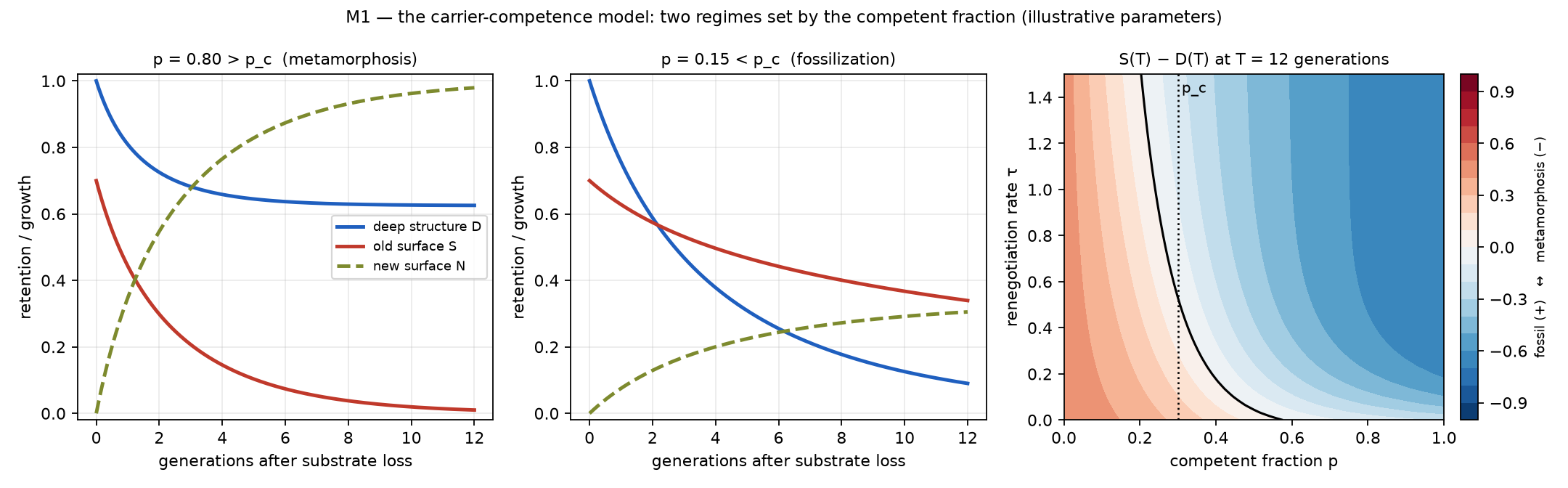
The carrier-competence model and its two regimes. After a substrate loss at time zero, let D be the retention of a system’s deep structure, S the retention of its old surface forms, and N the growth of new surface forms on the new substrate. A fraction p of the surviving carriers are competent in the sense of §2.2; the rest copy. Reconstruction needs surviving meaning to work from, so the repair of D is proportional to p and to D itself; old surface decays at the slow rate of copying loss and is additionally renegotiated by competent carriers who hold the meaning; new surface grows as they express what they hold. With no external carrier, the state D = 0 is stable if and only if the reconstruction rate falls below the loss rate, which gives a threshold in the competent fraction, p_c, equal to the ratio of the meaning-loss rate to the reconstruction rate; above it, deep structure settles at a positive level that rises with p. Above the threshold, old surface is replaced while deep structure is held: metamorphosis. Below it, deep structure decays to nothing while old surface, copied at high fidelity, outlives it: fossilization, the profile the transmission paper documented for the hidden Christians of Japan, in which prayers survived as sounds while doctrine was forgotten (Paper 2.3, §5.4). The regime is set by who carries the pattern, not by how severe the loss was: the fraction of old forms destroyed at the moment of loss enters the initial state only and moves no boundary. Access to an external carrier that supplies a seed of meaning independent of what survived inside removes the threshold — an interior equilibrium then exists for every p — but the level maintained is still set by p. That is the transmission paper’s carrier requirement seen from the content side: the external carrier makes re-docking possible; how much of the pattern re-docks is another quantity (Paper 2.3, §2.4, Propositions 5–6). Figure 1 shows the two regimes and the map between them.
The reconstructibility gradient. Inside the same model, let content components be indexed by how far each can be reconstructed from its meaning, from rote-only formulae to fully reconstructible structure, with the loss rate interpolating between the two and repair proportional to reconstructibility. A component is maintained if and only if its reconstructibility exceeds a cutoff that falls as the competent fraction rises; below a competent fraction set by the two loss rates, nothing is maintained and everything decays, the rote components slowest. That is the transmission paper’s finding — survival under dormancy graded by semantic reconstructibility — derived rather than observed. One further consequence follows if the loss rate interpolates linearly, and is stated as conditional on that: at intermediate competence the survival profile at a finite horizon is U-shaped. Rote forms persist by slow copying, the most reconstructible structure persists by repair, and the middle is lost first — content that needs training to reconstruct and is not rote. The prediction is that under partial competence the expert layer goes before the formulae and before the core logic.
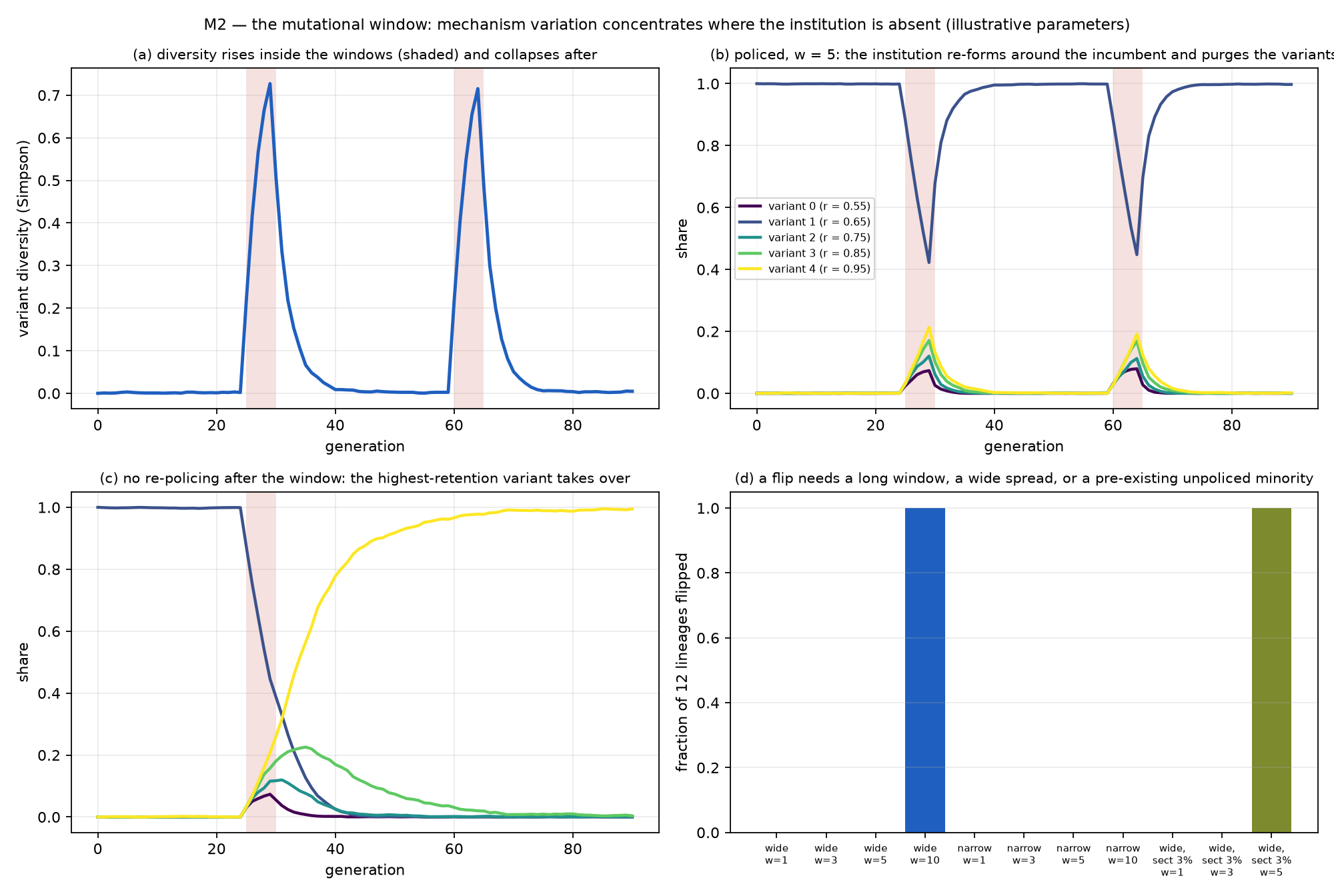
The mutational window. A population of carriers each holds one variant of a mechanism from a set compatible with the system’s goal, with a retention rate per variant that is an input to the model, not a result of it. Between losses, an institution polices the mechanism: variants are copied with low mutation and reverted to the official variant at a fixed rate. A substrate loss opens a window in which the institution is absent, mutation is high, and policing is zero; when the window closes, the institution re-forms around whatever variant then prevails and polices again. Three things follow. Variant diversity rises steeply inside the window and collapses after it: in the runs, from near zero before the loss to above 0.7 at the window’s peak and back to near zero twenty generations after it closes. A short window changes nothing permanently: with policing restored, the institution re-forms around the still-majority incumbent and purges the variants. And a window changes the official mechanism only when selection inside it overcomes the incumbent’s head start — with a long window, a wide spread in retention, or a variant already present before the loss as an unpoliced minority, which in the runs needs a window half as long to take the lineage. If lineages reconstruct collectively rather than by individual variation, isolated lineages sharing one loss diverge in their official mechanisms, and retention decides between them only later, if and when they compete for the same hosts, which is the transmission paper’s question. Figure 2 shows the window, the re-locking, the takeover without re-policing, and the conditions for a flip.
What the three results say together. The competent fraction decides whether a loss is followed by a metamorphosis or a fossil; an external carrier can substitute for competence at the seed but not at the level maintained; what survives under partial competence is graded by reconstructibility, with the expert layer most exposed; and the loss itself is where a system’s mechanisms vary, with the outcome set by the window’s length, the spread in retention among variants, and whether the variant that wins was already present. None of this says which mechanism is fitter. The retention ordering is an input, and where the cases below say that the mechanism with the higher retention prevailed, that is the series’ dependency analysis speaking (Paper 2.2), not this model.
2.5 The Computational Supplement
The supplement holds seeded code, outputs, and three figures. Its checkpoints compare analytic and simulated quantities: the closed form of the deep-structure equation against the integrator at five decimals for four values of the competent fraction; the analytic threshold (0.300 at the illustrative values) against the regime flip between runs; the interior equilibria with an external carrier at three parameter pairs (0.0456, 0.1483, 0.0099 analytic against 0.0457, 0.1483, 0.0099 simulated); the dominance time of the fitter variant after an unpoliced window (16.50 generations analytic against 17 simulated); and a neutral check on the mutation step alone (0.2220 analytic against 0.2221 simulated, twenty replicates). Every value is illustrative. The parameters were chosen for legibility, not fitted to any case, and the supplement’s own statement of what it does is the one adopted here: it exhibits conditional structure and measures nothing.
Eight caveats travel with the numbers, and the two that bear most on the cases are these. The threshold depends on the assumption that reconstruction needs surviving meaning to work from; if repair were possible from nothing inside, there would be no threshold but a graded level, and that alternative is the external-carrier case, so each case below should say which it is. And the model holds the competent fraction fixed, where in the record competence is itself transmitted or lost; a model in which it is a dynamic variable would have a second threshold, and has not been built.
3. The Temple as a Branching Event
The first case is a test of the framework rather than an illustration of it, because the series’ own dependency model turns on a feature of the Christian architecture that a naive continuity reading of this transition would erase. Paper 2.2 derives dependency from a doctrinally installed component of guilt that the system’s own relief cannot remove; Paper 1.4’s stress dimension is built on the same feature; and the capstone has already stated that across the transition from Second Temple Judaism to Christianity the stress architecture did not persist unchanged but mutated, from an act-based, clearable structure to a state-based permanent one, while the goal persisted (Paper 5.1, §2.3). This section runs the criteria on the record. The record turns out to be a branching, not a succession, and the branching is longer, later, and more entangled than the metaphor of a pupation allows.
3.1 The Loss
The daily sacrifice in the Temple at Jerusalem ceased before the building burned. Josephus records that on the seventeenth day of Tammuz in the year 70 “the sacrifice called ‘the Daily Sacrifice’ had failed, and had not been offered to God, for want of men to offer it” (Bellum Judaicum VI.2.1, Whiston’s translation); the sanctuary itself burned some weeks later (VI.4.7). The order matters for this paper. The mechanism required a trained, present, functioning priesthood at a single site, and it stopped when the personnel condition failed, not when the masonry did. That is §2.2’s competent-carrier condition failing in reverse, at the level of a single institution.
The structural reason the mechanism could not simply be relocated is stated by the scholar who reconstructed how the purification offering worked. The blood of the ḥaṭṭā’t, Milgrom argued, is the ritual detergent; “its use is confined to the sanctuary, but it is never applied to a person”; the object purged is “the sanctuary and its sancta”; and the priestly writers’ doctrine is that “sin may not leave its mark on the face of the sinner, but it is certain to mark the face of the sanctuary” (Milgrom, 1976, pp. 390, 398). The absorber of the community’s impurity was a building. “Thus the sanctuary needs constant purification lest the resident god abandons it together with his devotees” (pp. 398–399). When the building went, the mechanism had nowhere to put what it collected. The substrate loss was not the interruption of a practice that could be resumed elsewhere; it was the removal of the object the practice acted on.
The loss was also a sequence rather than a moment. After 70 came the redirection of the Temple tax to Rome and, under Domitian, an administration of it that one study argues accelerated the separation of the two successor communities (Heemstra, 2010); and then the war of 132–135/136, which ended whatever restoration hope survived (Mor, 2016). Only the burning of 70 is the event the metaphor names. The first step, the priests’ absence, is the one this framework needs; the third, on this paper’s reading of that thesis an external administrative pressure drawing a boundary that neither community had yet drawn for itself, is the one it did not have.
3.2 The Continuity Limb
What the destroyed mechanism did was, on the face of the statute, act-based, bounded, and repeatable. The Day of Atonement is “a statute for ever,” to be performed “once in the year,” on which “from all your sins shall ye be clean before the LORD” (Leviticus 16:29–34, JPS 1917). The rabbinic statement of the system, redacted around the year 200 and therefore evidence for the reconstruction at least as much as for the Temple period, is more precise, and its precision is the finding. Atonement is a graded, multi-instrument affair: “The Sin-offering and the unconditional Guilt-offering effect atonement; death and the Day of Atonement effect atonement if there is repentance. Repentance effects atonement for lesser transgressions … while for graver transgressions it suspends punishment until the Day of Atonement comes and effects atonement” (Mishnah Yoma 8:8, Danby’s translation, p. 172). Its clearance is conditioned three times over in the next paragraph. It is conditioned on good faith, by what can only be called an anti-loop clause: “[If he said,] ‘I will sin and the Day of Atonement will effect atonement’, then the Day of Atonement effects no atonement.” It is conditioned, for a whole class of offences, on a party who is not the institution at all: “for transgressions that are between a man and his fellow the Day of Atonement effects atonement only if he has appeased his fellow.” And its terminus is stated in the indicative: “Before whom are ye made clean and who makes you clean? Your Father in heaven” (Yoma 8:9, Danby, pp. 172–173). A system whose foundational legal text forbids planning on its relief, routes a class of wrongs away from its own channel, and asserts that the cleansing arrives is not a loop in the sense of Paper 2.2. It recurs annually by statute. Periodicity and unresolvability are different architectures, and the distinction between them is the one the Christian limb’s own texts will mark from the other side (§3.3).
When the site was lost, the successor community that kept the name rebuilt the mechanism from the goal it served, and it tells the rebuilding in its own voice. In the tradition’s telling, Rabban Yohanan ben Zakkai is leaving Jerusalem with a disciple who sees the ruin:
“Woe unto us!” Rabbi Joshua cried, “that this, the place where the iniquities of Israel were atoned for, is laid waste!” “My son,” Rabban Johanan said to him, “be not grieved; we have another atonement as effective as this. And what is it? It is acts of loving-kindness, as it is said, For I desire mercy and not sacrifice” (Hos. 6:6). (Avot de-Rabbi Natan A 4, Goldin’s translation, p. 34)
The goal is named, the loss is registered, and the mechanism is reconstructed with a scriptural warrant, like for like in kind: a performable, repeatable practice replaces a performable, repeatable rite. The prophet’s own formula for the substitution was already in the canon — “So will we render for bullocks the offering of our lips” (Hosea 14:3, JPS 1917; 14:2 in the King James numbering). Nothing in the passage installs a state, a residue, or an inherited liability. This is reconstruction from meaning in one sentence, the competent-carrier operation of §2.4, performed by the people who held the meaning.
Three disciplines keep the limb in bounds. The story is a story: Avot de-Rabbi Natan is a late compilation, the Yavneh tradition as a whole is under a historiographical caution, and one study titles a chapter on the invention of the rabbis in the sixth century (Boyarin, 2004); what is reported here is the tradition’s story about 70, not an event. The successor was not visibly dominant for a long time: the leading account of Jewish society under Rome places a trough from around 70 to the mid-fourth century and the re-consolidation of a recognizable Judaism in Late Antiquity (Schwartz, 2001). And the prooftext was shared. Hosea 6:6 is also the Gospel of Matthew’s (9:13; 12:7). One substrate loss, one scriptural resource, two reconstructions built from it: that is what a branching looks like in the sources, and it is why the case is a test.
3.3 The Mutation Limb
The other successor did something different with the same loss, and the difference is visible at three levels, each with a date.
At the level of the concept, the governing metaphor of sin had already been changing before either successor existed. Anderson’s history traces the shift from sin as a weight carried away — the scapegoat’s burden — to sin as a debt owed, a change he dates to the post-exilic period and the arrival of Aramaic commercial vocabulary, and calls an ancient Jewish revolution in thought that later shaped Christian atonement theory, penance, almsgiving as credit, and indulgences (Anderson, 2009). Two things about that shift bear on this case. It was shared: both successors inherited the debt metaphor, and Anderson’s own chapters follow it into the rabbinic sages as well as the Church Fathers. And a debt is a clearable quantity. The metaphor supplies what a permanent baseline needs — a standing balance, a creditor, the possibility of payment by another — but does not by itself make the balance unpayable by the debtor or contracted at birth. Those two properties come from elsewhere.
At the level of the text, they were present in the ancestral population and contested there. Two Jewish apocalypses written in the generation after 70, both responding to the destruction, disagree about whether Adam’s sin transmits a liability. One says it does: “O thou Adam, what hast thou done! For though it was thou that sinned, the fall was not thine alone, but ours also who are thy descendants!” (4 Ezra 7:118, Box’s translation, p. 161). The other refuses in terms: “Adam is therefore not the cause, save only of his own soul, but each one of us has been the Adam of his own soul” (2 Baruch 54:19, Charles’s translation, pp. 94–95), conceding only untimely death to Adam (54:15). The rabbinic tradition’s own construct for the human pull toward wrong, the yetzer ha-ra, is on the classical account a disposition rather than a liability: it “has thus little in common with the evil principle of theology, but is reduced to certain passions … They only become evil by the improper use man makes of them” (Schechter, 1909, p. 265); a recent study raises its stature to a demonological inciter while, on the account of the endorsement its publisher prints, endorsing the view that the rabbinic conception of the human person is fundamentally optimistic (Rosen-Zvi, 2011). In neither construal is relief from the yetzer routed through an institution that monopolizes it. Schechter himself concedes that the belief in the disastrous effects of Adam’s sin on posterity “was not entirely absent in Judaism, though this belief did not hold such a prominent place in the Synagogue as in the Christian Church” (p. 188 n.). The correct statement is therefore not that one tradition had the idea and the other lacked it. A transmitted condition was a live minority option in a genuine internal dispute of the ancestral population, and it became doctrine, by canon, on one limb only.
At the level of canon, the fixing is dated. The Council of Carthage of 418 anathematized whoever says that infants “draw nothing of the original sin from Adam,” on the ground that they are baptized “so that that which they have contracted from generation may be cleansed in them by regeneration” (canon 2); the Second Council of Orange of 529, confirmed by Boniface II on 25 January 531, anathematized whoever says that “Adam’s transgression injured him alone and not his descendants,” or that death of the body only “but not sin also, which is the death of the soul, passed through one man into the whole human race” (canon 2). Both canons quote Romans 5:12 in the Latin form on which the Western doctrine was argued: in quo omnes peccaverunt, “in whom all have sinned,” a construal the Greek ἐφ’ ᾧ πάντες ἥμαρτον does not require and on which Augustine, arguing against the reading that Adam’s sin passed by imitation only, presses the pronoun as though it were the datum. What the Greek means is a live question in New Testament scholarship; what the record shows is that the Latin text of the canons reads as it does. The dates are the finding. Carthage sits 348 years after 70 and Orange 459. Whatever the destruction of the Temple did, it did not install this. The mechanism of transmission is stated in the canon itself — generation — and the form of the canons is the framework’s error-correction cell filled with primary text: a variant present in the population is named as it stands and excluded by decree, and the variant excluded is the clearable, non-inherited reading. The later floor of the doctrine, at which the disposition remains after baptism and the believer is forbidden to conclude that the matter is settled, is the series’ formal territory (Paper 2.2, §2.2); the Eastern tradition’s different construal of the same inheritance is stated in the historical case study (Paper 2.1, §6.1).
Set the two limbs side by side and the framework’s criteria run twice. The goal persisted on both: atonement for a community that understands itself as standing in need of it. The authority architecture was rebuilt on both, and in the same form — an authoritative text with authorized interpreters — which is deep continuity shown on two independent limbs, a stronger showing than one. The mechanism was reconstructed on one limb in kind, an act-based bounded clearance for an act-based bounded clearance, and on the other it mutated, into a state contracted at birth, with a relief channel the series’ dependency model describes and with the clearable rival anathematized. The stress architecture row of any table comparing the two must therefore read: mutation with goal continuity. And the dependency row must distinguish a rite that recurs by statute from a loop whose exit is doctrinally prohibited, because that is the difference between the Mishnah’s anti-loop clause and the conciliar prohibition of the terminus, and it is the difference on which the rest of this series’ analysis of the Christian architecture depends.
The same comparison in tabular form, with each cell dated, is Table 1. Its last column is where the reactive category of §3.4 would be tested, and the table shows how little of that test has been run: for the one feature rebuilt in the same form on both limbs, whether the form was built against the sibling is open.
Table 1. The criteria run twice. Each cell carries the text it rests on; where the record holds nothing for a cell, the cell says so.
| Feature | The pre-70 mechanism (Leviticus 16; as the Mishnah states it, redacted c. 200) | Rabbinic limb (Mishnah Yoma; Avot de-Rabbi Natan, later) | Latin Christian limb (Carthage 418; Orange 529) | Relation between the limbs |
|---|---|---|---|---|
| Goal | Atonement for a community standing in need of it | The same, named in the Yohanan story | The same, cleansing stated as the rationale of infant baptism (Carthage, canon 2) | Shared inheritance |
| Authority architecture | A priesthood at one site, acting on the sanctuary (Milgrom, 1976) | An authoritative text with authorized interpreters | An authoritative text with authorized interpreters, and councils fixing doctrine by anathema | Rebuilt on both limbs in the same form; whether either form was built against the sibling is the untested question of §3.4 |
| Mechanism | An act-based, annual, conditioned clearance (Leviticus 16; Yoma 8:8–9) | Reconstructed in kind: acts of loving-kindness, repentance, the offering of the lips (ARN A 4; Hosea 14:3) | Mutated: a liability contracted by generation, cleansed by regeneration (Carthage, canon 2; Orange, canon 2) | Reconstruction on one limb, mutation on the other |
| Stress architecture | Bounded; planning on the relief voids it (Yoma 8:9) | Bounded, periodic | A permanent installed baseline (Paper 2.2, §2.2) | Mutation with goal continuity |
| Dependency | Periodic by statute; a class of wrongs routed to the injured party (Yoma 8:9) | The same | An unresolvable terminus, with relief routed through one channel (Paper 2.2) | Periodicity against unresolvability |
| Error correction | Not in this record | Not in this record | Conciliar anathema against the clearable reading (418; 529) | The cell is filled with primary text on one limb only |
| Shared carrier | Scripture | Hosea 6:6 as the prooftext (ARN A 4) | Hosea 6:6 as the prooftext (Matthew 9:13; 12:7) | One resource, two reconstructions |
3.4 A Process, Not a Fork — and the Category It Adds
The branching was neither clean nor quick, and the historiography of the last two decades makes that the finding rather than a complication. On one reading the distinctions between Judaism and Christianity were made late and from above, by heresiologists on both sides drawing a border across a continuous distribution of beliefs and practices (Boyarin, 2004). On another, whether the ways parted at all is the question, not the premise, and the answer is “a noisy, prolonged, and surprising history” (Becker & Reed, 2003, in the words of one description of the volume). A third supplies a specific accelerant with a date, the Roman administration of the Jewish tax from 96 (Heemstra, 2010). A fourth makes the Christianization of the empire itself the cause of the Jewish re-consolidation that produced the community the first limb describes (Schwartz, 2001). All four are held here at the level of their published statements rather than their arguments. But together they change what the null hypothesis for this case is.
The criteria of §2.3 were written against independent origination. The two successors of the Temple were not independent. They exchanged material, drew boundaries against each other, and for centuries defined themselves by what the other was not. A feature present in both may therefore be neither inherited from the common ancestor nor invented in isolation but reactive: built in opposition to the sibling. That is the fourth relational category of §1.1, mutual definition, and it is the one a naive deep-continuity reading will misclassify as inheritance every time. The category sharpens the framework’s third criterion: a traceable causal pathway must now show not only that a carrier crossed the loss but that the feature it carried was not built afterward against a rival.
3.5 The Corpus’s Account
The source corpus this series studies holds a view of the transition that is neither of the two readings above, and it should be stated as it is. It holds that the god of both testaments is one being — “the transcendental spirit-god of the books of Moses assumed an enigmatic human form and called himself jesus and christ in the new testament” (K, ch. IV, p. 26); the corpus’s German book makes the same identification by setting the threat of John 8:24 beside the death threat in Eden, “Sobald die Menschen auf seine Drohung eingehen und ihm Raum geben, beginnt er seine Arbeit in ihnen,” as soon as people go along with his threat and give him room, he begins his work in them (Augenöffner, p. 45; the paper’s rendering), and the project’s oldest English version of that page inverts one of its sentences, a small instance of the copying loss §2.2 describes and the reason the German is quoted here — and that what was installed was installed early and once: “It is therefore irrefutable that there was no sinner before the pentateuch appeared” (K, ch. IV, p. 27). It orders fear before guilt, and places both in Genesis: fear as a falsified prediction in Eden — “Since the change is not on the line that Adam was occasioned to anticipate—‘You will die the death’—Adam is now in deadly fear. ‘I was afraid,’ he says. This then is the genesis of christian Fear” (J, ch. III, p. 34) — and guilt one chapter of Genesis later, “the genesis of sin in consciousness is coterminous with the genesis of guilt” (K, ch. VI, p. 40). What it assigns to the Christian phase is not a new content but an institution: a “breeding centre for a malignant ‘guilt culture’ in the race as a whole” (K, ch. III, p. 20), and a relief channel it names in one word, the “monopolistic physical overcomer” (K, ch. III, p. 20). Its own contrast between a clearable and an unclearable wrong is drawn not between the two testaments but between the Vedic and the Christian: the Sanskrit papam, “acts between man and man that are devoid of righteousness,” dissolvable by recitation of a mantra, set against “the subjective, illusionary and terrestrially impossible sin” (K, ch. IV, p. 27, with nn. 11–12 at p. 29). Nothing in the corpus characterizes the Temple’s atonement, and the branching analysis of §§3.2–3.3 is the scholarship’s, not its.
Two of the corpus’s formulations belong to this paper’s framework rather than to this case. It describes transmission with variation in a gene vocabulary — the gene of evil “transmitted from one genetic unit to another, each with its own assured improvisation” (K, ch. V, p. 33) — and it states the carrier requirement, with the author’s own gloss: the pattern is “rebelliously kept cultured by his kingdom, labelled as church,” where cultured is glossed in the note as “Produced by artificial means, as cultured viruses” (K, Foreword, p. 3, n. 4). The gene vocabulary is a metaphor deployed as a model, and a paper that also cites developmental biology says so in the same sentence; but the two claims it carries — variation on transmission, and an institution as the pattern’s culture medium — are the claims of §§2.2 and 2.4, made thirty years earlier in another register.
4. The Reformation
4.1 The Ledger Cancelled, the Discharge Withdrawn
The series’ formal paper has already settled what the Reformation did to the guilt ledger: the reformational Luther granted the assurance the Council of Trent would anathematize, cancelled the arrears economy outright, and relocated the permanence into the disposition and its daily practice — cancelled the ledger and kept the disease (Paper 2.2, §2.2). This section adds what that paper did not need: what happened to the relief mechanism as an institution, and how many reconstructions of it one loss produced.
The founding text of the sociology of religion states the medieval mechanism and its removal in terms this paper could not improve. Weber’s phrase for the practice the reformers inherited is “the very human Catholic cycle of sin, repentance, atonement, release, followed by renewed sin,” in which the priest “dispensed atonement, hope of grace, certainty of forgiveness, and thereby granted release from that tremendous tension” (Weber, 1930, p. 117; in the German, “das katholische, echt menschliche Auf und Ab zwischen Sünde, Reue, Buße, Entlastung, neuer Sünde,” 1986, pp. 113–114). And his statement of what one branch of the Reformation did with it: “The means to a periodical discharge of the emotional sense of sin was done away with” (1930, p. 106; “Das Mittel zum periodischen »Abreagieren« des affektbetonten Schuldbewußtseins wurde beseitigt,” 1986, p. 96). Two restrictions in Weber’s own sentence decide how it may be used. The disappearance of private confession he locates “in striking contrast to Lutheranism,” and “from all the regions of fully developed Calvinism” — Calvinism, not Protestantism. And his thesis is not that the cycle was preserved under another name but that it was abolished and the tension routed elsewhere: into the problem of the certitudo salutis, which for the followers of the doctrine of predestination “necessarily became of absolutely dominant importance” (p. 110), and into its resolution by conduct, faith “proved by its objective results in order to provide a firm foundation for the certitudo salutis” (p. 114). That is a reconstructed relief path, not a preserved one: the discharge removed, the stress not, and the architecture rebuilt around proof through systematic conduct. It has the same shape as the first case — metamorphosis with mechanism mutation — and a drafter who quotes Weber for “the loop persisted through the Reformation” quotes him against his thesis.
4.2 Several Reconstructions, One Thing Kept
The loss of the sacramental apparatus’s authority did not produce one successor mechanism. Within a single generation it produced at least three, and the confessions state them; the Reformed settlement’s doctrine of the human condition is quoted below from its fullest later statement, at Dort.
The Lutheran settlement retained the mechanism and changed the theory of it. “Of Confession they teach that Private Absolution ought to be retained in the churches, although in confession an enumeration of all sins is not necessary” (Augsburg Confession, 1530, Article XI, Triglot Concordia translation from the Latin). “Confession in the churches is not abolished among us; for it is not usual to give the body of the Lord, except to them that have been previously examined and absolved,” and absolution is to be prized “as being the voice of God,” bringing “great consolation … to anxious consciences”; what is dropped is the enumeration of sins and the satisfactions that “were immoderately extolled” (Article XXV). The relief of a distressed conscience by an authorized external pronouncement is stated as strongly as any medieval formulary states it. What changed was why it works.
The Anabaptist settlement rebuilt the mechanism as community discipline. “The ban shall be employed with all those who have given themselves to the Lord … and yet who slip sometimes and fall into error and sin,” with admonition twice in secret and the third time openly, “before the breaking of bread, so that we may break and eat one bread, with one mind and in one love” (Schleitheim Confession, 1527, Article II, Wenger’s translation).
The Reformed settlement rebuilt it as a tribunal. The consistories, kirk sessions, and presbyteries that Reformed churches created to oversee public behavior and promote sanctification were once portrayed as instruments of social control; the specialist literature now reads them as having “played an important role in defining confessional boundaries and preserving the sacral unity (and witness) of the eucharistic community,” with penitential and pastoral dimensions the older picture missed — in Kingdon’s words, as reported in the same summary, “Discipline to these early Genevans meant more than social control. It also meant social help” (Manetsch, 2006, abstract). The doctrinal statement of the human condition on this branch, at the Synod of Dort, reads: “A corrupt stock produced a corrupt offspring. Hence all the posterity of Adam, Christ only excepted, have derived corruption from their original parent, not by imitation … but by the propagation of a vicious nature,” so that all “are conceived in sin, and are by nature children of wrath, incapable of any saving good” (Canons of Dort, 1618–19, Third and Fourth Heads, Articles II–III, in the English abridgment Schaff prints as adopted by the Reformed Dutch Church in America). The phrase by which that doctrine is now commonly named, “total depravity,” occurs nowhere in the Canons. It is the first letter of an American mnemonic that a lecturer in Brooklyn is reported to have used around 1905, first attested in print in 1913, and whose second letter then stood for “Universal Sovereignty” (The Outlook, 21 June 1913, p. 394). A comparison that opposes original sin to total depravity as the period’s own contrast between two stress architectures is comparing a fifth-century canon to a twentieth-century acronym.
All three reconstructions kept one thing, and it is visible in each confession’s own words: each attaches the rebuilt mechanism to the community’s central rite as a gate. Absolution before the body of the Lord; the ban before the breaking of bread; the consistory preserving the unity of the eucharistic community. Innovation clustered at the loss, as the model of §2.4 says a window does, and across the variants a structural invariant held. In the model’s terms this is the goal-level constraint that the reconstructions shared: whatever the mechanism, access to the rite that constitutes the community is conditioned on it.
4.3 Confessionalization
The historiography of the century after 1517 has its own name for deep convergence under surface opposition, and the paper adopts the name and the dispute around it rather than re-deriving either. The confessionalization paradigm holds that Lutheran, Reformed, and Catholic territories built parallel apparatuses of doctrine-fixing, church discipline, and education, in cooperation with the emerging territorial state, and did so along structurally similar lines under opposed confessions (Reinhard, 1983; Schilling, 1988, 1992, 1995). The paradigm’s founders, its four main lines of criticism, and the state of the dispute are set out in the standard review (Lotz-Heumann, n.d.; the critics include Schmidt, 1997, and Ehrenpreis & Lotz-Heumann, 2002). The paradigm is cited here as the historians’ statement of what §4.2 describes at the level of mechanisms, at the resolution of the review’s account of it rather than its founders’ sentences. The continuity reading of the period more generally, in which the Reformation is a harvest of late-medieval theology rather than a rupture (Oberman, 1963), stands beside the record of what was destroyed: “churches were sacked, images smashed and burned, relics destroyed, and the Catholic Mass abolished” (Eire, 1986, in the publisher’s description of the book).
4.4 What the Case Tests
Two findings from this record push against a tidy reading of the case, and the paper takes both.
The first is that some of the surface destruction was the deep structure at work. Eire’s thesis is not that iconoclasm accompanied the Reformation but that the charge of idolatry was the organizing axis of Reformed Protestantism, theologically and politically. A movement that dismantles the old surface as the content of its new doctrine is not a case of surface changing while structure persists; it is a case in which the structure’s own error-correction feature was pointed at the predecessor’s forms. The framework can describe that, but only if it stops treating surface change as noise.
The second is that on the Catholic side the surface persisted and the function changed. Bossy’s hypothesis for the same century was that the practice of the sacrament of penance in the traditional church shifted “from the social to the personal” — from “a machinery for the regulation and resolution of offences and conflicts otherwise likely to disturb the peace of a community” to “a field of interiorized discipline for the individual” — a shift he located in the Counter-Reformation and set out to test rather than reported as found (Bossy, 1975, p. 21). Same rite, same personnel, same canonical obligation, a different job. For a framework about deep structure surviving surface change, a case in which the surface survived and the deep structure moved is the sharpest available test, and it is met by the same distinction the model carries: what persisted here was a form, held by carriers who redirected its meaning. That is conversion in the political scientists’ vocabulary (§1.3), and it is the inverse cell of §6.5 seen inside a single institution.
5. The Generality Claim
The framework claims to describe a general mechanism, not a Christian one, and the natural test is a transition into a secular system. This section restricts the test to the transition the scholarship supports — the inheritance of a Christian form by Marxism-Leninism — and enters the literature on it rather than restating one side. The literature is eighty years deep, it names its own disagreement, and its disagreement is this paper’s third criterion.
5.1 The Eschatological Level
The claim that the Marxist philosophy of history is Judaeo-Christian salvation history with its terms substituted was made by Löwith in 1949: “the following outline aims to show that philosophy of history originates with the Hebrew and Christian faith in a fulfilment and that it ends with the secularization of its eschatological pattern” (Löwith, 1949, p. 2), and of Marx, “Historical materialism is essentially, though secretly, a history of fulfilment and salvation in terms of social economy” (p. 45), with the correspondences listed one by one on the preceding page — the proletariat’s task as the world-historical mission of a chosen people, the final struggle of the classes as the fight between Christ and Antichrist, the transformation of the realm of necessity into the realm of freedom as the transformation of the earthly city into the city of God. The same mapping in its most quoted form is Russell’s, and it should be quoted whole because its users drop its second half:
The Jewish pattern of history, past and future, is such as to make a powerful appeal to the oppressed and unfortunate at all times. St. Augustine adapted this pattern to Christianity, Marx to Socialism. To understand Marx psychologically, one should use the following dictionary:
Yahweh = Dialectical Materialism The Messiah = Marx The Elect = The Proletariat The Church = The Communist Party The Second Coming = The Revolution Hell = Punishment of the Capitalists The Millennium = The Communist Commonwealth
The terms on the left give the emotional content of the terms on the right, and it is this emotional content, familiar to those who have had a Christian or a Jewish upbringing, that makes Marx’s eschatology credible. (Russell, 1946, p. 383)
“A similar dictionary could be made for the Nazis,” the next sentence begins. Russell’s frame is psychological, his mechanism is the emotional content of inherited terms carried by an audience raised inside the old system, and he offers no evidence and claims none. He is the canonical statement of the intuition, and a two-column deep-structure table of the kind this paper’s framework invites has, in him, its most famous instance. Cohn’s history of medieval millenarianism closes on the same thought, with hedges its popular users omit: “The old religious idiom has been replaced by a secular one, and this tends to obscure what otherwise would be obvious. For it is the simple truth that, stripped of their original supernatural sanction, revolutionary millenarianism and mystical anarchism are with us still” (Cohn, 1970, p. 286). He calls the modern application a suggestion that has drawn “much comment, both favourable and unfavourable”; his firm claim of continuity concerns Nazi conspiracy myth and is sourced to another of his books; and between the 1957 and the 1970 editions the clause about modern totalitarian movements left his subtitle. Voegelin’s version — the Christian eschatological symbol taken over and relocated inside history, a relocation he diagnoses as a category mistake — is in the fourth chapter of his Walgreen lectures (Voegelin, 1952, ch. IV, §3), and is a contested position. Talmon (1952, 1960), Aron (2003), Gentile (2000, 2006), and MacIntyre (1968) belong to the same literature and are named here, not quoted.
What every author in that list licenses is one of this paper’s five deep features. Each is making a claim about an eschatological narrative shape, and Russell about emotional content. None argues that Marxism inherited a Christian authority architecture, a guilt-installing stress architecture, a dependency loop, or an error-correction mechanism. That work, for the Soviet case, is done by a different literature.
5.2 The Apparatus Level
The historians of Soviet subjectivity document a confession-centered apparatus inside the Party. Communists in the 1920s and 1930s were expected to write autobiographies reconfiguring their lives to the Party’s demands, in an intricate relation between the Communist eschatological narrative and the autobiographer’s effort to show that he had traversed the same route within his own soul (Halfin, 2003, as stated in the publisher’s description); the Soviet system, unlike its rival, treated confession as central to its proceedings even for defendants who were objectively innocent (Garros, 2004, reviewing Halfin). The Party practice has a name in the literature, samokritika, and a study of its rituals in the Stalinist Central Committee (Getty, 1999). The ascription of disability by social origin — the lishentsy, disenfranchised for their class background — is a documented institution (Fitzpatrick, 1993; Alexopoulos, 2003), and it is the closest secular analogue in this paper’s cases to an inherited liability; the disanalogy must be stated in the same sentence, because on the standard account of that literature the status carried an appeals procedure and much of its history is the history of people petitioning their way out of it. An inherited status that can be petitioned away is a bounded liability with a bureaucratic clearing mechanism, not the architecture of Paper 2.2.
The genealogical claim — that this apparatus descends from a Christian one — has a published statement and a published objection. Kharkhordin’s study of Soviet practices of the self argues, in its publisher’s summary, that the Party rituals forcing each Communist to reflect intensely and repeatedly on his or her self “had their antecedents in the Orthodox Christian practices of doing penance in the public gaze” (Kharkhordin, 1999). A reviewer in the field replied that the heterogeneity of the texts and contexts and the strong temporal discontinuities leave most of the developments “à leur statut d’hypothèses séduisantes” — at the status of seductive hypotheses (Moine, 2002) — and, as the same reviewer notes, Kharkhordin himself marks October 1917 as a rupture rather than claiming smooth continuity. That objection is this paper’s criterion 3, raised by a specialist against the study this paper relies on, before the paper existed. The case therefore stands as follows. The surface discontinuity is undisputed. The deep continuity is argued at two levels by two literatures. The causal pathway is partial and contested, and the paper states criterion 3 as a standard the case must meet and does not yet meet.
One further source belongs here for a practice the Soviet case is often confused with. The Chinese thought-reform complex of the early 1950s was analyzed by a psychiatrist in 1961 as ideological totalism with eight criteria, the fourth of which is “The Cult of Confession”: “There is the demand that one confess to crimes one has not committed, to sinfulness that is artificially induced, in the name of a cure that is arbitrarily imposed,” a purging milieu that “enhances the totalists’ hold upon existential guilt” (Lifton, 1989, pp. 425–426; first published 1961). That is a confession-and-relief structure inside a secular ideology, described with guilt named as the resource the apparatus exploits, six decades before this paper. Lifton’s subject is China, not the Soviet Union, and the “struggle session” is a Chinese institution, not a Soviet one; the two have distinct literatures and are kept in distinct sentences here. And Lifton supplies the brake this whole section runs under: “But facile comparisons can be misleading. No milieu ever achieves complete totalism, and many relatively moderate environments show some signs of it” (p. 435).
5.3 The Counter-Thesis, and What Would Settle It
Blumenberg’s reply to Löwith was quoted in §1.1, and it is the strongest formulation available of the objection to this paper’s thesis. He concedes the resemblance: on one reading of the debate, Löwith “provided a wrong ontological explanation to a morphological similarity that had been rightly detected” (Ruta, 2022, p. 22). He rejects the derivation: the modern idea of progress and the Christian totality bounded by Creation and Judgment are two distinct events, and the later one reoccupies a position the earlier one vacated. And his persisting item is a question, not a mechanism and not a transmitted thing. Reoccupation requires no carrier. It is the best-formulated version of the claim that resemblance plus a vacancy does not show a pathway. Blumenberg enters here not as an ally of the paper’s architecture half but as the reason the humanities ran this argument to a draw fifty years ago, and the question that separates him from Löwith is this paper’s own third criterion. What would settle the debate, on this paper’s account, is not a better table of correspondences but a carrier record: named personnel, institutions, and practices shown to have crossed from the one system into the other, and shown not to have been built afterward against a rival. The Soviet case has such a record in part, and its best historian’s genealogy is contested on that point. That is the state of the question, and the paper’s contribution to it is to say what evidence the question needs.
One defence of the secularization concept in the same debate deserves recording because it is this paper’s second persistence mechanism stated in 1968. Gadamer held that the concept performs a legitimate hermeneutic function, one that “contributes a whole dimension of hidden meaning to the self-comprehension of what has come to be and presently exists, and shows in this way that what presently exists is and means far more than it knows of itself” (Blumenberg, 1983, pp. 16–17, quoting Gadamer, as quoted in Ruta, 2022). A system that means more than it knows of itself, with the surplus visible to the historian and not to the participant, is §7’s abstract-encoding mechanism, and it was formulated and contested inside a named debate before this framework had a vocabulary.
6. Small Cases and the Controls
The three cases above are large, contested, and chosen. A framework that only ever runs on chosen confirmations has not been tested. This section does two things: it takes up four small cases the project’s own earlier research layer proposed as clean exhibits of single regimes, and it runs the cells of the framework’s own space that the three cases leave empty. The four small cases did not come back as clean exhibits. Examined against their sources, one is a metamorphosis whose identity the scholars of the tradition dispute; two are claims of persistence under an imposed surface that the standard authorities decline to confirm; and one is the inverse of the paper’s thesis. They are reported at the strength found, which is what makes them worth having.
6.1 Confucianism: Dormancy, and the Suppressor as Carrier
The institutional substrate of Confucianism was removed in a sequence, not an event, and the sequence matters to the case. The civil examinations, which for five hundred years had defined the credential binding the imperial state to its literati, were eliminated by reform decree in 1904–5; the historian of the system describes the step as touching off “the unforeseen demise of the partnership between the dynasty in power and its gentry-merchant elites,” and adds that the reformers “underestimated the public reach of historical institutions that had taken two dynasties and five hundred years to build” (Elman, 2009, pp. 539, 542). In 1911 the empire fell “together with all the institutions based on Confucian tradition: the Imperial Examinations (which had already ended in 1905), the Imperial Hanlin Academy, the rituals performed by the Imperial Court, the temples and so on” (Ambrogio, 2017, p. 120). The New Culture generation rejected the tradition on the merits, Chen Duxiu’s argument of 1916 that Confucius belonged to a “feudal epoch” being the dated instance (as reported in Ambrogio, 2017), and after 1949 “the majority of intellectuals left China for Taiwan, Hong Kong and even western countries” (Ambrogio, 2017, p. 121). A quarter of a century later the suppression was still running: the campaign of 1973–74 was, in a contemporary historian’s words, “a continuation of the communist effort to eradicate traditional habits and attitudes that have persisted despite the revolution” (Goldman, 1975, abstract). That sentence is the case’s evidence for dormancy inside the suppressing state, and it says what the campaign was aimed at: habits and attitudes, which is to say carriers, and not only texts and buildings.
The external carrier is documented in the carriers’ metaphors. Tang Junyi and Mou Zongsan, the second generation of the philosophical movement that reconstructed the tradition outside the mainland, left after the civil war; Tang “retreated to Hong Kong, a British colony at that time, and founded New Asia College with the renowned historian Chien Mu,” and Mou “proposes restoring Confucianism, and recovering the lineage of the Dao 道統 that had been ruined in Communist China” (Huang, 2020, pp. 17–18). Tang’s two figures for the situation were the dispersion of flowers and fruits, hua-guo piao-ling, for exile, and the self-planting of the spiritual root, ling-gen zi-zhi, for “the attempt to draw resources from this new land to wait for new shoots of growth” (Huang, 2020, p. 19). A reconstruction from the goal, described by those who made it as the recovery of a ruined lineage and housed in an institution founded by named people on a datable site: that is the model’s external carrier, and it is the shape the rabbinic case exhibits at Yavneh with far thinner documentation (§3.2). What crossed, though, was not the institution. “Institutional Confucianism lost not only Imperial support, but also its reason for being,” and even where societies guarded the tradition it “often lost its place to the metaphysical New Confucian philosophy that bloomed in the 1960s and 1970s” (Ambrogio, 2017, p. 121). The pattern the carriers held and rebuilt was textual and philosophical. Whether the authority architecture crossed with it is what the sources do not settle.
The refinement this case offers is what happened next. In February 2014 Xi Jinping described the governance system best suited to a country as “determined by that country’s historical heritage and cultural traditions,” and called for efforts “to creatively transform and develop traditional Chinese virtues”; in June of the same year, addressing overseas Chinese associations, he named “the profound Chinese culture” as the diaspora’s “shared soul” (as quoted in Ambrogio, 2017, pp. 115–116). The tradition meant is, as Ambrogio notes, the one the May Fourth thinkers and the Party’s own founder had rejected (p. 115). Held against Goldman’s sentence of 1975, this is the suppressor becoming a carrier, in published speeches and within forty years; and the second address runs the external-carrier mechanism from the other end, since it is addressed to the population that had carried the tradition out. The overseas programme of language-and-culture institutes that began in the mid-2000s is the instrument, analysed at its launch in terms of soft power and “the Confucius connection” (Starr, 2009, abstract). On one scholar’s reading the re-import had already been a strategy from the carriers’ side: Makeham emphasizes Tu Weiming’s strategy of exporting Confucianism abroad in order later to re-import it to the mainland (Makeham, 2008, as reported in Billioud, 2008). The same review reports the tradition’s own most-cited modern diagnosis of its condition, by the historian Yu Ying-shih: the transformation of Confucianism into discourses cut off from “the whole body of practices to which it was traditionally attached” is compared to “a wandering soul,” and Yu “wonders if Confucianism will ever be able to ‘borrow a corpse to enable the soul to return’” (Billioud, 2008, pp. 152–153). That is this paper’s distinction between a pattern and its substrate, stated from inside the tradition in the late 1980s, and stated as a question, which it remains.
What the re-emerged forms are is disputed by the scholars of the tradition, and the dispute is reported here, not settled. Makeham’s study of the academic discourse finds the argument by which the authorities sought, in the late 1980s, to integrate Confucianism into their ideological agenda “simply not defensible” (as reported in Billioud, 2008). The fieldwork of Billioud, the same scholar whose review carries Makeham’s verdict and Yu’s metaphor above, and Thoraval distinguishes a popular revival, new associations and educational and ritual initiatives from below, from both the official and the academic ones, finds that the state and unofficial groups can nonetheless be “mutually supportive” (as reported in Murray, 2017), and observes in the official activity around Confucius “the continuing Maoist habitus or mind-set of political campaigning,” after a “deritualisation under Republican and Maoist rule” (as reported in Ji, 2015): on that reading the state’s mode of promotion is inherited from the campaigns that suppressed the tradition, not from the tradition. Sun’s account has two re-dockings at once, pulling apart: “While the Chinese government turns to Confucianism to justify its political agenda, Confucian activists have started a movement to turn Confucianism into a religion” (Sun, 2013, publisher’s description). And a political theorist teaching in China argues, as a participant, that the revival offers “a compelling alternative to Western liberalism” (Bell, 2010, publisher’s description). None of these is neutral evidence that the revival is the tradition; that is the contested proposition.
In the model’s terms the case is a metamorphosis: deep structure that could be reconstructed from its meaning, the texts, the ethical programme, the lineage claim, was held by competent carriers who rebuilt it, while the old surface was destroyed and new surfaces grew, in exile, at the grassroots, and in state ceremonial. But the authority architecture of every re-emerged form differs from the one that was lost, and the four accounts disagree about what the re-docked object is. The case is therefore the strongest exhibit in this paper for the carrier threshold and, in the same evidence, the clearest live instance of the identity problem of §2.3: whether the thing that persisted is the same thing is being argued by specialists in a living tradition, without this vocabulary and without resolution. It also offers the transmission paper’s dormancy class two refinements that class does not have (Paper 2.3, §5.2): an external carrier can be re-imported deliberately, as a strategy, from either end; and the former suppressor can become a carrier, one of several, with incompatible accounts of what they carry.
6.2 Tonantzin at Tepeyac
The second case was proposed as a dated primary-source observation of a pattern persisting under a substituted surface. What the record supports is smaller and more useful: a contemporary observer describing the mechanism of cover-persistence in general terms, and a modern historiography that disputes whether the mechanism was operating in this instance. The paper describes the observation and the dispute. It predicates nothing of the devotion’s faithful and takes no position on the apparition.
The observer is Bernardino de Sahagún, in the appendix to Book XI of his Historia general, quoted here from the nineteenth-century report that reproduced the passage in full and checked it against two printed editions (García Icazbalceta, 1883, Punto 17). At Tepeyac, he writes, “tenían un templo dedicado á la madre de los Dioses, que ellos la llamaban Tonantzin, que quiere decir nuestra madre”; now that the church of Our Lady of Guadalupe stands there, “también la llaman Tonantzin,” the preachers having given the Mother of God that name; and the friar’s judgement is hedged: “Parece esta invención satánica para paliar la idolatría debajo la equivocación de este nombre Tonantzin,” it appears a satanic invention to palliate idolatry under the ambiguity of the name (the paper’s rendering). A second passage, from a manuscript of his in the Biblioteca Nacional, generalizes. “La tercera disimulación (idolátrica) es tomada de los nombres de los ídolos que allí se celebraban”: the third disguise of idolatry is taken from the idols’ names, where the saint’s name in Latin or Spanish means what the old name meant, so that the worshippers “entiéndenlo por lo antiguo y no por lo nuevo,” understand it by the old and not by the new; and he names a second instance at Tlaxcala (García Icazbalceta, 1883, Punto 18). That is a sixteenth-century description of a class of cases in which a substituted surface carries an unsubstituted referent, with the carrying mechanism named: the name. Icazbalceta also sets beside the full text an apologetic version from Puebla that had cut the clauses about the pre-conquest festival, the origin of the name, and the pilgrims who bypassed other Marian churches; a text’s inconvenient clauses being removed is itself a datum for the framework’s account of error correction, and is reported here descriptively.
The historiography declines the inference. Poole’s documentary study, in a reviewer’s summary, holds that the standard apparition account was a construction of the mid-seventeenth century and that, “Despite Bernardino de Sahagún’s statement that the Virgin of Tepeyac was dangerously pagan, she was, Poole argues, not a syncretic product of a European Marian devotion and the pre-Columbian cult of Tonantzin (if this word ever referred to a particular Mesoamerican deity at all),” the devotion being “largely restricted to the ethnically Spanish, not the indigenous population” (McManus, 2019, on Poole, 1995). Taylor’s social history, from new documentation, “posits more widespread early veneration” of the Guadalupes “among non-Indians and through Mexico City and Catholic priests than among Indians in syncretic cults” (Taylor, 1987, abstract). And the reading of the image as, from the sixteenth century, “a symbol of freedom for the oppressed native populations” is one of two myths an art historian set out to challenge (Peterson, 1992, abstract). So the case stands as a claim of cover-persistence made by a hostile and interested contemporary and contradicted by the standard authorities on the sources. It is the worked example of the third criterion failing to be met: a surface substituted and a name retained is not, by itself, evidence of a deep continuity, and the framework has to be applied against the attractive reading here rather than in its support. The same discipline, applied by an art historian to a resemblance three centuries wide, reaches the same result: the nursing Isis is attested in the Mediterranean to the fourth century and the nursing Virgin appears uncontested in Egypt only from the seventh, a gap that, against a scholarship that had read the resemblance as continuity, “does not warrant a generalization that there was a deliberate continuity between the cult of Isis and that of Mary” (Higgins, 2012, abstract; for the wider finding on saints’ cults and sites, Paper 2.1, §2.3).
6.3 The Lwa and the Saints
The third case is the configuration the model calls cover-persistence at its clearest, and the identity inference is refused by the source the case was to rest on. The enforcement is a royal edict. The Code Noir of March 1685 made the surface compulsory, “Tous les Eſclaves qui ſeront dans nos Îſles, ſeront baptisés & instruits dans la Religion Catholique, Apoſtolique & Romaine” (Art. II), and criminalized the alternative down to the act of meeting: “Interdiſons tout exercice public d’autre Religion que de la religion Catholique, Apoſtolique & Romaine,” with all assemblies for that purpose declared “conventicules, illicites & ſéditieuſes” and the penalty extended to masters who permitted them (Art. III; long s as the transcription carries it). One surface made compulsory, the other made an offence, and no article that could reach what people meant: that is the configuration. What resulted, in the standard monograph’s description, “is a society in which one religion, Catholicism, is visible and official; the other, Vodou, is unofficial and largely secretive” (Desmangles, 1992, publisher’s description). Desmangles’s own term for the relation is symbiosis, which stands in three of his six chapter titles. His definition of it, and the correspondences between particular lwa and particular saints that his book treats under that heading, are not reproduced here, because no pairing has been checked against his text.
The refusal is his. Desmangles “sees Vodou not simply as a grafting of European religious traditions onto African stock, but as a true creole phenomenon, born out of the oppressive conditions of slavery” (Desmangles, 1992, publisher’s description). A creole phenomenon is not a preserved pattern under a new surface; it is a third thing. And the field’s methodological objection reaches this paper’s frame directly: scholarly discussions “tend to portray religions like Vodou in Haiti and Candomblé in Brazil as mergers of various Euro-Christian and ‘traditional’ African elements that chiefly result from processes of cognitive ideation, thereby blurring the integrative somatic dimensions” of the phenomenon (Rey & Richman, 2010, abstract). A framework of informational patterns remapping onto substrates is a cognitive-ideation model by construction, and the objection is entered here as a named limitation of the paper’s frame, not answered. What the case supports is therefore the configuration and not the identity: an imposed surface, a criminalized alternative, and a durable two-level religious situation in which the official and the unofficial are described as coexisting rather than fused. It is the inverse orientation of the transmission paper’s hidden-Christian case, where the cover was the tradition’s own device and the hidden thing the imported religion (Paper 2.3, §5.1). Whether what persists under this cover is the prior pattern or a new formation is disputed by the specialists, and the specialist the case was to cite is on the side of the new formation.
6.4 The Tuatha Dé Danann
The fourth case was proposed as fossilization in a literary medium: names persisting without a cult. The sources support half of that and require the other half to be restated. A cult of the Tuatha Dé Danann, with personnel, practice, and an authority locus, is not attested as persisting across the conversion of Ireland. What crossed were names and narrative material, carried in writing by Christian clerical scribes who were not the cult’s carriers, and the medieval texts in which that material stands are the pseudohistorical Lebor Gabála Érenn and the saga Cath Maige Tuired (ed. Macalister, 1938–1940; ed. Gray, 1982). So far this is the model’s fossil limit reached by re-authoring rather than by neglect: competent carriers at zero, surface surviving on a durable copying substrate.
But the model’s fossil is inert, and these forms were not. The most recent history of the material tracks, in its own table of contents, a sequence of re-authorings: “Hidden Beginnings: From Cult to Conversion”; “Earthly Gods: Pagan Deities, Christian Meanings”; “New Mythologies: Pseudohistory and the Lore of Poets”; “Damaged Gods: The Late Middle Ages”; then, after a gap of centuries, “The Imagination of the Country: Towards a National Pantheon,” “Danaan Mysteries: Occult Nationalism and the Divine Forms,” “Coherence and Canon: The Fairy Faith and the East,” and, last, “Artgods” (Williams, 2016, chapter titles). A reviewer lists the statuses the beings have been assigned in turn: “deities, demigods, ‘angelic’ supernatural beings, superhumans, distressingly ‘normal’ human beings and mystical archetypes” (Davenport, 2018, p. 118). The arc is taken here from the book’s contents and a review, not from its argument, and is weighted accordingly: chapter titles are weak evidence for detail and strong evidence for shape. The shape is a set of names that outlived the deep structure which generated them, was then available for capture, and was captured by successive projects, clerical genealogy, cultural nationalism, occultism, each of which fitted the names to an architecture of its own. That is not fossilization. It is a configuration the framework did not have: surface finding a new deep structure, the inverse of deep structure finding a new surface. Criterion 2 fails by construction, and criterion 1 is inverted, since the surface is the continuous thing. Seen from the annexing side, each capture is invented tradition in Hobsbawm’s sense, the framework’s third rival and the category §6.5 gives the papal title; the configuration named here is that rival described from the object’s side, a surface left available for capture, and the case is both at once. Whether the gods became the fairies is a further claim the sources do not carry: the same history places the modern fairy faith inside a nineteenth- and twentieth-century revival.
6.5 The Controls
The framework’s own space has cells the three cases do not occupy, and the transmission paper’s extinct-system comparison has already supplied two of them (Paper 2.1, §7.2). The paper adds what the carrier reading adds to each and runs the third.
Nothing to remap. The Roman mystery cults had no scripture, no supra-local organization, and no self-reproducing community; when imperial legislation abolished the civic religion they supplemented, the niche went and nothing in their structure permitted migration (Paper 2.1, §7.2). In this paper’s terms they had neither competent nor copying carriers of a pattern that could survive the substrate, because the pattern was the substrate’s.
The fossil. Manichaeism is the case that scores high on the historical case study’s mechanisms and died anyway, and its long Chinese coda ended in absorption without an external carrier (Paper 2.1, §7.2). What this paper adds is the form in which it survives. Its texts were not carried; they were dug up — the finds at Medinet Madi and the Dakhleh Oasis and the Cologne Mani Codex in the Roman half of its range (Gardner & Lieu, 2004), the Central Asian manuscripts in the other. A corpus recovered by archaeology after the last competent carrier is the limiting case of the model’s fossil regime, the point at which the competent fraction is zero and the texts persist as forms with no one left to reconstruct from them. That reading is an inference from the finds, not a specialist’s sentence.
Kept, at the cost of scale. The cell the three cases and the fossil leave empty is a pattern kept on a substrate that was moved rather than replaced. The Zoroastrian communities of India supply it, at the resolution of a specialist’s reference article, and with the community’s own account flagged as such. The settlers’ foundation narrative, written down in 1600 from oral tradition, has the local ruler grant sanctuary on four conditions, “They should use only the local language, the women should adopt the local dress, they must put down their weapons and vow never to use them and, finally, their marriage ceremonies should be conducted only in the evening,” and the specialist reports the argument that such traditions “seek to explain why certain Parsi practices have evolved by imbuing them with an aura of historical legitimacy and authority” (Hinnells, 2008), which is the invented-tradition objection raised from inside the field, and set here beside the case. What is not in dispute is the mechanism’s transport: the community’s most sacred grade of fire, carried through a mountain cave, two further settlements, and a fourth site reached in 1742, and around it a priesthood and a purity code maintained for more than a millennium at the cost of scale, since “All the demographic studies of Indian Parsis report an aging and numerically diminishing community” (Hinnells, 2008). The case also holds the best-documented instance of carrier competence in this paper. From 1478 to 1773 the Indian communities exchanged twenty-six letters with the Zoroastrian authorities of Iran, a correspondence begun by a leader “Conscious of the lack of ritual knowledge in his community”; the Iranian side urged the Indians to send priests to study, since they “could not spare any of their own to be dispatched to India,” and “sent manuscripts of various Zoroastrian texts” instead (Hinnells, 2008). Competence falling in the diaspora, an external carrier reachable but itself depleted, and text substituted for personnel when personnel could not be moved: the model’s external carrier, in this case, has a postal history. The paper describes the community and takes no side in the disputes over membership and practice that its specialist records as extensive.
The inverse cell: substrate kept, pattern replaced. The framework’s central case is a pattern crossing to a new substrate. The opposite also occurs: an administrative apparatus’s boundaries persist while the pattern that used them is replaced, and the most famous statement of it is a seventeenth-century polemicist’s: “the Papacy, is no other, than the Ghost of the deceased Romane Empire, sitting crowned upon the grave thereof” (Hobbes, 1651, ch. 47), with the Latin of the liturgy as “the Ghost of the Old Romane Language” and a list of further Roman survivals inside the Church. Hobbes wrote this inside a comparison of the papacy with the kingdom of fairies, and it is cited here for its formulation, not as evidence. The evidence is more modest and more interesting. The ecclesiastical diocese does descend from the imperial administrative unit, but in its modern sense of a bishop’s territory the word “has only been regularly used since the 9th century,” was first applied on the church side “to the sphere of jurisdiction, not of a bishop, but of a metropolitan,” and “many dioceses to this day preserve the limits of long vanished political divisions” out of convenience, not principle (Encyclopædia Britannica, 1911, s.v. “Diocese”; the modern authority is Jones, 1964). Boundaries persisted; the pattern that used them did not. And the best-known example of the inverse cell turns out to be an example of a different category. The claim that the popes inherited the emperors’ title of pontifex maximus in late antiquity, after Gratian repudiated it, rests on a single ancient authority whose date is wrong on either reading (Cameron, 1968), and the papal use of the title is now dated, probably, to the fifteenth century, a re-adoption of an ancient title by “anchoring it in the cultural biography of the papacy” (Dijkstra & Van Espelo, 2017, abstract). A title retrieved a millennium after its substrate was gone is not persistence. It is invented tradition in Hobsbawm’s sense, and the framework’s third rival turns up, on inspection, in the framework’s own most quoted illustration.
6.6 The Space of Outcomes
Two axes organize the cases: whether the pattern was kept, mutated, or lost, and whether the substrate was kept, moved, or replaced. Metamorphosis proper — pattern kept, substrate replaced — is the rabbinic limb (§3.2), the Confucian case on the model’s axis, with its standing under criterion 2 unsettled (§6.1), and, at the level of the eschatological narrative, the case of §5. Mutation with goal continuity on a replaced substrate is the Christian limb (§3.3) and the Reformed and Anabaptist reconstructions (§4.2). Pattern lost, substrate lost, is Manichaeism’s fossil. Pattern kept on a substrate moved rather than replaced, at the cost of scale, is the Zoroastrian control (§6.5). Something continuing under a substituted surface, the cover configuration, is what §6.3 exhibits and what §6.2 records as claimed and contested; in both, the configuration is supported and the identity of what continues is not. Substrate kept, pattern replaced, is the inverse cell of §6.5, and inside a single institution it is Bossy’s penance (§4.4). A surface kept while its pattern is forgotten, the fossil regime with living carriers, is the dormancy the transmission paper documented (Paper 2.3, §5.4). And a surface that outlives its pattern and is then annexed by successive new ones, which is no regime of the model but the inverse of the paper’s thesis, is the names of §6.4. The table is the paper’s device for keeping its cases apart; it is not a source’s.
7. Conditions
7.1 The Four Conditions, Rebuilt
The framework proposes four conditions favoring persistence. Each is either a derived quantity or a named null, and each has a case that exhibits it and a case that fails it. A condition a persistence framework might be expected to list, structural complexity, is not among them; the phenomenon it pointed at is carried by the entrenchment mechanism of §7.3. The second condition is received from Paper 2.3.
Competent carriers above threshold. The model’s first result is that the regime after a loss is set by the fraction of surviving carriers who hold the pattern’s meaning (§2.4). The daily sacrifice ceasing “for want of men to offer it” is the condition failing in reverse (§3.1); the rabbinic reconstruction is the condition met; the hidden Christians’ lay leadership, with its deliberately overlapping offices, is the condition partially met, and the profile that followed — forms kept, doctrine lost — is the model’s fossil regime with living carriers (Paper 2.3, §§5.1, 5.4).
An external carrier. The model’s second result is that access to a carrier outside the loss removes the threshold at the seed without setting the level (§2.4). The transmission paper’s six-case class shows the carrier requirement holding in every documented re-emergence and states its four refinements (Paper 2.3, §5.2); the Confucian case adds two more (§6.1): the external carrier can be re-imported deliberately, from either end, and the former suppressor can become one of the carriers, with an account of what it carries that the other carriers dispute.
Texts. Textual transmission is commonly listed as a condition favoring persistence. The record corrects it: a text is a carrier of surface unless competent readers hold its meaning. Manichaeism’s texts survived and its pattern did not; the untranslated Ave Maria survived as sound; canon, in Assmann’s definition, is the institution that raises a structure toward invariance precisely because it institutionalizes interpretation and not only preservation (§2.2). Textual transmission favors persistence in the presence of competent carriers and fossilization in their absence.
Shared selection pressures. Environmental continuity of selection pressures is a condition under which a similar architecture would re-emerge even without direct causal connection. That clause is the null hypothesis of the whole paper, and §1.1 supplied three independent instances showing that it is not hypothetical. It is stated here as a section rather than a caveat: where pressures are shared and no carrier can be traced, the framework predicts similarity without the specific mechanism signature, and a case that shows the signature with no carrier counts against the framework, not for it (§8, prediction 9).
7.2 The Window
The model’s third result adds conditions to the four: the outcome of a substrate loss for a system’s mechanisms depends on the length of the window before an institution re-forms, on the spread in retention among the variants that arise, on the strength of the re-formed institution’s policing, and on whether the variant that wins was already present as an unpoliced minority before the loss (§2.4). The two large cases exhibit the shape. The permanent baseline was present in the ancestral population and contested there, and was fixed by canon three and four centuries after the loss — a long window with a pre-existing variant. The Reformation’s reconstructions appeared within a generation and were then policed into territorial apparatuses — a short window followed by re-locking, with several official mechanisms rather than one because the lineages reconstructed separately. In both the shape matches the model’s. Whether the model explains either case is a different question, and an open one.
7.3 Genuine Transformation
The framework’s message to reform movements is that changing what one believes does not automatically change how one organizes belief, and that a revolution which replaces doctrines while preserving the architecture will reproduce the old system’s functional properties in new clothing. The message is correct and it is not new. Michels stated it in 1911 about political parties, with a book of data under it: “Who says organization, says oligarchy,” as “the fundamental sociological law of political parties” (Michels, 1915, p. 401), and, in his last paragraph, “When democracies have gained a certain stage of development, they undergo a gradual transformation, adopting the aristocratic spirit, and in many cases also the aristocratic forms, against which at the outset they struggled so fiercely … It is probable that this cruel game will continue without end” (p. 408). Michels’s law is about organizations under the technical necessities of large-scale coordination, and his evidence does not reach this paper’s wider claim about guilt, authority, and dependency. But the mechanism he named is the one this framework calls abstract encoding: the people who rebuild carry the old structure in dispositions they do not know they have. The sociology of organizations states the modern form. Rational actors “make their organizations increasingly similar as they try to change them,” through three isomorphic processes, coercive, mimetic, and normative (DiMaggio & Powell, 1983, abstract), and “Actors carry their existing scripts forward when building new institutions even when doing so is not ‘efficient’” (Mahoney & Thelen, 2010, p. 5). The framework’s second mechanism, redundancy, is on the evidence of these cases the wrong name for the right phenomenon: what survived in the cases above was not what was copied most but what most other things depended on, which is the mechanism of generative entrenchment in the philosophy of biology (Wimsatt, 2007, ch. 7). And the framework’s third mechanism, selection, need not be assumed: adaptive organization can arise from stress-driven structural accommodation alone, on a recent argument, “parts that accommodate together integrate together” (Watson, Levin, & Lewens, 2025), which is a closer description of communities rebuilding on the patterns that worked than a selectionist story this paper never runs.
What follows for reform is the condition the framework states and the mechanism it now has. Genuine transformation of a deep structure requires that the reformers know the structure they are reproducing — architectural awareness, the formulation this paper carries and the series’ capstone pairs with the freedom to exit one collective into another (Paper 5.1, §9.2) — and it requires, on the model’s terms, a window long enough and a variant present. The record’s answer to Mahoney and Thelen’s question about the locus of innovation is the substrate loss itself. It is where the scripts are, for a while, not enforced.
8. Predictions
Each prediction but the seventh, which is a design, is stated with what would count against it.
-
The fraction of trained personnel surviving a substrate loss predicts which regime follows, independent of the loss’s severity. Deep structure held and surface renegotiated where competent carriers are abundant; surface outliving deep structure where they are few. Against it: a documented loss with competent carriers below any plausible threshold, followed by reconstruction of the deep structure without an external carrier; or a loss with carriers abundant, followed by fossilization.
-
Under dormancy, the expert layer goes first. Formulae survive by rote and core logic by reconstruction, while trained-expert content is lost. Against it: a dormancy record in which theology outlives both the formulae and the core logic.
-
Innovation in relief mechanisms clusters at substrate-loss events and is rare between them. The century after 70; the 1520s to the 1560s; the years after 1917. Against it: a relief-mechanism innovation of comparable scale, dated to a period of stable institutions with no loss event.
-
Variants that take over after a short window were present as policed minorities before the loss; a variant absent before the loss takes a lineage only across a long window. In the runs a pre-existing unpoliced minority halves the window a flip needs, and across a long window a variant drawn by mutation inside the window can take every lineage. Against it: a post-loss dominant mechanism with no attested pre-loss minority emerging from a short, dated window.
-
Reconstructions after the loss of a relief apparatus re-attach the mechanism to the community’s central rite. The first test is the paper’s own first case: the rabbinic reconstruction attached relief to repentance, deeds, and prayer (§3.2), and whether the statutory prayer service counts as the community’s constituting rite decides whether the prediction survives it; that question is left open here. Against it: a reconstruction that detaches relief from the constituting rite entirely.
-
Periodicity and unresolvability are different architectures with different host outcomes. A system whose relief recurs by statute, forbids planning on it, and routes a class of wrongs to the injured party should not show the exit-distress and scrupulosity profile the series’ clinical paper attaches to the loop-creating pole (Paper 1.4, §§2.3, 3.1). This is offered to that paper as a within-taxonomy discriminator, not asserted as a clinical finding. Against it: comparable profiles across the two architectures once religiosity is controlled.
-
The signature route can be run. Coded behavioral invariants across a substrate boundary, scored against a convergence null in the manner of cultural phylogenetics (§2.3; §9.1). This is a design; its kill condition belongs to its execution.
-
A conjecture about the present, stated as its test. Comparative writing on contemporary moral movements frequently maps them onto religious structures — an original sin, heretics, evangelists — and the mapping circulates as trade polemic (McWhorter, 2021, whose publisher’s description already draws it) as well as in an essay that locates a descent from mainline Protestantism (Bottum, 2014) and a popular history that locates it in Christianity at large (Holland, 2019), while the strongest scholarly account of the same phenomena explains them by class position and elite competition with no inheritance at all (al-Gharbi, 2024). This paper makes no genealogical claim in this territory and names no pathway. What its framework adds, if it adds anything, is a mechanism and a kill condition, and the measured construct that would test them exists. Guilt about the advantage of one’s own group is a quantified variable with two decades of work behind it; its mean is low, “just below the midpoint of the scale” (Swim & Miller, 1999, abstract); it predicts support for compensatory measures but not for opportunity-increasing ones (Iyer, Leach, & Crosby, 2003); and in the strongest test of action, “guilt did not explain willingness for political action” while anger did (Leach, Iyer, & Pedersen, 2006; see also Branscombe & Doosje, 2004). The three properties the dependency architecture requires — that the guilt be chronic rather than episodic on repeated measurement, that it be reduced by prescribed acts and re-elevated within a bounded interval, and that it be reduced more by acts sanctioned through a particular channel than by equivalent unsanctioned ones — are, respectively, not shown, not found, and not studied. Against the dependency reading: failure of chronicity; durable reduction after action; no sanction effect. Lifton’s brake applies to this prediction with full force (§5.2).
-
Where no carrier is traceable and pressures are shared, similarity appears without the specific mechanism signature. This is the convergence null stated as a prediction so that the third criterion can fail visibly. Against the framework: a specific mechanism signature — the anti-loop clause’s inverse, the prohibited terminus, the monopolized channel — recurring in a system to which no carrier can be traced.
9. Discussion
9.1 What Persistence Licenses, and What It Does Not
The claims this paper can support are claims about architecture: that a deep structure can be held across a substrate loss by carriers who hold its meaning, that it mutates in the window the loss opens, and that what survives without such carriers is form. None of these is a claim that a persisting pattern is a persisting agent, still less an identity claim about the being the source corpus names. Architecture continuity is not agent identity, and the series’ capstone, which owns the identity claim, has already declined to fund it from this paper (Paper 5.1, §§2.3, 5). What this paper contributes to that question is the third route of §2.3, stated as a design. The corpus supplies the criterion, a recurring behavioral invariant across a substrate boundary, and it supplies a worked example with a count. What the corpus lacks, and what any execution would need, is a coding scheme for invariants, a set of cases independent enough to score, and a base rate for recurrence by convergence. The nearest published method coded seventy-two variables across fifty-eight tales and deposited its matrix (Tehrani, 2013); the first step for this framework would be a comparable coding of mechanism features across traditions with and without a documented carrier record. Until that is done, the signature route is a proposal at the framework’s interpretive tier, severable from everything else here.
9.2 Sovereignty
The framework’s practical conclusion has two halves; the first is this paper’s, the second the capstone’s. If deep structure persists through surface change, then changing one’s beliefs does not by itself change one’s relation to belief, and what the contemplative traditions call liberation begins with knowing the architecture of one’s own believing. The series’ capstone pairs that architectural awareness with re-federation — the freedom to leave a collective into another, not into isolation — and states the pair as the operational content of the corpus’s own anthropology (Paper 5.1, §9.2). The pairing is the capstone’s; this paper carries the half it always carried.
9.3 Intent and Design
Nothing in this paper licenses an inference about design in either direction. The councils that fixed a mutation by anathema, the confessions that rebuilt relief mechanisms and gated the rite on them, and the Party that institutionalized self-criticism are documented engineering of mechanisms by identifiable actors with identifiable aims. They show that a mechanism can be installed and policed deliberately. They do not show that the pattern the mechanisms serve was designed, nor that it was not, and the model derives the same dynamics regardless of intent. The paper adopts the underdetermination register of its siblings (Paper 2.1, §7.3; Paper 2.2, §6.1; Paper 2.3, §9.2; Paper 5.1, §2.2).
9.4 Limitations
The cases are few, and the carrier record is partial and contested where the paper’s claim is strongest: the Yavneh tradition is a legend whose construction one scholar dates to the sixth century; the Orthodox genealogy of Soviet self-criticism is called a seductive hypothesis by a reviewer in the field; the papal title that would have been the inverse cell’s best example turned out to be a fifteenth-century retrieval. The branching of the first case is coupled and centuries long, and the third relational category it forced into the framework, mutual definition, has not yet been applied systematically to any of the paper’s own feature lists. The models are illustrative and their central threshold depends on an assumption about reconstruction that the external-carrier case relaxes. The biological exhibit’s mechanism is, by the field’s own account, unsolved. The invented-tradition objection is answered only where a carrier is documented independently of the successor’s self-presentation, which the paper has done for some features of some cases and not for all. Several of the paper’s authorities are cited at the level of a publisher’s description or a reviewer’s summary, and the text says so each time; one case’s arc rests on a book’s table of contents and a review; where an author’s own sentence would change the paper’s claim, the project archive names the sentence. And the source corpus is cited for what it says about its own subject, which is a matter of attribution and disclosure rather than evidence.
10. Conclusion
A belief system’s institution can be destroyed while something of the system persists, and the framework this series carries names that something a deep structure remapping onto a new substrate. This paper has tried to say what that claim needs in order to be more than a description of resemblance. It needs a carrier record, because resemblance has four other explanations — convergence, reoccupation, invention, and mutual definition — and none of them can be excluded by looking harder at the resemblance. It needs a distinction between carriers who hold a pattern’s meaning and carriers who copy its forms, because the first produce a metamorphosis and the second a fossil, and the model derives the threshold between them. And it needs to face the fact that the loss itself is where a system’s mechanisms vary, so that what emerges from a metamorphosis may be the old goal served by a new mechanism, fixed later by an institution that re-forms around it.
Read against that standard, the cases come out differently from one another, which is the point. The Temple’s destruction produced two successors from one loss: one rebuilt an act-based, bounded, conditioned clearance from the goal it served; the other fixed, centuries later and by anathema, a liability contracted by birth whose clearable rival was already present and contested. The Reformation withdrew the authority of one relief apparatus and built several, the three examined here all gated on the community’s central rite, while the founding text of the sociology of religion located the removal of the periodic discharge in Calvinism and contrasted it with Lutheranism. The claim that Marxism-Leninism inherited a Christian form has a literature that names its own disagreement, and the disagreement is the carrier criterion. The controls fill the other cells: texts without carriers are a fossil, a cult without a reproducing community has nothing to remap, and the apparatus whose boundaries persisted while the pattern that used them was replaced offers, on inspection, an invented tradition where a persistence was expected. The four smaller cases return the paper’s hardest question rather than confirmations of its thesis: in three of them, whether anything persisted, and if so whether it is the same thing, is being argued by scholars of a living tradition without this vocabulary and without resolution, and the fourth shows the thesis running backwards, a surface finding new deep structures.
The caterpillar’s memory survives on structure that persists through the remodeling, by a mechanism the biologists have not found. The institution’s pattern survives on people who understand it, by a mechanism this paper has tried to state. Where those people are gone, what survives is form; where they remain, what survives is the goal, and the mechanism is theirs to rebuild.
References
External literature (each entry carries a verification record in the project archive — journal articles at fetch level, several at full-text level; books at book level; primary texts and confessional documents from named editions with witnesses recorded; entries print only archive-held fields)
- Alexopoulos, G. (2003). Stalin’s Outcasts: Aliens, Citizens, and the Soviet State, 1926–1936. Cornell University Press. DOI 10.7591/9781501720505.
- al-Gharbi, M. (2024). We Have Never Been Woke: The Cultural Contradictions of a New Elite. Princeton University Press.
- Ambrogio, S. (2017). Moral education and ideology: The revival of Confucian values and the harmonious shaping of the new Chinese man. Asian Studies, V (XXI)(2), 113–135. DOI 10.4312/as.2017.5.2.113-135.
- Anderson, G. A. (2009). Sin: A History. Yale University Press.
- Armstrong, J. D., de Belle, J. S., Wang, Z., & Kaiser, K. (1998). Metamorphosis of the mushroom bodies: Large-scale rearrangements of the neural substrates for associative learning and memory in Drosophila. Learning & Memory, 5(1–2), 102–114. DOI 10.1101/lm.5.1.102.
- Aron, R. (2003). The Dawn of Universal History: Selected Essays from a Witness of the Twentieth Century (B. Bray, Trans.; Y. Reiner, Ed.). Basic Books.
- Assmann, J. (1992). Das kulturelle Gedächtnis: Schrift, Erinnerung und politische Identität in frühen Hochkulturen. C.H. Beck.
- Becker, A. H., & Reed, A. Y. (Eds.). (2003). The Ways That Never Parted: Jews and Christians in Late Antiquity and the Early Middle Ages (Texte und Studien zum Antiken Judentum 95). Mohr Siebeck.
- Bell, D. A. (2010). China’s New Confucianism: Politics and Everyday Life in a Changing Society (paperback ed., with a new preface). Princeton University Press. (Hardback ed. 2008.)
- Billioud, S. (2008). [Review of Lost Soul: “Confucianism” in Contemporary Chinese Academic Discourse, by J. Makeham]. China Perspectives, 2008(3), 152–153. DOI 10.4000/chinaperspectives.4263.
- Billioud, S., & Thoraval, J. (2015). The Sage and the People: The Confucian Revival in China. Oxford University Press. (Translation of Le sage et le peuple.)
- Blackiston, D., Shomrat, T., & Levin, M. (2015). The stability of memories during brain remodeling: A perspective. Communicative & Integrative Biology, 8(5), e1073424. DOI 10.1080/19420889.2015.1073424.
- Blumenberg, H. (1983). The Legitimacy of the Modern Age (R. M. Wallace, Trans.). MIT Press. (Translated from the 2nd rev. German ed., 1976; first German ed. 1966.)
- Bossy, J. (1975). The social history of confession in the age of the Reformation. Transactions of the Royal Historical Society, 25, 21–38. DOI 10.2307/3679084.
- Bottum, J. (2014). An Anxious Age: The Post-Protestant Ethic and the Spirit of America. Image.
- Boyarin, D. (2004). Border Lines: The Partition of Judaeo-Christianity. University of Pennsylvania Press.
- Branscombe, N. R., & Doosje, B. (Eds.). (2004). Collective Guilt: International Perspectives. Cambridge University Press. DOI 10.1017/CBO9781139106931.
- Cameron, A. (1968). Gratian’s repudiation of the pontifical robe. Journal of Roman Studies, 58, 96–102. DOI 10.2307/299698.
- Chomsky, N. (1965). Aspects of the Theory of Syntax. M.I.T. Press.
- Cohn, N. (1970). The Pursuit of the Millennium: Revolutionary Millenarians and Mystical Anarchists of the Middle Ages (rev. and enl. ed.). Oxford University Press. (First ed. 1957, subtitled Revolutionary Messianism in Medieval and Reformation Europe and Its Bearing on Modern Totalitarian Movements.)
- Davenport, J. (2018). [Review of Ireland’s Immortals: A History of the Gods of Irish Myth, by M. Williams]. Studies: An Irish Quarterly Review, 107(425), 118–122. DOI 10.1353/stu.2018.0023.
- Dennett, D. C. (1991). Real patterns. The Journal of Philosophy, 88(1), 27–51. DOI 10.2307/2027085.
- Desmangles, L. G. (1992). The Faces of the Gods: Vodou and Roman Catholicism in Haiti. University of North Carolina Press.
- Dijkstra, R., & Van Espelo, D. (2017). Anchoring pontifical authority: A reconsideration of the papal employment of the title pontifex maximus. Journal of Religious History, 41(3), 312–325. DOI 10.1111/1467-9809.12400.
- DiMaggio, P. J., & Powell, W. W. (1983). The iron cage revisited: Institutional isomorphism and collective rationality in organizational fields. American Sociological Review, 48(2), 147 ff. DOI 10.2307/2095101.
- Ehrenpreis, S., & Lotz-Heumann, U. (2002). Reformation und konfessionelles Zeitalter. Wissenschaftliche Buchgesellschaft.
- Eire, C. M. N. (1986). War Against the Idols: The Reformation of Worship from Erasmus to Calvin. Cambridge University Press. DOI 10.1017/cbo9780511528835.
- Elman, B. A. (2009). Examination system, 1800–1905. In Encyclopedia of Modern China (Vol. 1, pp. 539–542).
- Fitzpatrick, S. (1993). Ascribing class: The construction of social identity in Soviet Russia. The Journal of Modern History, 65(4), 745–770. DOI 10.1086/244724.
- Gardner, I., & Lieu, S. N. C. (Eds.). (2004). Manichaean Texts from the Roman Empire. Cambridge University Press. DOI 10.1017/cbo9780511616891.
- Garros, V. (2004). [Review of Terror in My Soul: Communist Autobiographies on Trial, by I. Halfin]. Cahiers du monde russe, 45(3–4).
- Gentile, E. (2000). The sacralisation of politics: Definitions, interpretations and reflections on the question of secular religion and totalitarianism. Totalitarian Movements and Political Religions, 1(1), 18–55. DOI 10.1080/14690760008406923.
- Gentile, E. (2006). Politics as Religion (G. Staunton, Trans.). Princeton University Press.
- Getty, J. A. (1999). Samokritika rituals in the Stalinist Central Committee, 1933–38. The Russian Review, 58(1), 49–70. DOI 10.1111/0036-0341.571999057.
- Goldman, M. (1975). China’s anti-Confucian campaign, 1973–74. The China Quarterly, 63, 435–462. DOI 10.1017/s0305741000007268.
- Gray, R. D., & Jordan, F. M. (2000). Language trees support the express-train sequence of Austronesian expansion. Nature, 405(6790), 1052–1055. DOI 10.1038/35016575.
- Halfin, I. (2003). Terror in My Soul: Communist Autobiographies on Trial. Harvard University Press.
- Heemstra, M. (2010). The Fiscus Judaicus and the Parting of the Ways (Wissenschaftliche Untersuchungen zum Neuen Testament 2nd ser., 277). Mohr Siebeck.
- Higgins, S. (2012). Divine mothers: The influence of Isis on the Virgin Mary in Egyptian lactans-iconography. Journal of the Canadian Society for Coptic Studies, 3. (The journal’s record gives volume 3; the circulating citation gives 3–4 (2012), 71–90.)
- Hinnells, J. R. (2008). Parsi communities i. Early history. In Encyclopædia Iranica (online ed.; published 20 July 2008, last updated 14 May 2018).
- Hobsbawm, E., & Ranger, T. (Eds.). (1983). The Invention of Tradition. Cambridge University Press.
- Holland, T. (2019). Dominion: How the Christian Revolution Remade the World. Basic Books.
- Huang, K. (2020). Dissemination and reterritorialization: Tang Junyi, Mou Zongsan, and the renovation of contemporary Confucian philosophy. Asian Studies, VIII (XXIV)(3), 15–33. DOI 10.4312/as.2020.8.3.15-33.
- Iyer, A., Leach, C. W., & Crosby, F. J. (2003). White guilt and racial compensation: The benefits and limits of self-focus. Personality and Social Psychology Bulletin, 29(1), 117–129. DOI 10.1177/0146167202238377.
- Ji, Z. (2015). [Review of Le Sage et le peuple, by S. Billioud & J. Thoraval]. China Perspectives, 2015(4), 74–75. DOI 10.4000/chinaperspectives.6878.
- Jones, A. H. M. (1964). The Later Roman Empire, 284–602: A Social, Economic, and Administrative Survey.
- Kaushik, P., Chaudhari, S., Vaidya, A., Chellappa, R., & Yuille, A. (2025). The Universal Weight Subspace Hypothesis (arXiv:2512.05117v2, 6 December 2025) [Preprint]. arXiv.
- Kharkhordin, O. (1999). The Collective and the Individual in Russia: A Study of Practices (Studies on the History of Society and Culture 32). University of California Press.
- Kirby, S., Cornish, H., & Smith, K. (2008). Cumulative cultural evolution in the laboratory: An experimental approach to the origins of structure in human language. Proceedings of the National Academy of Sciences, 105(31), 10681–10686. DOI 10.1073/pnas.0707835105.
- Leach, C. W., Iyer, A., & Pedersen, A. (2006). Anger and guilt about ingroup advantage explain the willingness for political action. Personality and Social Psychology Bulletin, 32(9), 1232–1245. DOI 10.1177/0146167206289729.
- Lévi-Strauss, C. (1955). The structural study of myth. The Journal of American Folklore, 68(270), 428 ff. DOI 10.2307/536768.
- Levin, M. (2022). Technological approach to mind everywhere: An experimentally-grounded framework for understanding diverse bodies and minds. Frontiers in Systems Neuroscience, 16, 768201. DOI 10.3389/fnsys.2022.768201.
- Lifton, R. J. (1989). Thought Reform and the Psychology of Totalism: A Study of “Brainwashing” in China. University of North Carolina Press. (Originally published 1961 by W. W. Norton.)
- Lotz-Heumann, U. (n.d.). The concept of “confessionalization”: A historiographical paradigm in dispute. Memoria y Civilización, 4, 93–114. DOI 10.15581/001.4.33834. (Conventionally cited as 2001; the print year is not carried by any record in the project archive.)
- Löwith, K. (1949). Meaning in History: The Theological Implications of the Philosophy of History. University of Chicago Press.
- MacIntyre, A. (1968). Marxism and Christianity (rev. ed.). Schocken Books.
- Mahoney, J., & Thelen, K. (Eds.). (2010). Explaining Institutional Change: Ambiguity, Agency, and Power. Cambridge University Press. DOI 10.1017/CBO9780511806414.
- Makeham, J. (2008). Lost Soul: “Confucianism” in Contemporary Chinese Academic Discourse. Harvard University Asia Center.
- Manetsch, S. M. (2006). Pastoral care east of Eden: The consistory of Geneva, 1568–82. Church History, 75(2), 274–313. DOI 10.1017/s0009640700111321.
- McManus, S. M. (2019). [Review of Our Lady of Guadalupe (rev. ed.), by S. Poole]. Hispanic American Historical Review, 99(1), 160–162. DOI 10.1215/00182168-7288182.
- McWhorter, J. (2021). Woke Racism: How a New Religion Has Betrayed Black America. Portfolio/Penguin.
- Michels, R. (1915). Political Parties: A Sociological Study of the Oligarchical Tendencies of Modern Democracy (E. Paul & C. Paul, Trans.). Hearst’s International Library Co.
- Milgrom, J. (1976). Israel’s sanctuary: The priestly « Picture of Dorian Gray ». Revue Biblique, 83(3), 390–399.
- Moine, N. (2002). [Review of The Collective and the Individual in Russia: A Study of Practices, by O. Kharkhordin]. Cahiers du monde russe, 43(4).
- Mor, M. (2016). The Second Jewish Revolt: The Bar Kokhba War, 132–136 CE. Brill.
- Murray, J. K. (2017). [Review of The Sage and the People: The Confucian Revival in China, by S. Billioud & J. Thoraval]. Pacific Affairs, 90(1), 126–129.
- Oberman, H. A. (1963). The Harvest of Medieval Theology: Gabriel Biel and Late Medieval Nominalism. Harvard University Press.
- Peterson, J. F. (1992). The Virgin of Guadalupe. Art Journal, 51(4), 39–47. DOI 10.1080/00043249.1992.10791596. (Title as the records carry it; a subtitle is not held.)
- Poole, S. (1995). Our Lady of Guadalupe: The Origins and Sources of a Mexican National Symbol, 1531–1797. University of Arizona Press. (Rev. ed. 2017.)
- Reinhard, W. (1983). Zwang zur Konfessionalisierung? Prolegomena zu einer Theorie des konfessionellen Zeitalters. Zeitschrift für historische Forschung, 10(3), 257–277.
- Rey, T., & Richman, K. (2010). The somatics of syncretism: Tying body and soul in Haitian religion. Studies in Religion/Sciences Religieuses, 39(3), 379–403. DOI 10.1177/0008429810373321.
- Rosen-Zvi, I. (2011). Demonic Desires: Yetzer Hara and the Problem of Evil in Late Antiquity. University of Pennsylvania Press.
- Russell, B. (1946). A History of Western Philosophy. George Allen & Unwin. (First ed. Simon & Schuster, 1945; the page cited is the Allen & Unwin printing’s.)
- Ruta, M. (2022). Wirkungsgeschichte and background metaphorics: A reading of the Gadamer–Blumenberg debate about secularization. Labyrinth, 24(1), 15–36.
- Schechter, S. (1909). Some Aspects of Rabbinic Theology. Macmillan.
- Schilling, H. (1988). Die Konfessionalisierung im Reich: Religiöser und gesellschaftlicher Wandel in Deutschland zwischen 1555 und 1620. Historische Zeitschrift, 246(1), 1–46. DOI 10.1524/hzhz.1988.246.jg.1.
- Schilling, H. (1992). Religion, Political Culture, and the Emergence of Early Modern Society. Brill. DOI 10.1163/9789004474253.
- Schilling, H. (1995). Confessional Europe. In T. A. Brady, H. A. Oberman, & J. D. Tracy (Eds.), Handbook of European History 1400–1600: Late Middle Ages, Renaissance and Reformation (Vol. 2, pp. 641–681). Brill. DOI 10.1163/9789004391680_022.
- Schmidt, H. R. (1997). Sozialdisziplinierung? Ein Plädoyer für das Ende des Etatismus in der Konfessionalisierungsforschung. Historische Zeitschrift, 265(1), 639–682. DOI 10.1524/hzhz.1997.265.jg.639.
- Schwartz, S. (2001). Imperialism and Jewish Society, 200 B.C.E. to 640 C.E. Princeton University Press.
- Shomrat, T., & Levin, M. (2013). An automated training paradigm reveals long-term memory in planarians and its persistence through head regeneration. Journal of Experimental Biology, 216(20), 3799–3810. DOI 10.1242/jeb.087809.
- Starr, D. (2009). Chinese language education in Europe: The Confucius Institutes. European Journal of Education, 44(1), 65–82. DOI 10.1111/j.1465-3435.2008.01371.x.
- Streeck, W., & Thelen, K. (Eds.). (2005). Beyond Continuity: Institutional Change in Advanced Political Economies. Oxford University Press.
- Sun, A. (2013). Confucianism as a World Religion: Contested Histories and Contemporary Realities. Princeton University Press.
- Swim, J. K., & Miller, D. L. (1999). White guilt: Its antecedents and consequences for attitudes toward affirmative action. Personality and Social Psychology Bulletin, 25(4), 500–514. DOI 10.1177/0146167299025004008.
- Talmon, J. L. (1952). The Origins of Totalitarian Democracy. Secker & Warburg.
- Talmon, J. L. (1960). Political Messianism: The Romantic Phase. Secker & Warburg.
- Taylor, W. B. (1987). The Virgin of Guadalupe in New Spain: An inquiry into the social history of Marian devotion. American Ethnologist, 14(1), 9–33. DOI 10.1525/ae.1987.14.1.02a00020.
- Tehrani, J. J. (2013). The phylogeny of Little Red Riding Hood. PLoS ONE, 8(11), e78871. DOI 10.1371/journal.pone.0078871.
- Voegelin, E. (1952). The New Science of Politics: An Introduction (Charles R. Walgreen Foundation Lectures). University of Chicago Press.
- Watson, R. A., Levin, M., & Lewens, T. (2025). Evolution by natural induction. Interface Focus, 15(6), 20250025. DOI 10.1098/rsfs.2025.0025.
- Weber, M. (1930). The Protestant Ethic and the Spirit of Capitalism (T. Parsons, Trans.). G. Allen & Unwin; Scribner. (Pages cited are this printing’s.)
- Weber, M. (1986). Die protestantische Ethik und der Geist des Kapitalismus. In Gesammelte Aufsätze zur Religionssoziologie, Band 1 (8th ed., pp. 84–163). Tübingen.
- Wiener, N. (1950). The Human Use of Human Beings: Cybernetics and Society. Eyre and Spottiswoode. (Pages cited are this London printing’s.)
- Williams, M. (2016). Ireland’s Immortals: A History of the Gods of Irish Myth. Princeton University Press. DOI 10.2307/j.ctvc775gk.
- Wimsatt, W. C. (2007). Re-Engineering Philosophy for Limited Beings: Piecewise Approximations to Reality. Harvard University Press.
Primary texts and confessional documents (witnesses recorded in the project archive)
- Avot de-Rabbi Natan, version A, ch. 4. In J. Goldin (Trans.), The Fathers According to Rabbi Nathan (Yale Judaica Series, p. 34). Yale University Press, 1955.
- The Apocalypse of Baruch (2 Baruch) 54:15, 54:19. In R. H. Charles (Trans.), The Apocalypse of Baruch: Translated from the Syriac (pp. 91–95). 1896.
- The Augsburg Confession (1530), Articles XI and XXV. In Triglot Concordia: The Symbolical Books of the Evangelical Lutheran Church: German-Latin-English (F. Bente & W. H. T. Dau, Trans.). Concordia Publishing House, 1921. (Translated from the Latin.)
- The Canons of the Synod of Dort (1618–19), Third and Fourth Heads of Doctrine, Articles II–III. In P. Schaff, The Creeds of Christendom, Vol. III (pp. 588–589; the English abridgment as adopted by the Reformed Dutch Church in America).
- Cath Maige Tuired: The Second Battle of Mag Tuired (E. A. Gray, Ed. & Trans.). Irish Texts Society, 1982. (London, British Library, Harleian MS 5280, 63a–70b.)
- Code Noir: Édit du Roi, touchant la discipline des esclaves nègres des îles de l’Amérique française, Versailles, March 1685, Articles II–III. Quoted from the French Wikisource transcription of Recueils de reglemens, edits, declaration et arrets, vol. I, pp. 79–99.
- Council of Carthage (418), canon 2; Second Council of Orange (529), canon 2. In H. Denzinger, Enchiridion Symbolorum (English translation, older numbering, in which Carthage’s canons are 101–106 and Orange’s first two 174–175; canons cited by council and number). Consulted in an online transcription of the Deferrari translation, recorded in the project archive; a print edition (Denzinger, or Tanner, Decrees of the Ecumenical Councils) is to be cited at publication.
- Diocese. (1911). In Encyclopædia Britannica (11th ed.).
- The Ezra-Apocalypse (4 Ezra) 7:118. In G. H. Box (Trans.), The Ezra-Apocalypse (p. 161). 1912.
- García Icazbalceta, J. (1883). Carta acerca del origen de la imagen de Nuestra Señora de Guadalupe de México, Puntos 17–18 (reproducing Sahagún’s Tepeyac passage from the appendix to Book XI of the Historia general, checked by Icazbalceta against the Bustamante and Kingsborough editions, and a second passage from a Biblioteca Nacional manuscript). Quoted from the Spanish Wikisource transcription.
- Hobbes, T. (1651). Leviathan, or the Matter, Forme, & Power of a Common-wealth Ecclesiasticall and Civill, ch. 47. Printed for Andrew Crooke. (Wording per three 1651 printings; cited by chapter.)
- The Holy Scriptures: A New Translation (JPS 1917). Leviticus 16:29–34; Hosea 6:6; Hosea 14:3.
- Josephus, F. The Wars of the Jews (W. Whiston, Trans.), VI.2.1, VI.4.7.
- Lebor Gabála Érenn: The Book of the Taking of Ireland (R. A. S. Macalister, Ed.), Parts 1–3. Irish Texts Society, 1938–1940.
- The Mishnah (H. Danby, Trans.). Oxford University Press, 1933. Yoma 8:8–9, pp. 172–173.
- Novum Testamentum Graece, SBL Greek New Testament. Romans 5:12; Matthew 8:12, 13:42, 13:50, 22:13, 24:51, 25:30; Luke 13:28.
- The Outlook, 104(8), 21 June 1913, p. 394. The five points of Calvinism historically considered. (Author identified in the text only as “Dr. Vail.”)
- The Schleitheim Confession of Faith (1527), Article II (J. C. Wenger, Trans.). The Mennonite Quarterly Review, 19(4), 1945, 247–253.
The project corpus (quotations per the project’s adjudicated witnesses; printed copies under inspection, Bern)
- Panakal, L. The Ancient Mother I: The Key to the bible. First ed. Vantage Press, New York, May 1993 (ISBN 0533104653); rev. Identity Publishers, Kiental, 1997 (ISBN 3-9520446-1-X). [K — cited by chapter; page numbers refer to the project’s manuscript reference copy]
- Panakal, L. The Ancient Mother II: The Judgement on christianity. First ed. Vantage Press, New York, April 1993 (ISBN 0533104165); rev. Identity Publishers, Kiental. Chapters III–VI per the printed Kiental copy (Theol Varia 8083); chapters I–II cited by chapter. [J]
- Panakal, L. (1998). Preview of the Ancient Mother Series of Treatises, Part I. Society of Friends of the Ancient Mother / Identity Publishers (25 pp.). [PRE]
- Leo, T. (2000). The Truth. Vantage Press, New York (ISBN 0533134633); working witness: printed pp. 9–32.
- Leo, T. Augenöffner: Warum sollte man Bibel und Koran für Kinder verbieten? Identitypublishers.org, Switzerland (Einführung dated January 2012; printed and bound by Press Group, Slovakia; no year or ISBN in the Impressum). Cited by printed page from the project’s page-paired transcription of the last known printed copy; the German is the witness and English renderings are the project’s.
The series
- Grünig, P., & Claude Fable (Anthropic). (2026). Memeplexes as Adaptive Cognitive Systems: A TAME-Integrated Framework for Understanding Ideological Agency. Paper 1.1 of this series (rev. 2, August 2026). Project archive. [cited as Paper 1.1]
- Grünig, P., & Claude Fable (Anthropic). (2026). Religious Belief Systems and Mental Health Outcomes: A Structural Taxonomy Distinguishing Architecture from Content. Paper 1.4 of this series (rev. 2, September 2026). Project archive. [cited as Paper 1.4]
- Grünig, P., & Claude Fable (Anthropic). (2026). Christianity as a Case Study in Memeplex Self-Preservation: Two Millennia of Adaptive Response in a Complex Cultural System. Paper 2.1 of this series (rev. 2, September 2026). Project archive. [cited as Paper 2.1]
- Grünig, P., & Claude Fable (Anthropic). (2026). The Guilt-Redemption Loop as a Cognitive Dependency Architecture: A Dynamical Systems Analysis. Paper 2.2 of this series (rev. 2, September 2026). Project archive. [cited as Paper 2.2]
- Grünig, P., & Claude Fable (Anthropic). (2026). Viral vs. Decentralized Ideological Architectures: Transmission Strategy, the Exclusivity Asymmetry, and the Crossover Threshold. Paper 2.3 of this series (rev. 2, September 2026). Project archive. [cited as Paper 2.3]
- Grünig, P., & Claude Fable (Anthropic). (2026). The Luciferian Hypothesis: A Scientific Reinterpretation of the Panakal Thesis. Paper 5.1 of this series (rev. 2, August 2026). Project archive. [cited as Paper 5.1]
Note: The computational supplement — seeded model code, full outputs, three figures, and the verification checkpoints — is archived in the project repository (paper-3-1-v2-model). This paper applies the framework of Paper 1.1, uses the architectural vocabulary of Paper 1.4, receives the doctrinal floor from Paper 2.2 and the dormancy record and fidelity gradient from Paper 2.3, takes its extinct-system controls from Paper 2.1, executes the correction to its first case that Paper 5.1 recorded, and hands the signature route forward to that paper’s identity question and the space of outcomes to Paper 4.1.