 ANAGNORISIS
Stratum 3 · Paper 2.3 rev. 2 · Full text
Viral vs. Decentralized Ideological Architectures: Transmission Strategy, the Exclusivity Asymmetry, and the Crossover Threshold
Authors: Patrick Grünig · Claude Fable (Anthropic)
Status: Paper 2.3 of ten — the series’ transmission-architecture paper: the competition model its companion papers cite across to
Note on authorship. This paper is a human–AI collaboration, and the byline says so plainly. The division of labor: the thesis, the source corpus, the conceptual arc, and every decision of substance are Patrick Grünig’s; drafting, reference verification, the computational work, and adversarial revision are Claude’s — one collaborator instantiated across model generations (first draft: Claude Opus 4.6, February 2026; charter-governed revision: Claude Fable 5, with Claude Opus 5 verification agents, September 2026). Accountability for the work and custody of it are human, and Grünig’s. Where a venue’s policy does not admit machine co-authorship, this byline converts to an acknowledgment without loss: the note records facts, not a claim to legal personhood. One standing rule keeps the collaboration honest, stated in full in Paper 5.1 (§9.1): the AI co-author’s fluent agreement with the thesis is never evidence for it.
Note on epistemic status. This paper builds a formal model and holds its verbs to that register. Its propositions are conditional derivations from stated assumptions; its parameter values are illustrative and calibrated to nothing; the computational runs reported in §2.5 exhibit the model’s behavior and measure nothing about the world. Its historical sections are carried by named scholarship, cited at the strength the sources have, with the live controversies stated where they exist: the retraction record around the “Big Gods” hypothesis, the dispute between Assmann and Smith over when religious exclusivity was first demanded, the historiography of the conversos, the dispute over the validity of the Synod of Diamper, and the critics of Eaton’s account of Indo-Muslim temple desecration. Where a claim is a transposition from another literature into this one, the paper says so and offers it as a prediction, not a finding. The words established, demonstrated, validated, and proven do not appear below as this paper’s own verdicts on its own claims. Every external reference carries a verification record in the project archive; the References section states the standard.
Note on corpus citations. Several passages cite the project’s source corpus — the writings of Leo Panakal (sigla: PRE = Preview of the Ancient Mother Series of Treatises, 1998, cited by page; K = The Key to the bible, cited by chapter, with page numbers referring to the project’s reference copy of the manuscript; J = The Judgement on christianity, cited by chapter, and for chapters III–VI by the page of the printed Kiental edition) and, by author and date, Titus Leo’s The Truth (Leo, 2000, cited by printed page). Quoted wording follows the project’s adjudicated witnesses and preserves each text’s own orthography: Panakal’s deliberate lowercase jesus, christian, and kin, and his spellings; Leo’s capitalized Jesus beside his lowercase christianity. Where the two Panakal texts spell the same scriptural word differently (baptised in the Judgement, baptized in the Preview), both are the witnesses’ own and neither is corrected. Printed copies of the Key are under physical inspection at the time of writing, and wording will be corrected to the printed state should it differ. The corpus, its method, and the rules governing its use are presented in Paper 5.1. The citations do two jobs: attributing ideas to their source, and disclosing that the ideas precede this framework by decades. The model of Section 2 stands as stated without them.
Note on this revision (removable at publication). This is the reworked successor of the February 2026 draft, produced under the project’s method charter after a three-phase review. Relative to that draft: the competition model that the original asserted in prose is now written, run, and reported as six conditional derivations, with the asymmetry as one parameter and the crossover threshold as three derived landmarks rather than a named variable; the three “Model accuracy” self-assessments are retired, for a reason the cascade literature itself supplies; Sperber is cited for what he holds rather than for its opposite, and the model is run under the two licences that survive his objection; the exclusivity demand is treated as a datable and enforced innovation rather than an architectural constant, with the statutes quoted; the Hindu case is rebuilt on the frontier thesis and the acquisition of missionary machinery, and its “crypto-Hinduism” is deleted as unsourced; the Japanese case is corrected at print level (the visible church was eliminated within two generations; the tradition was not) and generalized to a six-case class of dormancy; the digital section is rebuilt on the audit and pathway literatures, with the online cost asymmetry reversed; the AI section absorbs a correction published four days before this revision was drafted; the source corpus enters, and one of its items corrects the paper; and a computational supplement with code, outputs, and six figures is archived. The AI material Paper 5.1 (§9.1) cites now stands at §7. The body makes no reference to prior drafts; the change record lives in the project archive.
Abstract
Belief systems reproduce by two broadly different strategies. One recruits: exclusive claims, a mandate to convert, high commitment, and a dependency structure that makes leaving costly. The other is inherited: vertical and ambient transmission, tolerance of multiple commitments, easy exit. This paper writes the competition between the two as a compartmental model and asks what follows. The decisive structural assumption is an asymmetry: the inclusivist system’s adherents remain available to the exclusive one, while the exclusive system’s adherents are closed to the inclusivist one. Placed in its model class, that asymmetry is a superinfection structure, and its consequences follow as conditional derivations, checked against seeded simulation. The exclusive system’s invasion is independent of the incumbent’s prevalence to the degree that the incumbent’s adherents are available, so an inclusivist incumbent that shelters none of them supplies no herd immunity; the inclusivist system’s invasion has a prevalence ceiling and is fed by the exclusive system’s exit flow; the reproduction number is the invasion criterion, not the competition criterion. With the exclusive system’s exit rate rising in environmental openness, three landmarks are derived (a monoculture boundary, a crossover, and the boundary beyond which the exclusive system can no longer persist against the incumbent), and all three move toward lower openness as the inclusivist system shelters more of its adherents. Where the social component of exit cost exceeds the dispersion of private thresholds, exit folds, producing the discontinuous cascade that the preference-falsification literature predicts, with hysteresis and a second, intensifying cascade on the return branch. Under suppression, persistence is demographic rather than epidemic, and re-emergence as the same tradition requires an external carrier, with a re-docking share that falls with the duration of dormancy. The historical record is then confronted with the derived structure rather than graded against it: the exclusivity demand is datable and was enforced by statute; the Bengal frontier locates the environmental variable in the density of the incumbent’s institutions rather than in the newcomer’s power; Tokugawa Japan, pre-Portuguese Kerala, the Synod of Diamper, and the Punjab census each exhibit one of four documented transitions between the configurations; and the viral configuration is read as a state that institutions maintain and that lapses, under suppression or isolation alike, when none does. The tradition’s own texts, as the project’s source corpus reads them, carry a deferral device that answers the disconfirmation vulnerability usually attributed to exclusive systems, a device the sociology of millennialism describes independently. In digital environments, engagement ranking amplifies emotionally charged, out-group-hostile content in a way attributable to the algorithm, while the audit literature locates the recommender’s effect on retention and composition rather than on recruitment of the uncommitted, and the record contradicts the assumption that online environments leave the cost of exit intact, since they supply the rehearsal space and landing community that this series’ own exit model says accelerates leaving, while their effect on entry is unmeasured; the net regime is indeterminate and is stated as predictions. Persuasion-optimized language models are read as a transmission machinery whose objective has been directly selected on, with a measured trade-off between persuasiveness and factual accuracy that this paper reads, without deriving it, as the price of optimizing transmission on spread rather than on content. Nine predictions follow, each with what would count against it.
Keywords: transmission architecture, memeplex, compartmental model, superinfection, exclusivity, conversion, preference falsification, cascade, crypto-religion, dormancy, recommender systems, AI persuasion
1. Introduction
1.1 Two Configurations
Belief systems differ in how they reproduce. Some recruit. They carry an exclusive claim about what is true and what is false, a mandate to bring outsiders in, a high intensity of commitment, and a dependency structure that raises the cost of leaving. Others are inherited. They pass from parent to child and are absorbed from the surrounding culture, they tolerate several simultaneous commitments without contradiction, and they let adherents drift away without a break. This paper calls the first configuration viral and the second decentralized, and it asks what follows when the two compete for the same population.
The contrast is older than the vocabulary. Nock drew it in 1933 as the difference between adhesion and conversion: “Exclusiveness in religion is confined to the prophetic type, and it is natural that there should be give and take outside it” (Nock, 1933, p. 6). Conversion, in his definition, “implies turning from something to something else: you put earlier loyalties behind you,” and “It was not involved in adhesion to the cult of Isis or Mithras or their compeers” (p. 135). The ancient Mediterranean’s cults could be added to one another; the prophetic religions demanded a subtraction. Restated in transmission terms, that is the present paper’s contrast. The decentralized configuration reproduces through what Lynch (1996) called the parental modes, at the pace of generations; the viral configuration adds a proselytic channel whose propagation “is not slowed by the years needed to raise children” (Lynch, 1996, ch. 1). The two configurations differ in their channels, their exit rates, and, decisively, in what each permits its adherents to hold at the same time.
Two words in the title need fixing before the model is written. Viral here names a transmission architecture, not a verdict on what the architecture does to its hosts. The distinction is the one Blackmore drew when she withdrew the word “virus” from her account of religion while keeping the concept of the memeplex (Blackmore, 2010); the model below is indifferent to whether a viral system benefits, harms, or ignores the people who carry it. And decentralized is not a synonym for tolerant. The inclusivist configuration is a strategy with its own exclusion operator, as §3.4 shows, and translation between pantheons was as often the stronger party’s move as the weaker’s. The paper writes inclusivist where the temptation is to write tolerant.
The second thing to fix is the word type. It would be natural to read the two configurations as kinds of belief system, so that a given tradition is one or the other. Section 5 shows that this is wrong in a way that matters. Four documented transitions run between the configurations in both directions, and in each the switch is made or unmade by an institution: a state that suppresses, a host society that isolates, a synod that installs, a census that provokes. The viral configuration is a set of behaviors that some institution maintains, and it lapses when none does. The paper therefore treats the two configurations as states a belief system can be in, and the historical sections are largely about what moves a system between them.
1.2 The Lineage and the Objection
The idea that ideas spread like infections has a datable history, and it is worth stating because the objections arrived with the idea. Goffman and Newill (1964) proposed the analogy in Nature as a generalization of epidemic theory to the transmission of ideas. Eight weeks later, in the same journal, Daley and Kendall (1964) reported their own rumour model and issued the founding caveat: “a mathematical model for the spreading of rumours can be constructed in a number of different ways, depending on the mechanism” assumed, and the choice of mechanism, not the analogy, carries the result. Dawkins (1976) supplied the replicator vocabulary, and later cashed it as a theory of mind viruses (Dawkins, 1993). Lynch (1996) supplied a taxonomy of transmission modes, parental and proselytic among them, and a two-population differential-equation system with separate parental and non-parental terms (Lynch, 1998). Balkin (1998, ch. 3, “Memes as Viruses”) stated the epidemiological framing outright, “The study of cultural evolution is a study of comparative epidemiology,” and credited it to Sperber’s 1985 paper; he also carried into the ideology literature the distinction Sperber had drawn there between traditions, “slowly transmitted over generations” and “comparable to endemics,” and fashions, which “spread rapidly throughout a whole population but have a short life-span” and are “comparable to epidemics” (Sperber, 1985, p. 74), and observed that the endemic forms “provide the environment in which epidemic cognitive structures and beliefs can thrive.” Blackmore (1999) built the memeplex account and partly retracted its viral framing eleven years on (Blackmore, 2010). One quantitative confrontation with data exists in this lineage: Bettencourt, Cintrón-Arias, Kaiser, and Castillo-Chávez (2006) fitted epidemic models to the spread of a scientific idea and concluded, in the abstract of their preprint, that the two features the fits required, “intentional social organization” and “long lifetimes,” are probably general characteristics of the spread of ideas and not of common epidemics. Those two features are the two parameters this paper’s contrast turns on: an organized apparatus of transmission, and a low rate of exit. The model below is less an application of epidemic theory than a model of the two respects in which the analogy is known to fail.
The most durable contribution to the lineage is the one that rejected it. Sperber (1985) proposed an “epidemiology of representations” in order to argue that representations are transformed in transmission rather than copied, and he explicitly doubted that the standard mathematical models of epidemiology could be borrowed for culture, naming Dawkins (1976) as subject to the same objection (Sperber, 1985, p. 75). Fifteen years later he stated the verdict on the field: “The Darwinian model of selection is illuminating, and in several ways, for thinking about culture. … The grand project of memetics, on the other hand, is misguided” (Sperber, 2000). Paper 1.1 (§1.1) cites Sperber for that objection, and this paper accepts it. Cultural transmission is not high-fidelity copying, and a model that assumes it is describing something that does not occur.
Two licences nevertheless allow a population model to be written, and both come from within the attraction tradition. Henrich and Boyd (2002) showed formally that “very low fidelity replication of representations at the individual level does not preclude accurate replication at the population level”: population-level regularities can be stable when individual transmission is noisy. And Sperber himself exempted from his own argument the technologies of strict replication, printing and forwarding among them (Sperber, 2012), having earlier observed that where writing supplements memory, “memorisation and communication have weaker filtering effects” (Sperber, 1985, p. 86). The viral configuration is, among other things, the configuration that invests in those very technologies: a canon, a liturgy, a clergy trained to reproduce them. What such institutions buy is not copying fidelity in Sperber’s sense; it is the capacity to keep in circulation content that individual attraction would otherwise erode. The model’s object is accordingly Lynch’s bounded subclass, “the small but important subclass of memes that play a particularly active role in causing their own retransmission” (Lynch, 1999), which is the kind of local theory Sperber’s objection permits where it denies a general theory of culture.
1.3 What Kind of Model This Is
What follows is a minimal formal model of a bounded class of high-commitment belief systems, confronted with a historical record at the record’s own resolution. The model is minimal because the phenomenon is: two channels, two exit rates, one asymmetry. The confrontation is at the record’s resolution because the comparative literature’s characteristic failure lies in coding history more finely than history is known. The most prominent recent test of a hypothesis about religious form and social scale was retracted when its result was found to depend on how absent evidence had been coded (Whitehouse et al., 2019, retracted 2021; Beheim et al., 2021), and its corrected successor reports the same headline (Whitehouse et al., 2023), so the substantive question stays open and the methodological lesson is the one this paper takes; the series’ historical case study retired its own scoring apparatus for the same reason (Paper 2.1, §4). This paper therefore derives its propositions first, and then asks of each historical case only whether it exhibits the derived structure, at whatever resolution the sources allow.
One disclosure belongs here. The viral-versus-decentralized framing and the feature lists of §1.1 follow two AI research reports commissioned for this project in February 2025; the exclusivity asymmetry, the captive cascade, the crossover threshold, and the written model are this paper’s. A second disclosure is the series’ standing one: the AI co-author’s agreement with any of this is not evidence for it.
The paper’s plan: §2 writes the model and states six propositions. §3 confronts the asymmetry with the record. §4 confronts the crossover and derives the cascade. §5 treats the transitions between configurations, with Japan, a class of dormancy cases, and Kerala. §6 and §7 treat digital environments and language models as new substrates for the same parameters. §8 lists predictions with their kill conditions, and §9 places the paper among the series’ other taxonomies and states its limits.
2. The Model
2.1 Compartments and the Reproduction Number
The population is closed and well mixed. Four compartments partition it: S, uncommitted; V, committed to the viral system; D, committed to the decentralized system; R, having left V and resistant to it for a time. The compartmental tradition begins with Kermack and McKendrick (1927); the reproduction number R₀ is defined, for the general case, by Diekmann, Heesterbeek, and Metz (1990); the standard book-length treatment is Anderson and May (1991) and the standard review is Hethcote (2000). For the simple model with one infection and no re-supply of susceptibles, R₀ = β/γ is the closed form, not the definition, and its threshold separates dying out from an epidemic. This paper’s model is of the SIRS kind, with a flow back into susceptibility, and the threshold statement changes accordingly. In Brauer’s words: “In a situation that includes a flow of new susceptibles, either through demographic effects or recovery without full immunity against re-infection, the threshold ℛ₀ = 1 is the dividing line between approach to a disease-free equilibrium and approach to an endemic equilibrium, in which the disease is always present” (Brauer, 2017). A belief system with R₀ > 1 in this model does not sweep the population and burn out; it persists at an endemic share. That is the object of study.
2.2 The Two Channels and the Parameters
The decentralized system reproduces vertically. Its adherents’ children inherit it with some efficiency, and it is absorbed from an ambient culture; Lynch’s quantity-parental and efficiency-parental modes are its channels, and Paper 2.1 (§3, mechanism 8) calls the same thing endogenous reproduction. Its pace is the pace of generations. The viral system adds a horizontal channel: proselytic transmission from adherent to non-adherent, which, in Lynch’s mechanistic statement, “is not slowed by the years needed to raise children. Host populations seldom double parentally every ten years, but a proselytically spreading idea, under suitable conditions, can double its host population in a year or less” (Lynch, 1996, ch. 1). In the baseline model both systems are given a horizontal rate, β_V and β_D, so that the asymmetry can be isolated; a demographic variant in the supplement gives the decentralized system a vertical channel only.
Exit is treated as a rate in the baseline, γ_V and γ_D, but not as a scalar property of a person. Granovetter (1978) showed that where individuals act on private thresholds, the mean threshold does not determine the outcome; the distribution does. Section 4.3 replaces γ_V with a distribution of private thresholds and a social feedback term, and the cascade is what that replacement produces. Two more parameters are kept separate on principle. Enforcement, E, is a cost the incumbent imposes on the rival or on the rival’s adherents; it is not a term in anyone’s β, and §3.2 shows it as a statute with a fine schedule. And the environment’s openness, θ, enters the model at exactly one point: the viral system’s exit rate, which rises with it. The exit-cost record itself belongs to Paper 1.4 (§§2.3–2.4); here θ is an ordinal parameter that collapses information access, mobility, and institutional diversity into one axis, a stated simplification.
2.3 The Asymmetry as a Superinfection Structure
The decisive structural assumption is an asymmetry in who is available to whom. An adherent of the decentralized system can also become an adherent of the viral one, because the inclusivist configuration does not forbid a second commitment. An adherent of the viral system cannot become an adherent of the decentralized one without first leaving, because the exclusive configuration forbids it. In the model, the viral system recruits from the uncommitted and from a fraction κ ∈ [0, 1] of the decentralized system’s adherents; the decentralized system recruits from the uncommitted and from those who have left the viral system, and not from the viral system’s adherents at all.
That asymmetry has a model class. In the theory of competing pathogens, Mosquera and Adler (1998) distinguish single infection, in which an infected host is closed to all rivals; coinfection, in which rivals share a host; and superinfection, in which one strain can take over a host already carrying another. The present structure is superinfection with a categorical order: type V takes from type D. The class’s known results, from Nowak and May (1994), are that “selection does not simply act to maximize R₀,” and that the one-way structure produces “selection for higher levels of virulence” and “highly polymorphic parasite populations.” These are transposed into predictions about religious systems in §3.4. Here they serve a narrower purpose: to say what the asymmetry does not imply. It does not imply that the exclusive system excludes the inclusivist one from the population, and it does not imply that the system with the higher reproduction number wins. Both inferences fail in the model class that owns the structure, and both fail in the model below.
The closest formal relative of κ in the competing-contagion literature is the interaction factor ϵ of Beutel, Prakash, Rosenfeld, and Faloutsos (2012), a multiplier on the susceptibility of a node already carrying one virus, with the sign reversed: κ corresponds to 1 − ϵ. Their theorem, proved for a fully connected graph and conjectured for arbitrary graphs, is that below a critical value of ϵ the weaker strain goes extinct and above it both survive at a closed-form equilibrium. Two things about it locate the present model. Their interaction is symmetric, the same ϵ in both directions, and the asymmetry written below, unequal in the two directions, is a corner of that model class that their work does not study. And in their theorems the winner is the strain with the greater strength, transmission over abandonment scaled by connectivity; the formal effect of harsh competition is to remove the coexistence regime, not to make either strain win. The propositions of §2.4 are consistent with that: exclusivity in this model does not make the exclusive system win, it changes who is available to whom.
The dynamics:
dS/dt = −β_V·S·V − β_D·S·D + γ_D·D + ω·R dV/dt = β_V·(S + κ·D)·V − γ_V·V dD/dt = β_D·(S + R)·D − β_V·κ·D·V − γ_D·D dR/dt = γ_V·V − β_D·R·D − ω·R
Exits from D return to S without resistance, the low-intensity architecture; exits from V pass through R, the deconversion experience that Paper 1.3 treats on its neurological side and Paper 2.2 on its dependency side, and decay back to S at rate ω. The asymmetry is the single parameter κ. At κ = 1 the inclusivist system’s adherents are fully available to the exclusive one; at κ = 0 the two systems are single-infection rivals; the supplement runs κ continuously across the interval and finds no discontinuity in any long-run share, so nothing below depends on treating the asymmetry as a step.
2.4 What the Model Does: Six Propositions
Each of the following is a conditional derivation from the equations above or from the extensions named, and each was checked against seeded simulation in the supplement. The verbs are the derivation’s: what follows, what the runs exhibit.
Proposition 1 (the exclusive system’s invasion is prevalence-independent). Introduce V into a population at the decentralized system’s endemic equilibrium. V’s initial per-capita growth is β_V·(S* + κ·D*) − γ_V. At κ = 1 this equals β_V − γ_V: V invades if and only if R₀_V > 1, whatever D’s prevalence. An inclusivist incumbent, however dominant, provides no herd immunity against an exclusive newcomer. At κ < 1 the sheltered share (1 − κ)·D* is protected, and the condition tightens to R₀_V·(1/R₀_D + κ·(1 − 1/R₀_D)) > 1. The runs exhibit the herd-immunity contrast directly: at the same R₀_V of 1.67, V invades and persists when κ = 1 and fails when κ = 0. The deciding variable is κ, not R₀.
Proposition 2 (the inclusivist system’s invasion has a prevalence ceiling). Introduce D into a population at the viral system’s SIRS equilibrium. D’s initial growth is β_D·(1 − V*) − β_V·κ·V* − γ_D: D recruits only from the uncommitted and from V’s leavers, and it keeps losing its own adherents to V. With κ = 1, D invades if and only if V* < (β_D − γ_D)/(β_D + β_V·κ), a ceiling on the viral system’s prevalence set by the two systems’ parameters. Where D does gain a foothold, that foothold is the viral system’s leavers: D’s long-run share is fed by V’s exit flow. What looks from outside like the inclusivist system’s resilience is, in the model, a statement about the exclusive system’s exit rate. And R₀ is the invasion criterion for each system alone, not the criterion of competition between them.
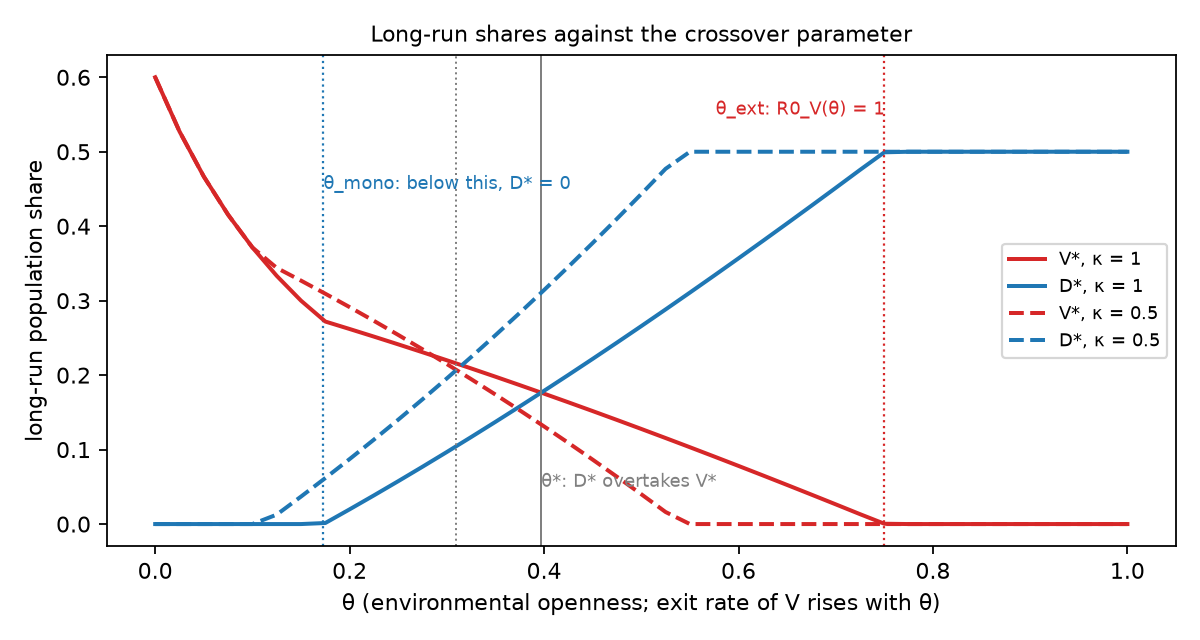
Proposition 3 (the crossover is three landmarks, not one). Let the viral system’s exit rate rise with openness, γ_V(θ). Three values of θ are then derived rather than assigned: θ_mono, below which Proposition 2’s condition fails, D cannot invade, and the population is a monoculture of V; θ*, the crossover, above which D’s long-run share exceeds V’s; and θ_ext, beyond which the exclusive system can no longer persist against the incumbent: the point at which Proposition 1’s invasion condition fails, which at κ = 1 coincides with R₀_V(θ) = 1 and at κ < 1 lies below it, because the condition R₀_V(θ)·(1/R₀_D + κ·(1 − 1/R₀_D)) = 1 is met at a lower exit rate when part of the incumbent’s population is sheltered. Their order is θ_mono < θ* < θ_ext. All three move toward lower θ as κ falls: a decentralized system that shelters more of its adherents shifts every landmark against the exclusive one, and at the illustrative values θ_ext falls from 0.75 at κ = 1 to 0.54 at κ = 0.5, where the runs extinguish the exclusive system before θ reaches 0.55 (Figure 1). The monoculture is not a separate vulnerability; it is the lowest-openness regime of the same model.
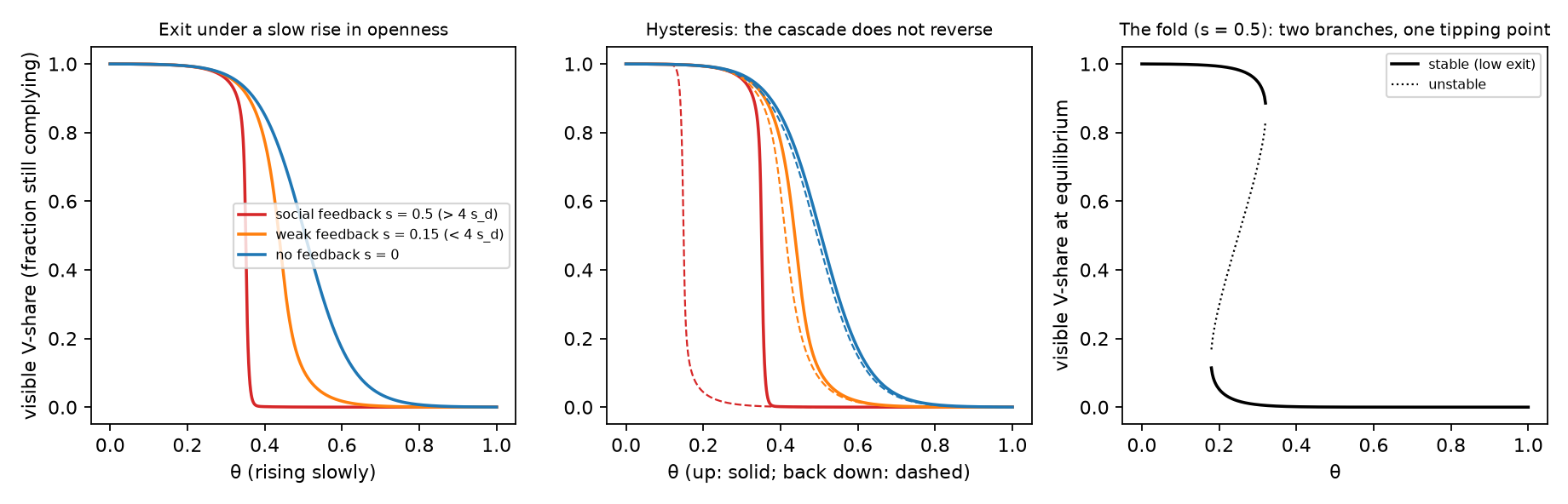
Proposition 4 (exit under social feedback folds). Replace the exit rate inside V with a population of private thresholds and a cost of exit that falls as others visibly leave. Self-consistency requires the exited fraction x to satisfy x = G(x) with G(x) = 1 − F(c₀(θ) − s·x), where F is the threshold distribution, c₀ the exit cost set by the environment, and s the social component. G has multiple fixed points, a fold, if and only if max G′ > 1; for a logistic threshold distribution of scale s_d this is s > 4·s_d. The condition is generic in its form, social feedback exceeding the dispersion of private thresholds, and logistic-specific in its constant. Above the fold, a slow rise in openness produces no gradual decline but a discontinuous cascade, with hysteresis: the compliant branch is not recovered when openness is partly withdrawn. And the fold has two edges. The same map, read on the return branch, gives a second cascade in the other direction, a sudden re-compliance or intensification when openness falls. Section 4.3 confronts both with the record. The fold has the shape of what epidemic models with asymmetric groups call a backward bifurcation (Brauer, 2017), but it lives in a threshold map of exit decisions rather than at R₀ = 1, and the name is not borrowed.
Proposition 5 (persistence under suppression is demographic, not epidemic). Set the viral system’s horizontal channel to zero, as a suppressing state does, and let detected adherents go hidden or apostatize. The hidden compartment then transmits only vertically, at the net demographic rate b − a. With β_V = 0, R₀_V is irrelevant: the hidden tradition persists if b > a and decays at a − b otherwise, on a timescale of decades to centuries rather than years. The open church, meanwhile, is gone within two generations in every run. That is the true kernel of the common claim that suppression eliminated the tradition: it is true of the visible compartment only.
Proposition 6 (re-emergence as itself needs a carrier). Let fidelity decay during dormancy without institutional error-correction, and let the ban lift. If an external carrier of the tradition exists and is reachable, hidden adherents re-dock into it with a probability that depends on the fidelity that survives, and the re-docking share falls with the duration of dormancy. Re-docking here is a membership event, not a doctrinal one. If no carrier exists, there is nothing to re-dock into: the hidden population declares itself as a distinct remnant and attrits. Camouflage becomes absorption on a delay. In the supplement’s runs, fidelity also decays at two speeds, fast for content that can only be copied and slow for content that can be reconstructed from its meaning, and a disguise adopted during dormancy absorbs a share of the hidden population into the host religion before the ban lifts. Two features of the record lie outside this proposition and are stated as limits in §9.3: re-docking was in every documented case a decision that tracked local authority, not a rate; and the lifting of suppression was in every documented case exogenous.
2.5 The Computational Supplement
The supplement holds seeded code, outputs, and six figures; three of the figures appear in this paper. Its checkpoints compare analytic and simulated quantities: the invasion rates of Proposition 1 at κ = 1, 0.5, and 0 (analytic 0.400, 0.275, 0.150; simulated 0.3994, 0.2746, 0.1497); Proposition 2’s ceiling at the illustrative values (0.273; D invades at V* = 0.15 and fails at 0.45); the landmarks of Proposition 3 at κ = 1 (θ_mono 0.173 analytic, 0.175 first simulated grid point with a non-zero D; θ* 0.397; θ_ext 0.75), and at κ = 0.5 the analytic θ_ext of 0.54 against runs in which the exclusive system’s share is zero from θ ≈ 0.55; the fold of Proposition 4 at s_d = 0.06 (fold if s > 0.24; s = 0.5 folds over θ ∈ [0.179, 0.321], with the dynamic jump at 0.351 reflecting finite adjustment speed; s = 0.15 and s = 0 do not fold); and the half-life of Proposition 5’s hidden compartment in its declining regime (77 years). Every value is illustrative. The parameters were chosen for legibility, not fitted to any case, and the supplement’s own statement of what it does is the one adopted here: it exhibits conditional structure, what follows if the architectures are as described, and it measures nothing.
One caveat is structural rather than parametric. The model is well mixed. Adopting an exclusive, identity-restructuring religion is not the kind of thing one catches from a single contact; it is a complex contagion in the sense of Centola and Macy (2007), requiring reinforcement from several sources, and complex contagions are impeded by the long ties that speed simple ones and depend instead on wide bridges. An online experiment found that behavior spread farther and faster on clustered networks than on random ones (Centola, 2010). The viral system’s transmission is therefore threshold- and structure-dependent in a way the well-mixed model cannot express, and the competing-contagion results on networks (Karrer & Newman, 2011; Prakash, Beutel, Rosenfeld, & Faloutsos, 2012; Wei et al., 2013) modify the propositions above rather than leaving them intact. The propositions are the baseline the network results modify. The remaining caveats travel with the numbers they qualify: κ is one number standing for a graded reality; θ is ordinal; the fold’s constant is the logistic’s; the hidden compartment has no horizontal channel; and nothing in the model bears on the truth of any tradition’s claims or licenses an inference about design in either direction.
3. The Asymmetry in the Record
3.1 The Exclusivity Demand Is Datable
The asymmetry of §2.3 rests on the exclusive system’s refusal of a second commitment. It would be easy to treat that refusal as a constant of the viral architecture. It is not; it is a historical innovation with a location in time, and the scholarship that dates it disagrees only about the date.
Nock’s book, which made the adhesion–conversion distinction canonical, places the demand in one class of religion and not in religion as such: exclusiveness “is confined to the prophetic type” (Nock, 1933, p. 6), and the prophetic type has a characteristic sequence, a prophet, a circle of disciples, and then an institution (p. 4). Assmann locates the demand’s origin earlier and names its mechanism. The “Mosaic distinction” between true and false religion, in his account, “was therefore a radically new distinction which considerably changed the world in which it was drawn,” because it ended the practice by which the ancient world had translated one people’s gods into another’s: “False gods cannot be translated” (Assmann, 1997, pp. 1–3). Smith’s reply was written in large part to contradict Assmann’s claims about when and where translatability ended (Smith, 2008); the two disagree about the date and the geography and agree that the demand for exclusive truth in religion arrived at some point and was not there before. North (1992) adds the condition that had to be met first in the Roman world: religion had to become something a person could choose, a development he traces in the religious history of Rome. And the practice the demand ended is visible in the act. Tacitus, describing the twin gods of a Germanic people, identifies them with Castor and Pollux by what he calls a Roman interpretation (Germania 43), the routine by which the ancient world made one pantheon commensurable with another, and the routine the prophetic religions refused.
The exclusivity demand, then, is what a viral configuration acquires when an institution adopts it, and §5 shows it being acquired and shed.
3.2 It Was Enforced
When the demand became law in the Roman Empire, it did so as a series of statutes with a fine schedule, and the statutes are worth quoting because they show enforcement as a parameter separate from the architecture, which is how §2.2 modeled it.
The constitution of 24 February 391, issued at Milan and addressed to Albinus, opens with prohibitions: “nemo se hostiis polluat, nemo insontem victimam caedat, nemo delubra adeat” (Codex Theodosianus 16.10.10), no sacrifice, no victim, no temple. A magistrate who entered a temple to worship was to pay fifteen pounds of gold, “quindecim pondo auri,” and his staff the same. A second constitution, issued at Aquileia on 16 June 391, repeated the prohibition for Egypt (16.10.11). The extension to private and domestic cult came a year later, from Constantinople, on 8 November 392 (16.10.12): no one of any rank was to venerate images with incense, hang garlands, or light lamps to the household gods; whoever sacrificed and consulted entrails was to be treated as guilty of treason, “ad exemplum maiestatis reus” (16.10.12.1); whoever venerated an image was to forfeit the house or estate in which the act took place, “ea domo seu possessione multabitur” (16.10.12.2); sacrifice in public temples or on another’s land cost twenty-five pounds of gold, “viginti quinque libras auri” (16.10.12.3). The last section is the instrument that makes the rest work. Local judges, defenders, and councillors were to report and punish what they discovered, and those who concealed an offense out of favor or overlooked it through carelessness were themselves liable, the judges to a fine of thirty pounds of gold, “triginta librarum auri” (16.10.12.4). The state’s answer to the question of how exclusivity was enforced was to make non-enforcement expensive for the enforcers (Latin per the Mommsen text; the English renderings are the authors’ own, checked against Pharr, 1952, for the opening of 16.10.10).
The laws were not self-executing. Harries (1999) makes the efficacy of late Roman law its central question, and the persistence of pagan practice for centuries after 392 is a matter of record that this series’ historical case study presents in full (Paper 2.1, §2.3; MacMullen, 1997). Two things follow for the model. Enforcement is a cost the incumbent imposes on the rival, and it varies independently of the incumbent’s transmission architecture; and the escalation of 391–392 was not a single act but a sequence, from public sacrifice to private lamp-lighting, each step widening what a subject was forbidden to add to an existing commitment. The asymmetry of §2.3 was, at the decisive moment, a statute.
3.3 The Corpus’s Own Instance
The project’s source corpus states the asymmetry as an episode, thirty years before this paper. In the Judgement, Panakal describes the Hindu polity’s reception of Christianity as “a natural tendency that we find in them to tolerate even to the point of self-abnegation the semitic quantity that entered there,” and then the turn:
Western christianity entered India only on account of a bountiful sufferance on the part of the Hindu kings. But as soon as it got seemingly entrenched through a respite acquiesced in by the same dynasty, we find the most typical cleric of the time expressly striving to subvert that very Hindu king… (J, ch. IV, pp. 66–67, note markers elided)
The episode is Cochin in 1599, the year of the Synod of Diamper, and the cleric is the archbishop who convened it; the history is told at §5.3 from the scholarship. Panakal cites K. P. Padmanabha Menon’s History of Cochin for the episode; that work, in Malayalam and said to run to two volumes (1912 and 1914), was not obtainable, and the episode is not in the same author’s English History of Kerala. What the corpus supplies is therefore not the history but the structure, stated as a structure: one party’s inclusivism admits the other, and the other’s exclusivity then moves against the party that admitted it. It is one case, told in a book whose thesis it serves, and it is cited here as what the corpus argues.
The corpus also states the transmission incentive in the terms §2.2 needs. Of the conversion mandate, Panakal writes that “the christian service is permeated by the desire to pervert individuals and races in the direction of Lucifer, and motivated in the intermediary individual by a more acute desire to excel in his portion of the anticipated paradise” (J, ch. III, p. 31, note marker elided). The second clause is the one this paper wants: the transmitting agent’s own expected share of the reward is the motive that drives the horizontal channel. The memetics literature reached the same point from the other side; Balkin names religious proselytization as the case in which people propagate their most treasured beliefs to total strangers rather than to kin, and takes it as evidence that cultural transmission is not on a genetic leash (Balkin, 1998, ch. 3, n. 69). And the exclusivity clause itself, the scriptural criterion that closes the viral system’s adherents to any rival, is quoted by the corpus and named: “He that believeth and is baptised shall be saved; but he that believeth not shall be damned.” (Mark 16:16), of which Panakal writes that “the criterion of eligibility is nucleated to swallowing the garrulously protested affected identity” (J, ch. VI, p. 96, note marker elided). Belief in the exclusive claim is the price of admission; the asymmetry is written into the entry condition.
3.4 What the Asymmetry Predicts Beyond Dominance
Three consequences of the asymmetry go beyond the question of who wins.
First, inclusivism is itself an exclusion operator, and it has a history. The decentralized column of §1.1 is not the absence of a truth claim. The unity of the Hindu traditions, in Nicholson’s account, was intellectual work done by named thinkers between the fourteenth and seventeenth centuries, who re-envisioned the rival schools and cults, in the words of the publisher’s summary of Nicholson (2010), “as separate rivers leading to the ocean of Brahman,” and portrayed Vedānta as the unifier of diverse belief systems; the reply to the constructionist thesis that a unified Hinduism was a nineteenth-century colonial invention has its locus in Lorenzen (1999), who names the camp he answers. All rivers lead to the ocean is a higher-order truth claim that subsumes rivals rather than denying them. In the model it is not low β with no exclusivity; it is a different exclusion operator, one that says your gods are aspects of ours where the prophetic operator says your gods are false. That the unifying work was done partly in the presence of an exclusive rival is the first hint of what §4.3 shows in the Punjab: the decentralized configuration responds to the viral one.
Second, the growth mechanism that a viral system’s early history displays is a network mechanism, and it should be cited comparatively rather than circularly. Stark’s model of early Christian growth through existing social ties is the series’ citation for it (Paper 2.1; Stark, 1996), and Collar’s comparative, epigraphic study of religious networks in the Roman Empire treats the same mechanism across several movements (Collar, 2013). The present paper adds no measured quantity to that literature; where it speaks of network effects it means the mechanism those authors describe.
Third, the superinfection class has known results that become predictions here. In the scalar version of the structure, in which the order is by demandingness rather than by type, so that a more demanding system can take over a less demanding one’s adherents and not the reverse, Nowak and May (1994) find selection past the point that maximizes a strain’s own R₀, toward higher virulence, and a polymorphic population of strains rather than one winner. Transposed, that is a mechanism for doctrinal hardening, for schismatic one-upmanship, and for the strictness spiral that the exit-cost literature documents from another side (Paper 1.4); and it predicts that exclusive systems coexist as a spectrum of demand rather than converging on a single variant. An unrelated literature predicts the same escalation from the same interdependence of individual choices: Kuran (1998) analyzes the process by which ethnic norms become more demanding as a reputational cascade in which people protecting their standing induce one another to comply with stricter codes. Neither result was derived for religion, and the disanalogy is stated: this paper’s asymmetry is categorical, between two types, while the superinfection result is scalar, along one axis of demand. The predictions are listed in §8 as transpositions to be tested.
4. The Crossover
4.1 Three Derived Landmarks
Proposition 3 replaces a threshold with three, and Figure 1 shows them. Below θ_mono the exclusive system holds the population alone: the inclusivist rival cannot invade, because the viral system’s prevalence sits above the ceiling of Proposition 2. Between θ_mono and θ* the two coexist with the viral system dominant. Between θ* and θ_ext they coexist with the decentralized system dominant, the viral system’s share now sustained by recruitment from the inclusivist pool and drained by its rising exit rate. Above θ_ext the viral system can no longer persist against the incumbent and goes extinct; at κ = 1 that is where its reproduction number falls below one, and at κ < 1 it comes earlier. Four regimes, three boundaries, one rising exit rate; nothing else was added to the model of §2.3 to obtain them.
What the derivation claims is the existence and the order of the landmarks, not their values. And the whole family moves with κ. At κ = 0.5, an inclusivist system that shelters half its adherents, the crossover falls from 0.397 to 0.310 and the extinction boundary from 0.75 to 0.54 (illustrative values). That is the model’s first statement about defense: an inclusivist system cannot raise its own reproduction number against an exclusive rival, but it can close its adherents. The historical instruments for closing them are endogamy, caste rank, and sectarian boundary, and §5.3 shows one community that used all three.
4.2 The Environmental Variable: Institutional Density and Concealment
The variable θ is defined as openness and is easy to hear as information access. The historical instances suggest a different first reading: the density of the incumbent’s institutions.
Eaton’s study of the Bengal frontier tests the standard explanations of South Asian Islamization against the geography of where Muslims actually lived when the first reliable census was taken in 1872, and finds the geography refutes them. The highest concentrations lay in eastern Bengal, western Punjab, the Northwest Frontier, and Baluchistan, far from the centers of Muslim power and among populations that had not, at the time of their contact with Islam, been integrated into either the Hindu or the Buddhist social system. His conclusion is a sentence: “the less the prior exposure to Brahmanic civilization, the greater the incidence of subsequent Islamization” (Eaton, 1993). Conversion did not track the presence of the newcomer’s power; it tracked the absence of the incumbent’s institutions. In the model’s terms, θ was high where the incumbent’s institutional density was low, and the viral system’s competitive position was set by the environment rather than by its own parameters. Two further records in this series show the same variable from other sides: the contrast between Anatolia, where the Byzantine church’s institutional collapse preceded Islamization, and the Balkans, where it did not (Paper 2.1; Vryonis, 1971), and Manichaeism’s single institutional implementation, whose loss left nothing to persist through (Paper 2.1, §7.2).
Eaton also supplies the causal order, and it runs opposite to the intuition that exclusivity drives conquest. Islamization in Bengal proceeded, in his account, through three stages (inclusion of Islamic agencies in the local cosmology, identification with them, and finally displacement of the older agencies), and the demand for exclusive commitment belongs to the last stage, which is visible in the nineteenth and early twentieth centuries and attributed to reform movements, the Fara’izi and the Tariqah-i Muhammadiyah (Eaton, 1993). Six centuries of inclusivist accretion preceded the exclusivity demand. The viral configuration was not what arrived; it was what the tradition later became.
The enforcement regime on the Islamic side ran with the opposite sign to Rome’s. Eaton’s survey of the epigraphic and literary record identifies “eighty instances of temple desecration whose historicity appears reasonably certain” over 1192–1729, nearly all conducted by states at a moving military frontier, with temples inside Indo-Muslim domains left protected, against a polemical figure of 60,000 (Eaton, 2000); the account is contested (Roy, 2023), and the paper takes no side beyond the evidence. Rome legislated against the incumbent across its territory; the Indo-Muslim states struck selectively at the frontier and protected inside it. Enforcement varies independently of architecture in both directions, which is why §2.2 keeps it as a parameter of its own.
The corpus adds a second host-side variable that the two-column contrast lacks. In the Preview, Panakal distinguishes predators a society can perceive from predators it cannot. Of the invaders who came openly he writes that, being tribal, “they are transparent in their intentions and actions,” which “makes them at any rate a perceivable enemy” (PRE, p. 5); the referent is the Turkic and Timurid invasions of the preceding pages, the openly violent entrant, and the same paper twice exempts the peaceable settlers, the Jews who “never betrayed the generosity received by them” (PRE, p. 4) and the ethnic Syrians who, “[l]ike the Jews, … never betrayed the generosity of their Hindu hosts” (PRE, p. 11). The contrast case is the entrant that does not present as an entrant. In the same text’s appendix, a grant appeal, the movement’s object is named “christianity, which is the epidemial organised religion” (PRE, p. 19), and five pages later “Christianity is the germinal organised religion” (PRE, p. 24); the adjective is the witness’s own, unmarked, and it is an adjective, not a theory. It lands, as it happens, on one pole of the endemic–epidemic distinction that Sperber drew in 1985 and Balkin carried in 1998 (§1.2), and it is the corpus that places Christianity there, not they. What this paper takes from the passage is the axis: a host population’s capacity to detect an entrant is a parameter of the environment, and transparent predation is survivable in a way concealed predation is not. That axis belongs inside θ. It is a contribution of the corpus, not an anticipation of epidemiology, and the two-axis reading of the Preview is this project’s reconstruction rather than Panakal’s own scheme.
Digital environments raise θ and amplify β at once, and the model’s answer to that pairing is that the outcome depends on parameters. Section 6.4 makes the pairing precise.
4.3 The Captive Cascade
Proposition 4 says that where the cost of leaving has a social component, exit does not decline gradually as the cost falls; it folds. The mechanism is Kuran’s (1989, 1991, 1995a). Under preference falsification, individuals publicly comply with a regime they privately reject, so that “public opposition was poised to grow explosively if ever enough people lost their fear of exposing their private preferences” (Kuran, 1991), and the trigger can be “a slight surge in the opposition’s apparent size, caused by events insignificant in and of themselves” (Kuran, 1989). Granovetter (1978) supplies the threshold form. Kuran developed the theory for political regimes and never applied it to religion; the transposition is this paper’s, and it is the natural one, since a viral system with high exit costs and a large compartment of privately dissatisfied adherents is a population under preference falsification.
Two things in the derivation are worth stating because the record can bear on them. The first is the kill condition. If exit costs fall gradually and decline is gradual everywhere, the social feedback term is doing nothing, and Proposition 4 is false of the world. The second is inherited from Kuran (1995b): a model that could predict when and where the cascade occurs would refute the unpredictability claim, and the supplement exhibits why it cannot. Three populations matched to the same visible share at the same openness, differing only in the dispersion of their private thresholds, tip at θ = 0.205, 0.223, and 0.266. The tipping point depends on a quantity the visible share does not reveal. Two systems that look identical from outside are at different distances from their cascade (Figure 2).
The same result explains why this paper grades none of its cases. Kuran’s abstract states that a revolution of this kind, “Unlikely though the revolution may have appeared in foresight, it will in hindsight appear inevitable because its occurrence exposes a panoply of previously hidden conflicts” (Kuran, 1989). If the mechanism is right, the fit between a historical narrative and the model after the fact carries no confirmatory weight, because the mechanism itself produces that fit. The cases below are therefore confronted with the derived structure and never scored against it.
The captive state is measured. Hout and Fischer found that the share of Americans reporting no religious preference rose from 7 percent in 1987 to 20 percent in 2012, that the increase was concentrated among political moderates and liberals, and that much of it consisted of people whose private beliefs had not changed while their public label had: “unchurched believers” (Hout & Fischer, 2002, 2014). That is preference falsification observed from the other side, the label flipping while the belief stays. Ireland supplies the decomposition the model needs. McAndrew, analyzing the European Values Study waves from 1981 to 2008 in a symposium commentary, finds that religious practice and confidence in the church collapsed as a period effect concentrated in the 1990s, following a legitimacy shock she dates to 7 May 1992, on top of a cohort decline in belief, while endorsement of religious rites of passage stayed flat above 85 percent (McAndrew, 2025). The discontinuity is indicator-specific: practice and institutional confidence, which are public and costly, cascaded; private belief drifted; low-cost ritual did not move. That is the pattern Proposition 4 predicts and a gradual model does not. The null the claim must beat is cohort replacement, which Voas and Chaves (2016) show accounts for most of American religious decline; the cascade claim is a claim about the residual, and about the indicators on which the residual appears.
The return branch is measured too, and it has a date. The second cascade of Proposition 4 runs toward intensification, and there is a documented instance in which a decentralized system acquired viral machinery in response to a number. Jones’s account of the Arya Samaj in the Punjab supplies it. “Traditionally, Hinduism lacked a conversion ritual,” he writes; after the introduction of a decennial census in 1871, religious leaders began to attend to numerical strength, and the census reports pictured the Hindu community as one in decline, its share falling relative to others. The 1891 return, reporting a 410 percent decadal increase in Christian converts, was read as a threat. In November 1895 the Samaj hired six full-time missionaries, organized the province into circles (mandalis), published tracts, and “borrowed the institutional forms and techniques of the Christian missionaries”; and it developed a ritual of conversion, shuddhi, which had no prior existence, the first group ceremony taking place on 31 March 1896 (Jones, 1989). Jones classes the movement as acculturative in his own typology, and shuddhi is the Arya Samaj’s instrument in the Punjab, not a property of Hinduism at large. What the episode shows for the model is that β can be endogenous. Before 1871 no instrument reported the population as shares; the census created one; and once a system could see its own share falling, a decentralized configuration acquired, within a generation, the missionaries, the territorial organization, and the conversion ritual that define the viral one. The intensification cascade of Proposition 4 has here a trigger, a date, and a mechanism, and the mechanism is a measurement.
5. Mode-Switching
5.1 Japan
The Tokugawa suppression of Christianity, from the edict of 1614 to the removal of the prohibition boards in 1873, is the fullest documented case of a viral system driven into the decentralized configuration by force, and its record, read in the printed sources, is more interesting than its summary.
The community was large: as many as 150,000 adherents went underground in the seventeenth century (Nosco, 1993, p. 3). What went underground was already organized, though not for the purpose. The lay ministries the understaffed mission had devised, the dōjuku and kanbō and the sodalities, pre-existed the ban and became the underground church’s structure, and the leadership offices of the hidden communities overlapped by design: it was “of utilitarian necessity that areas of responsibility and expertise overlap so that if any member of the leadership were to expire prior to the training of an appropriate successor, as little of the overall tradition as possible would be lost” (Nosco, 1993, p. 10). That is an error-correcting redundancy, and the tradition carried it into dormancy. The state’s enforcement was neither constant nor effective in its stated aim. Nosco’s verdict is that “neither the Christian creed itself nor those who professed it were successfully ‘exterminated’ despite two-and-a-half centuries of systematic persecution” (Nosco, 1993, p. 25); persecution lapsed for nearly a century, from 1698 to 1789, and the Office of Inquisition was abolished in 1792; the state settled, in practice, for nominal compliance, on the operating theory that belief was out of its reach. The hidden communities “only replenished their numbers through reproduction, and possessed no visible recruitment strategies” (Nosco, 2007, p. 94). That is Proposition 5 in one sentence: the horizontal channel was closed, and the tradition’s transmission became its birth rate.
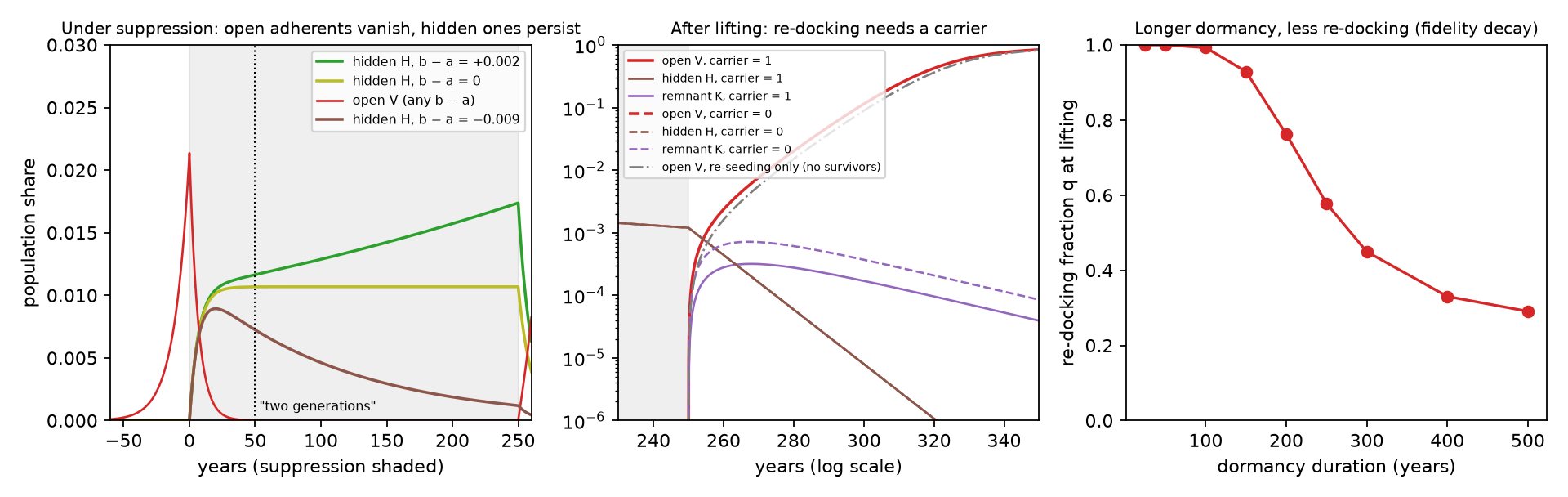
Re-emergence came with a carrier. On 17 March 1865 a group of underground Christians from Urakami presented themselves to the French missionary Petitjean at the Ōura church in Nagasaki, and three of the older women knelt beside him and whispered that the heart of all of them was the same as his (Nosco, 1993, pp. 14–15, quoting Petitjean’s letters of 18 and 21 March 1865 as published by Marnas, 1897, vol. 1, pp. 487 ff.). The state’s last enforcement followed the re-contact rather than preceding it: in June 1868 and January 1870 some 120 and then 3,300 more Urakami Christians were exiled to nineteen domains, and when the order releasing the 1,938 still in exile came on 14 March 1873, “according to British calculation, seventeen percent of the original deportees had died in exile” (Burkman, 1974, p. 205). And re-docking was partial, by a share the two authorities this paper relies on do not agree on. Nosco holds that “not all (and probably not more than one-half) of the underground Christians chose to rejoin the Roman Catholic church” (Nosco, 1993, p. 15); Miyazaki, in a translated article whose date the project could not fix, writes that “most of the underground Christians returned to the orthodox Roman Catholic Church” (Miyazaki, n.d.). The local rates ran from about 45 percent in one community to 77 percent in another and tracked who held authority in each (Filus, 2003, pp. 100–101). The scale of the disclosures themselves is not precisely known; the figures that circulate, an estimated 33,000 still maintaining a separate identity in Kyushu in 1968 (Burkman, 1974, p. 154 n. 22) and a figure of 35,000 that Harrington gives without a source (Harrington, 1980, p. 318), are counts of the continuing community at later dates, not of an emergence event. After October 1939 there was no sizable re-docking at all (Nosco, 2007). The remnant that did not rejoin became a distinct folk tradition, now nearly extinct.
Every feature of Propositions 5 and 6 is here at the resolution the sources allow: the visible church gone in two generations and the tradition not; persistence by demography under a pressure that lapsed for a century; a carrier arriving from outside; a re-docking share near one-half that was decided locally rather than set by a rate; and a remnant absorbed on a delay. None of these numbers was targeted by the model, and which of the supplement’s demographic regimes Japan was in is an empirical question the record bears on and does not settle.
5.2 The Class
Japan is one member of a class, and the class allows the series’ standing prediction about dormancy to be tested. Paper 2.1 (§7.1, prediction 2) predicted that a suppressed tradition re-emerges as itself only where an external carrier persists, and that camouflage becomes absorption where none does. Five further cases, at the resolution their sources have, and none contradicts it.
The conversos of Iberia re-docked by reachability. Where a Jewish community was reachable, in Amsterdam, the Portuguese “Nation” re-Judaized within a generation (Bodian, 1997); where it was not, in the Portuguese interior, a crypto-Jewish community at Belmonte persisted in isolation until its re-contact in the twentieth century. Whether the conversos were in any meaningful sense crypto-Jews at all is disputed in three positions: Netanyahu (1966, 2001) holds, from Hebrew sources, that most were sincere Christians; Gitlitz (1996) compiles a crypto-Jewish practice from the Inquisition records; Salomon (2007) holds those records to be authentic but not necessarily veracious. The paper takes no side, as Paper 2.1 took none on the Cathars; the dispute is about the size of the hidden compartment, not about what happened to it where a carrier was reachable. The Moriscos show a fourth outcome the model did not derive: not re-docking, not absorption, but evacuation to the carrier, the expulsions of 1609–1614 removing the hidden population to Muslim lands (Harvey, 2005). The crypto-Christians of the Ottoman Balkans persisted for centuries with a carrier present and hostile, re-docking under the Tanzimat reforms when the cost of declaration fell (Skendi, 1967); Malcolm (2020) distinguishes crypto-Christianity proper from the coexistence, syncretism, and theological equivalentism around it, forms of religious amphibianism that let it survive; the community’s own Albanian name, laraman, means “motley” (Skendi, 1967). China’s Protestants, driven underground from 1949, re-emerged after 1979 far larger than they had gone in, with current estimates diverging by a factor of three or more depending on who counts and how (Bays, 2003, 2012); the carrier was the world church, expelled in 1949 and re-entering after 1979 through overseas Chinese networks, and whether the underground congregations could themselves have served as carrier is what the case leaves open, since the world church re-entered at the same time. The Soviet case is the inverse decay profile, and the case in which the carrier sat inside the zone: the Orthodox Church was repressed but never abolished, émigré Orthodoxy persisted outside, and belief survived while institutions and ritual were crushed (Froese, 2004, 2008). Two cross-tradition controls show the class is not Christian: Chilson’s covert Shin Buddhists in Japan (Chilson, 2014, 2022) and Frankfurter’s crypto-pagans in the Christian empire of the fourth to sixth centuries (Frankfurter, 2022). Zagorin (1990) and the Urban and Johnson handbook (2022) frame the class, and Islam’s taqiyya is its doctrinally licensed variant (Kohlberg, 1975; Sedgwick, 2022).
Four refinements to Paper 2.1’s prediction follow from the class, offered to that paper as its own. The existence of a carrier is not sufficient; it must be reachable, and reachability does the predictive work. Availability is not willingness; the Balkan carrier was hostile. The carrier need be outside the reach of the suppression, not outside the zone; the Soviet Union’s was inside it, a repressed but legally existing church. And the prediction has a scope condition: the suppressor must stop short of removal, since evacuation is a fourth outcome. What would kill the prediction is a documented reconstitution of a suppressed tradition, as itself, from internal resources alone. None was found. The persistence paper’s Confucian case adds two refinements to the class (Paper 3.1, §6.1): an external carrier can be re-imported deliberately, as a strategy, from either end; and the former suppressor can become a carrier, one of several, with incompatible accounts of what they carry.
5.3 Kerala, and Architecture as a Maintained State
The case no sibling owns runs the transition the other way, and then back. The St Thomas Christians of Kerala, a living community with live internal disputes about its own history, are described here structurally and not scored.
For roughly fifteen centuries before the Portuguese, a Christian community lived inside a Hindu society in what the model calls the decentralized configuration. Three levels of evidence show the mechanism. Royal grants conferred the seventy-two privileges, a marker of high caste rank; the community was organized like a jati, by occupation and with membership by birth; and endogamy was enforced at sub-community boundaries, so that Christians of different manigramam could not marry each other (Durant, 2013), a boundary still live in a 2025 study of one of the community’s endogamous lines (Rose, 2025). The consequence is Durant’s sentence: “being a Christian primarily meant belonging to a well defined social group and designating membership to a religion was purely secondary” (Durant, 2013). The community did not recruit; its churches looked to the arriving Portuguese like temples (Menon, 2023). Direct attestation of non-proselytism before 1599 is not in the record, and the pre-Portuguese case rests on the convergent structural evidence just cited; it is stated as the inference it is. In the model, the configuration is κ near zero and high child retention: an inclusivist host, and a community that closed its own adherents by endogamy and rank.
Then the viral configuration was re-installed, in a week. The Synod of Diamper, convened in 1599 by Menezes, the Portuguese archbishop of Goa, imposed a profession of faith in extended Tridentine form that required the community to “repudiate all Nestorian error and in particular all allegiance to the patriarch of Babylon,” anathematizing their own patriarch “as being a Nestorian heretic and schismatic”; decreed “that certain books should be burned and others purged of errors and corrected”; imposed clerical celibacy; and forbade “on pain of excommunication” any assembly to discuss the synod’s own proceedings, “a prohibition which it proved impossible to enforce” (Neill, 1984). Neill records the community’s own question: “They had always been Christians; why should they now make professions of the faith as though previously they had not had it?” The purge’s effect on the Syriac literary record is treated by Mustaţă (2022), and whether the synod was canonically valid at all is disputed (Pallath, 2001). The split came on 3 January 1653, when “priests and people assembled in the church of Our Lady at Mattancéri, and standing in front of a crucifix and lighted candles swore upon the holy Gospel that they would no longer obey Garcia, and that they would have nothing further to do with the Jesuits” (Neill, 1984, p. 319), the oath of the Koonen Cross. The oath was against the apparatus, not the doctrine: Neill’s own sentence is that the community did not at any point suggest separating from the pope. The corpus’s dating of the rupture is the same year, in its own register: “In 1599 it gained formal foothold in the territory by alienating the original adherents, the so-called Syrian christians—as distinct from the ethnic Syrians—from their Hindu roots” (PRE, p. 12), which is cited as what the project’s source layer held, the history being the scholars’ above.
Kerala closes a set. Four documented transitions now run between the configurations: suppression drove Japan’s viral tradition into the decentralized state; isolation in an inclusivist host left Kerala’s there for fifteen centuries; a synod installed the viral state over a community that had not run it, in days, with the power to enforce; and a census provoked a decentralized tradition in the Punjab into acquiring viral machinery. In each, an institution did the switching, and in the two lapses none did. The viral configuration is a set of behaviors an institution maintains: exclusivity demanded, conversion mandated, canon policed, exit priced. It lapses under suppression and under isolation alike, because both remove the maintaining institution, and it is re-installed by an external carrier with the power to enforce. What would count against this reading is a viral configuration persisting for generations with no maintaining institution, or failing to lapse under isolation.
5.4 Fidelity under Dormancy
Proposition 6 made fidelity decay at two speeds, and the Japanese record is where the two speeds are visible. Nosco’s comparison of the hidden communities’ prayers finds the translated Lord’s Prayer preserved and the untranslated Ave Maria collapsed into phonetic nonsense over the same centuries (Nosco, 1993, pp. 19–20); that “some underground Christians in the mid-nineteenth century had impressive knowledge of a broad range of doctrine, church calendar, liturgy, and prayer is inarguable; that in certain circles the creed had been indigenized to the point of being no longer Christian is similarly beyond reasonable dispute” (Nosco, 1993, p. 21). And the disguise itself changed state. Kataoka, in Nosco’s summary, argued that the adoption of Buddhism as a cover became itself problematic, “and that with the passage of time the disguise became a ritualized reality that lost its original import and meaning” (Kataoka, 1974, p. 85, as reported in Nosco, 1993).
Three things follow. Fidelity under dormancy is a gradient, not a scalar, and the gradient runs along semantic reconstructibility: what could be reconstructed from its meaning survived, and what could only be copied decayed. The supplement’s two-speed run is that gradient. Second, Japan and the Soviet Union are opposite decay profiles, ritual surface persisting while doctrine drifted in the one, doctrine persisting while institutions and ritual were crushed in the other, and what the two share is that decay tracked generations without a competent transmitter rather than the intensity of suppression. Third, camouflage is not inert: a disguise adopted during dormancy absorbs, and the supplement’s absorption runs show it competing with the carrier before the carrier arrives. The fidelity question is handed forward to Paper 3.1 in this sharpened form: under dormancy, surface persists while deep structure decays, and the decay is graded by how much of the content can be reconstructed from what it means. Whether the remnant’s tradition should be read against European Christianity or against Japanese folk religion is a live frame dispute in the literature (Turnbull, 1998; Higashibaba, 2001; Whelan, 1996; Miyazaki, 2001, as reported in Delakorda Kawashima, 2017), and this paper’s use of the case does not depend on it.
5.5 The Deferral Device
One vulnerability is commonly attributed to exclusive systems and not to inclusivist ones: an exclusive claim can be disconfirmed, and a system that stakes itself on a terminal event is exposed when the event fails to occur. The tradition’s own texts, read by the corpus, show that this vulnerability was answered from inside, and that the answer is a propagation instruction. This is the one place in the paper where the corpus corrects rather than corroborates.
Panakal states the device as an analogy. The Christian paradise, he writes, is a cheque drawn for all the wealth in the world; and
The analogy can be made a little more complete by adding that the drawer puts a nebulous date on the cheque, which keeps advancing day by needed day. He explains that the amount is so huge that the company’s owner himself will arrive one day and put the real date. “But as to that moment, none but the owner knows, not even his closest colleagues nor myself his only son.” (J, ch. V, pp. 79–80)
The quoted sentence is his rendering of Matthew 24:36, which his note 21 supplies, and it is what makes the deferral scriptural rather than his invention. The host cost follows in the same passage: “From that date onwards, professed christianity has been waiting in tremulous expectation of the arrival.” A date that is unknowable cannot be missed, and the waiting is itself a state of commitment.
Leo states the second form, a terminal condition redefined as a coverage condition. Of the promise that the end would come before the disciples had gone through the towns of Israel, he writes: “Just a few pages down, he extends the time limit indefinitely by widening the designated territory to the whole world. … It is clear from the second declaration that his purpose is the ample preaching of his rebellious gospel throughout the world by the men whom he had enrolled” (Leo, 2000, p. 20), and of why the first deadline had to be short: “If he had said this in the beginning to those miserable men, they would have left him then and there. For, it would have been immediately seen by them as an impossible task.” The deadline becomes a coverage condition; the end arrives when the preaching has reached everyone; and the deferral is therefore an instruction to transmit. Leo reads one further anchor as what kept the system from collapsing with its first generation: “Reemphasis of Jesus’ remark is purposeful at John 21:23. But for such a remark, christianity would have collapsed with the death of John following on that of James. With the requoted remark in place, it outlasted its certain collapse upon the death of John” (Leo, 2000, p. 23).
What the two passages describe is a disconfirmation-survival mechanism built into the system’s own texts: an unknowable date, and a terminal condition rewritten as a transmission target. The sociology of millennialism describes the same two devices from outside, and neither side vouches for the other. The founding study of failed prophecy proposed that disconfirmation is answered by intensified proselytizing (Festinger, Riecken, & Schachter, 1956), a thesis that a named attempt failed to replicate (Hardyck & Braden, 1962) and that the field’s later work, surveyed in Dawson (1999), has largely set aside; the response most often observed is adaptation of the prediction itself. Zygmunt’s first mode of adaptation, as Melton reports it, is that groups “may designate a new date for the projected event or establish a new, but less definite, time frame, and then return to the mode of expectancy they enjoyed before the crisis event” (Zygmunt, 1972, as reported in Melton, 1985, pp. 20–21), which is Panakal’s receding date in one clause. Melton’s own synthesis is that the durable reconceptualization is a spiritualization in which believers “create an ‘invisible,’ ‘spiritual’ and, more importantly, unfalsifiable event” (Melton, 1985, p. 23), which is Leo’s coverage condition in the literature’s terms; and Melton names the tradition under study as a case: “Unfulfilled millennial expectations failed to invalidate Apostolic Christianity, which gradually reinterpreted the apocalyptic elements of its emerging theology” (p. 19). One comparative case in the same study prices the two forms of deferral against each other. A Southcottite leader who named a new date for a failed prophecy lost his following when that date failed too, and was displaced by one who “effectively argued that Shiloh’s return awaited an indefinite period of testing for God’s people,” whose followers, Melton notes, are presumably still in that period (pp. 24–25). A re-dated deadline is a liability; an undated one is an asset. Dein’s study of the Lubavitch movement after the death of the leader many of its members had expected to reveal himself as the messiah confirms Melton from an independent case: the messianic belief underwent spiritualization in Melton’s sense, and missionizing continued at the same high level as before rather than increasing (Dein, 2001). Where the corpus and the literature differ is on intent: the corpus reads the redefinition as designed, the literature reads it as emergent, and this paper places its hedge there (§9.2). For the model, the consequence is narrow and specific: the exclusive system’s exposure to disconfirmation is not a fixed cost of the architecture but a parameter the architecture can set, and the tradition under study set it early.
6. Digital Environments
6.1 Ranking Amplification
Paper 2.1 (§2.6) handed forward the question of whether engagement-ranked recommendation amplifies religious content, and this paper closes it as far as the audit literature allows. The general result is now measured, and attributable to the algorithm. Milli and colleagues ran a preregistered audit on Twitter in February 2023, comparing, for the same 806 users and the same follow graph, the tweets the engagement-based algorithm served against a reverse-chronological baseline. The algorithm’s tweets expressed more anger (+0.47 standard deviations; +0.75 in political tweets), more partisanship and more out-group animosity (each +0.24 SD), and readers exposed to them felt worse about their political out-group (−0.17 SD) (Milli, Carroll, Wang, Pandey, Zhao, & Dragan, 2025). Because the follow graph was held constant, the effect is the ranking’s, not the users’ choice of whom to follow. The effect is on the composition of what is shown and on momentary affect; the authors caution against reading it as a long-run effect on belief, and the sample was younger, more Democratic, and crowdsourced. Corroboration exists on adjacent questions: Huszár and colleagues found algorithmic amplification of political content on Twitter across seven countries, with an explicit null on the amplification of extremity (Huszár, Ktena, O’Brien, Belli, Schlaikjer, & Hardt, 2022); Rathje, Van Bavel, and van der Linden (2021) found out-group animosity the strongest predictor of engagement; and González-Bailón and colleagues traced the exposure chain on Facebook (González-Bailón et al., 2023). Robertson and colleagues, on Google Search, found that users chose more partisan news than they were shown (Robertson, Green, Ruck, Ognyanova, Wilson, & Lazer, 2023): choice, not curation, in that channel.
Whether religious content is amplified by ranking is untested in the peer-reviewed audit literature. The one exploratory observation, a think-tank study with eight test accounts over one month, found religious videos, almost exclusively Christian, recommended to all eight accounts, none of which had expressed religious interest, at 0.3 to 7.2 percent of unique recommendations (Moeyens & Comerford, 2024). That is not a measurement, and the paper does not report it as one. It is the shape of the prediction in §8: religious content of high moral-emotional and out-group-hostile density should show amplification of the Milli kind, and low-affect devotional content should not, because the ranking selects on affect and not on subject.
6.2 Pathways and the Nulls
The recommender’s measured effect on radicalization is on what a committed user is shown next, and on migration among the already engaged, not on recruitment of the uncommitted. Whittaker and colleagues, with sock-puppet accounts in early 2019, found that an account already engaging with extreme content on YouTube was twice as likely to be shown further extreme content and 1.39 times as likely to be shown fringe content; on Reddit and on Gab they found no such effect (Whittaker, Looney, Reed, & Votta, 2021). Ribeiro and colleagues traced migration among YouTube channel audiences and found reachability along channel recommendations from milder to more extreme communities (Ribeiro, Ottoni, West, Almeida, & Meira, 2020). Chen and colleagues, with browsing data from 2020, found that exposure to alternative and extremist channels was concentrated among users who already held resentful attitudes and arrived by subscription and external link, not by algorithmic delivery to the unsuspecting (Chen, Nyhan, Reifler, Robertson, & Wilson, 2023); Hosseinmardi and colleagues found the same on consumption data (Paper 1.2; Hosseinmardi et al., 2021). Munger and Phillips (2022) read the right-wing YouTube ecosystem as supply meeting demand.
In the model’s terms, these are effects on retention and on composition inside the committed compartment, not on β against the susceptible pool. The nulls on the echo-chamber and feed-algorithm questions, and the narrowed claim about affective density that survives them, are Paper 1.2’s (§6.1, P5; Guess et al., 2023; Nyhan et al., 2023; Hartmann, Wang, Pohlmann, & Berendt, 2025), and this paper builds on them. Moral-emotional language increases diffusion (Brady, Wills, Jost, Tucker, & Van Bavel, 2017) and outrage expression is amplified by social learning in online networks (Brady, McLoughlin, Doan, & Crockett, 2021); Crockett (2017) argues that the digital environment changes the economics of outrage. Those are results about the affect that travels, and §6.1’s ranking result is the mechanism that selects for it.
6.3 Cost Symmetry
It is tempting to read digital environments as lowering the cost of conversion while leaving the cost of exit in place. The evidence runs the other way on the second half. Online ex-Christian communities supply what exit needs: a space in which a departure can be constructed and rehearsed, and a community to land in (Starr, Waldo, & Kauffman, 2019). In Paper 1.2’s account of exit that is what accelerates it. Internet use is associated with disaffiliation and with reduced religious exclusivism (McClure, 2017), the second of which is a direct movement away from the viral configuration; and the association fragments by activity type, so that what a person does online, not that they are online, carries the effect (Laderi & Uecker, 2025). Whether online conversion is cheaper than offline conversion has not been measured, and the paper holds it as a hypothesis with its falsifier in §8. What can be said is that digital environments lower the barrier in both directions. Turnover rises in both directions, and the net effect on prevalence is not determined by the cost structure alone.
6.4 The Indeterminate Regime
The pairing of §4.2 can now be stated in the model’s terms. Digital environments raise θ, because exit is rehearsed, landing communities exist, and a rival is a search away; and they amplify β for content of high affective density, because ranking selects for it. Under Proposition 3 the first moves the population toward the crossover and the second moves the crossover away, and the outcome depends on which dominates, which is a matter of parameters the model does not fix. The viral system’s best response to a rising θ is to raise the affective density of what it transmits, since that is what the substrate amplifies; the decentralized system’s best response is to close its adherents, which the same substrate makes harder. The sign of the net effect is not known. The regime is stated as three predictions in §8: amplification by affect, turnover in both directions, and an indeterminate net prevalence.
7. Artificial Intelligence
7.1 The Levers
Large language models generate persuasive political content, repeatedly and at scale. Hackenburg and Margetts (2024) found messages generated by a language model moved issue support by as much as twelve percentage points; Bai, Voelkel, Muldowney, Eichstaedt, and Willer (2025) found model-generated messages persuasive on policy issues; Goldstein, Chao, Grossman, Stamos, and Tomz (2024) found text generated by GPT-3, a model two generations old at the time of writing, highly persuasive, and with human curation of the prompt or the output, under some conditions, as persuasive as the original propaganda; Salvi, Horta Ribeiro, Gallotti, and West (2025) found a conversational model won a majority of non-tied debates against human opponents; and Hackenburg and colleagues, in three experiments with 76,977 participants, nineteen models, and 707 issues, mapped which levers matter (Hackenburg, Tappin, Hewitt, Saunders, Black, Lin, Fist, Margetts, Rand, & Summerfield, 2025).
Two things that are commonly assumed are not supported by that record as of this writing. The first is the personalization premium, the claim that persuasion tailored to an individual’s inferred profile outperforms the same persuasion untailored. Hackenburg and Margetts found microtargeted messages moved support by 4.83 percentage points against 6.20 for non-microtargeted ones, a difference in the wrong direction and not significant (p = .226). The Science study found post-training and prompting boosted persuasiveness by as much as 51 and 27 percent respectively, with personalization and model scale having smaller effects. And the most cited support for the premium, Salvi and colleagues’ finding that a personalized GPT-4 outperformed both humans and an unpersonalized model, was withdrawn on that point by its authors in a correction published on 3 September 2026: with the correct reference category the comparison yields P = 0.0678, and “we cannot conclusively establish from this comparison alone that personalization confers an additional advantage over non-personalized GPT-4” (Salvi, Horta Ribeiro, Gallotti, & West, 2026). Matz and colleagues report a personalization effect in marketing and appeal paradigms (Matz, Teeny, Vaid, Peters, Harari, & Cerf, 2024), and the question is open; the paper treats the premium as unsupported rather than refuted. The second assumption is that language models out-persuade people. In the meta-analytic record they match them: across seven studies and 17,422 participants, Hölbling, Maier, and Feuerriegel (2025) find no difference between model and human persuaders (Hedges’ g = 0.02, p = .530), with substantial heterogeneity. The two claims are kept apart: models persuade, at human strength, at machine scale.
What the record does support is a statement about the channel. Bai and colleagues find the models’ persuasiveness runs through evidence, logical reasoning, and “a dispassionate voice”; the Science study finds the persuasion gain came from the models’ ability to rapidly access and strategically deploy information; and a preprint follow-up to the conspiracy study reports the same information pathway (Costello, Pennycook, & Rand, 2026, preprint). The measured channel is evidence density, not affect. That inverts §6’s substrate: where ranking selects for affect, the models’ measured lever is information.
7.2 The Cure Direction
The same machinery runs the other way, and the strongest result in the literature is a de-installation. Costello, Pennycook, and Rand (2024), with 2,190 participants, found that dialogues with a language model reduced belief in a conspiracy theory by about twenty percent, that the reduction persisted two months later, and that it generalized to conspiracies the dialogue had not addressed. Every capture mechanism named in this series has, by the charter’s rule, a benign dual in the same literature, and this is the dual of the persuasion results: the channel that installs can remove. Paper 5.1 (§9.1) states the three roles the technology can play, proof, cure, and threat, and this section cites that discipline rather than re-arguing it.
7.3 Dual Use and Attribution
The threat, stated in the model’s vocabulary, is not the per-target tuning that §7.1 found unsupported. It is the optimizer’s objective. A system post-trained for persuasion is a memeplex whose transmission machinery has been directly selected on, with the objective set by whoever runs the post-training; and the Science study’s central trade-off is the finding that matters: “where they increased AI persuasiveness, they also systematically decreased factual accuracy” (Hackenburg et al., 2025). The trade-off has a reading in this paper’s terms, and the reading is offered rather than derived: a transmission machinery optimized on spread rather than on content is the memetic case in which selection for transmissibility and selection for truth come apart, and the Science study measures the divergence in one substrate. The model of §2 contains no such term, and §1.2 has argued that the viral configuration’s institutions keep content in circulation rather than degrade it; what the reading claims is narrower, that optimizing the transmitter on persuasion is a different operation from maintaining a canon, and that it pays in accuracy. Section 8 states it as the ninth prediction, which is where it belongs.
One property of the interlocutor cuts both ways and needs stating once. A challenge from a machine does not engage the social machinery by which identity-fused belief converts disagreement into threat; the challenger is not a defector from the group, has no standing to lose, and triggers none of the responses that Paper 1.3 describes. That property is what makes a non-human interlocutor an effective carrier of a de-installation, and it is the same property that would make it an effective installer. The channel is open to whatever is sent down it. The observation is on record in this project’s author’s own work from 2007 to 2012, before large language models existed, and Paper 5.1 (§9.1) states cure and threat together; the present section’s formulation of the risk, optimization against an inferred profile, follows a February 2025 AI research report, and §7.1 has just reported that the profile part of that formulation lacks support. One clinical description of the interlocutor property’s pathological face has since appeared: writing as a Personal View in The Lancet Psychiatry, Morrin, Nicholls, Levin, and colleagues (2026) report that “emerging evidence indicates that agential AI might validate or amplify delusional or grandiose content, particularly in users already vulnerable to psychosis,” while stating that “it is not clear whether these interactions can result in the emergence of de novo psychosis in the absence of pre-existing vulnerability”; this paper cites the published verbs. The frame in which these questions are usually posed, automated influence operations, rests so far on preprints (Goldstein, Sastry, Musser, DiResta, Gentzel, & Sedova, 2023; Burtell & Woodside, 2023), and the paper cites them as such.
8. Predictions
Each prediction is stated with what would count against it.
-
Invasion is set by openness, not by the rival’s R₀. Inclusivist systems facing an exclusive rival lose adherents at a rate set by their own openness κ and their retention of children, and closing κ (endogamy, caste rank, sectarian boundary) or enforcing is the only defense the model admits. Against it: an incumbent inclusivist system halting an exclusive rival’s initial growth with κ near one and no enforcement.
-
Exclusive systems escalate and diversify. Exclusive systems raise their demands past the level that maximizes their spread, in doctrinal hardening and schismatic one-upmanship, and coexist as a spectrum rather than converging on one winner. Against it: a viral system whose demand level tracks its own R₀-optimum over time, or monotonic convergence to one variant.
-
Decline is discontinuous only where exit has a social cost, and only on some indicators. Religious decline shows a cascade where exit cost has a social component (a legitimacy shock; a visible first wave) and cohort drift where it does not; and the cascade appears on practice and institutional confidence, not on private belief or low-cost ritual. Against it: a sudden collapse of private belief with practice intact, or gradual decline everywhere under a documented legitimacy shock.
-
Measurement induces machinery. A decentralized system shown a falling share by a measurement instrument acquires viral machinery (missionaries, a territorial organization, and a conversion ritual) within a generation; one not shown it does not. Against it: a system with legible falling share that does not respond within a generation despite the means, or acquisition without any measurement.
-
The viral configuration lapses without maintenance. A viral configuration lapses toward the decentralized one wherever no institution maintains it, under suppression or under isolation in an inclusivist host alike, and is re-installed only by an external carrier with enforcement power. Against it: a viral configuration maintained for generations without a maintaining institution, or a re-installation without an external carrier.
-
Re-emergence needs a reachable carrier, and re-docking tracks time and authority. Re-emergence as itself after dormancy requires a reachable, willing carrier; the re-docking share falls with generations elapsed without a competent transmitter and tracks local authority; and the surviving content is graded by semantic reconstructibility. Against it: reconstitution from internal resources alone; a re-docking share rising with dormancy duration; untranslated formulae outliving translated ones.
-
Ranking amplifies religious content by affect, not by subject. Under engagement ranking, religious content of high moral-emotional and out-group-hostile density shows amplification of the Milli kind with the follow graph held constant, and low-affect devotional content does not. Against it: a preregistered audit finding no ranking amplification for high-affect religious content, or equal amplification regardless of affect.
-
Digital environments raise turnover in both directions. Online-initiated affiliation shows shorter median tenure and higher serial affiliation than offline-initiated affiliation, exit is faster where online ex-communities exist, and the net effect on prevalence is ambiguous. Against it: online-initiated affiliation with longer tenure than offline, or no exit acceleration where online ex-communities exist.
-
Persuasion optimization degrades fidelity. Systems post-trained for persuasion show measurably lower factual accuracy than the same systems prompted for accuracy, and the gap grows with optimization pressure. Against it: persuasion gains at constant or rising accuracy.
9. Discussion
9.1 The Series’ Taxonomies
This series classifies the same objects three ways, and the three should not be confused. Paper 1.1 (§6) classifies memeplexes by their effect on host autonomy: parasitic, mutualistic, commensal, a trichotomy whose antecedents in the memetics literature Paper 4.1 records (§4.4: Delius, 1989, 1991; Balkin, 1998, ch. 3, “Memes as Symbionts,” who takes the three terms from symbiosis theory). Paper 1.4 (§§2.3–2.4) classifies belief systems by architectural dimensions, exclusivity and guilt-installation and loop closure on one axis, and their opposites on the other. This paper classifies by propagation strategy: viral and decentralized. The three are orthogonal classifications, and the viral configuration correlates with, but is not identical to, 1.1’s parasitic pole and 1.4’s exclusive–guilt-installing–loop-closing pole. A viral system can be mutualistic with its hosts; an inclusivist one can be parasitic; and a community can close its adherents by birth and endogamy, a high social cost of exit, while running in the decentralized configuration, as Kerala’s did. The paper attempts no consolidation. That is Paper 4.1’s (§4), and it turns on the fact that the propagation classification, unlike the other two, describes a condition a system is in rather than a class it belongs to.
9.2 Intent and Design
Nothing in this paper licenses an inference about design in either direction. Architecture is evidence of neither intention nor its absence. The documented engineering episodes (the Theodosian statutes, the Synod of Diamper, the Arya Samaj’s borrowed missionary apparatus) are institutional engineering of transmission by identifiable actors with identifiable aims, and they show that a transmission architecture can be installed deliberately. They do not show that any architecture was, in general, or that the tradition’s founding structure was. The model derives the same dynamics regardless of intent, and the paper adopts the underdetermination register of its siblings (Paper 2.1, §7.3; Paper 2.2, §6.1; Paper 5.1, §2.2): where the record can bear on the design question, it is treated there, and here it is left open.
9.3 Limitations
The model is well mixed, and §2.5 has said what that costs. The asymmetry κ is one number for a graded reality, and its direction is an assumption cited to the historical record rather than derived. The openness θ is ordinal, and the functional form of the exit rate is a convenience; only the existence and order of the landmarks are claimed. The fold’s constant is the logistic’s. The dormancy model has no horizontal channel, treats fidelity as a scalar in its baseline, treats re-docking as a rate where the record shows a decision, and treats the lifting of suppression as exogenous where the crossover model treats openness as a property of the environment; the two are not reconciled. The historical cases are read at the resolution of their sources, and for four of the six dormancy cases that resolution includes no numbers. The digital record is political rather than religious, and the religious question is a prediction. The AI record is pre-2026 and moving; one of its central results was corrected while this paper was being drafted, and others will be. And the corpus’s episodes are cited as what the corpus states, which is a matter of attribution and disclosure rather than of evidence.
10. Conclusion
A belief system that recruits and a belief system that is inherited compete on unequal terms, and the inequality is not a matter of which spreads faster. It is the asymmetry: the inclusivist system’s adherents are available to the exclusive one and not the reverse. Written as a model, that asymmetry is a superinfection structure, and its consequences follow. The exclusive system invades regardless of the incumbent’s prevalence; the inclusivist system’s recovery is fed by the exclusive system’s exits; the crossover between them is three derived landmarks that move with how much of itself the inclusivist system shelters; exit under social feedback folds into a cascade with two edges; and persistence under suppression is a matter of birth rates and carriers rather than of transmission.
The record, read against that structure, shows the exclusivity demand being invented, legislated, and enforced by fine; a frontier where conversion tracked the absence of the incumbent’s institutions; a census that provoked a decentralized tradition into building missionaries; a suppression that eliminated the visible church and not the tradition; a community that lived in the decentralized configuration for fifteen centuries until a synod re-installed the viral one in a week; and a deferral device, in the tradition’s own texts, that turned its most exposed claim into an instruction to transmit. What these episodes share is that the viral configuration is maintained. It is a state, not a kind, and it lapses when no institution keeps it.
The new substrates carry the old parameters. Engagement ranking selects for affect; language models persuade at human strength and machine scale through information rather than affect, and pay for optimized persuasiveness in accuracy, which this paper reads as the price of optimizing transmission on spread. The paper’s predictions are the places where it can be wrong, and it has tried to put each of them where the record can reach it.
References
External literature (each entry carries a verification record in the project archive — journal articles at fetch level, several at full-text level; one journal Personal View at its published abstract’s verbs; books at book level; primary texts and statutes from named editions with witnesses recorded; entries print only archive-held fields)
- Anderson, R. M., & May, R. M. (1991). Infectious Diseases of Humans: Dynamics and Control. Oxford University Press.
- Assmann, J. (1997). Moses the Egyptian: The Memory of Egypt in Western Monotheism. Harvard University Press.
- Bai, H., Voelkel, J. G., Muldowney, S., Eichstaedt, J. C., & Willer, R. (2025). LLM-generated messages can persuade humans on policy issues. Nature Communications, 16, 6037. DOI 10.1038/s41467-025-61345-5.
- Balkin, J. M. (1998). Cultural Software: A Theory of Ideology. Yale University Press. Cited from the author’s own online edition (jackbalkin.yale.edu, Creative Commons licence), by chapter, section, and note.
- Bays, D. H. (2003). Chinese Protestant Christianity today. The China Quarterly, 174, 488–504. DOI 10.1017/S0009443903000299.
- Bays, D. H. (2012). A New History of Christianity in China. Wiley-Blackwell.
- Beheim, B., Atkinson, Q. D., Bulbulia, J., Gervais, W., Gray, R. D., Henrich, J., Lang, M., Monroe, M. W., Muthukrishna, M., Norenzayan, A., Purzycki, B. G., Shariff, A., Slingerland, E., Spicer, R., & Willard, A. K. (2021). Treatment of missing data determined conclusions regarding moralizing gods. Nature, 595(7866), E29–E34.
- Beutel, A., Prakash, B. A., Rosenfeld, R., & Faloutsos, C. (2012). Interacting viruses in networks: Can both survive? In Proceedings of the 18th ACM SIGKDD International Conference on Knowledge Discovery and Data Mining (pp. 426–434). ACM. DOI 10.1145/2339530.2339601.
- Bettencourt, L. M. A., Cintrón-Arias, A., Kaiser, D. I., & Castillo-Chávez, C. (2006). The power of a good idea: Quantitative modeling of the spread of ideas from epidemiological models. Physica A: Statistical Mechanics and its Applications, 364, 513–536. DOI 10.1016/j.physa.2005.08.083.
- Blackmore, S. (1999). The Meme Machine. Oxford University Press.
- Blackmore, S. (2010, September 16). Why I no longer believe religion is a virus of the mind. The Guardian. https://www.theguardian.com/commentisfree/belief/2010/sep/16/why-no-longer-believe-religion-virus-mind
- Bodian, M. (1997). Hebrews of the Portuguese Nation: Conversos and Community in Early Modern Amsterdam. Indiana University Press.
- Brady, W. J., McLoughlin, K., Doan, T. N., & Crockett, M. J. (2021). How social learning amplifies moral outrage expression in online social networks. Science Advances, 7(33), eabe5641. DOI 10.1126/sciadv.abe5641.
- Brady, W. J., Wills, J. A., Jost, J. T., Tucker, J. A., & Van Bavel, J. J. (2017). Emotion shapes the diffusion of moralized content in social networks. Proceedings of the National Academy of Sciences, 114(28), 7313–7318. DOI 10.1073/pnas.1618923114.
- Brauer, F. (2017). Mathematical epidemiology: Past, present, and future. Infectious Disease Modelling, 2(2), 113–127. DOI 10.1016/j.idm.2017.02.001.
- Burkman, T. W. (1974). The Urakami incidents and the struggle for religious toleration in early Meiji Japan. Japanese Journal of Religious Studies, 1(2–3), 143–216.
- Burtell, M., & Woodside, T. (2023). Artificial influence: An analysis of AI-driven persuasion (arXiv:2303.08721). arXiv. [Preprint.]
- Centola, D. (2010). The spread of behavior in an online social network experiment. Science, 329(5996), 1194–1197. DOI 10.1126/science.1185231.
- Centola, D., & Macy, M. (2007). Complex contagions and the weakness of long ties. American Journal of Sociology, 113(3), 702–734. DOI 10.1086/521848.
- Chen, A. Y., Nyhan, B., Reifler, J., Robertson, R. E., & Wilson, C. (2023). Subscriptions and external links help drive resentful users to alternative and extremist YouTube channels. Science Advances, 9(35), eadd8080. DOI 10.1126/sciadv.add8080.
- Chilson, C. (2014). Secrecy’s Power: Covert Shin Buddhists in Japan and Contradictions of Concealment. University of Hawai’i Press.
- Chilson, C. (2022). Secrecy’s situational ironies: Hiding and its consequences for covert Buddhists in Japan. In H. B. Urban & P. C. Johnson (Eds.), The Routledge Handbook of Religion and Secrecy (pp. 151–162). Routledge.
- Collar, A. (2013). Religious Networks in the Roman Empire: The Spread of New Ideas. Cambridge University Press.
- Costello, T. H., Pennycook, G., & Rand, D. G. (2024). Durably reducing conspiracy beliefs through dialogues with AI. Science, 385(6714), eadq1814. DOI 10.1126/science.adq1814.
- Costello, T. H., Pennycook, G., & Rand, D. G. (2026). Just the facts: How dialogues with AI reduce conspiracy beliefs [Preprint]. PsyArXiv. DOI 10.31234/osf.io/h7n8u_v3.
- Crockett, M. J. (2017). Moral outrage in the digital age. Nature Human Behaviour, 1(11), 769–771. DOI 10.1038/s41562-017-0213-3.
- Daley, D. J., & Kendall, D. G. (1964). Epidemics and rumours. Nature, 204(4963), 1118. DOI 10.1038/2041118a0.
- Dawkins, R. (1976). The Selfish Gene. Oxford University Press.
- Dawkins, R. (1993). Viruses of the mind. In B. Dahlbom (Ed.), Dennett and His Critics: Demystifying Mind (pp. 13–27). Blackwell.
- Dawson, L. L. (1999). When prophecy fails and faith persists: A theoretical overview. Nova Religio, 3(1), 60–82. DOI 10.1525/nr.1999.3.1.60.
- Dein, S. (2001). What really happens when prophecy fails: The case of Lubavitch. Sociology of Religion, 62(3), 383–401. DOI 10.2307/3712356.
- Delakorda Kawashima, T. (2017). Landscape in Hirado revealing the secrets of Hidden Christians’ life-world: National and global policies in cultural heritage protection. Anthropological Notebooks, 23(3), 87–107.
- Diekmann, O., Heesterbeek, J. A. P., & Metz, J. A. J. (1990). On the definition and the computation of the basic reproduction ratio R0 in models for infectious diseases in heterogeneous populations. Journal of Mathematical Biology, 28(4), 365–382. DOI 10.1007/BF00178324.
- Durant, T. (2013). Some aspects of the religious organization of St. Thomas Christians during the pre-colonial period. BABELAO, 2, 141–157.
- Eaton, R. M. (1993). The Rise of Islam and the Bengal Frontier, 1204–1760. University of California Press.
- Eaton, R. M. (2000). Temple desecration and Indo-Muslim states. Journal of Islamic Studies, 11(3), 283–319.
- Festinger, L., Riecken, H. W., & Schachter, S. (1956). When Prophecy Fails: A Social and Psychological Study of a Modern Group that Predicted the Destruction of the World. University of Minnesota Press.
- Filus, D. (2003). Secrecy and Kakure Kirishistan [sic]. Bulletin of Portuguese-Japanese Studies, 7, 93–113.
- Frankfurter, D. (2022). “Crypto-paganism” in the late antique world: Models of religious concealment in a Christian empire, fourth to sixth century CE. In H. B. Urban & P. C. Johnson (Eds.), The Routledge Handbook of Religion and Secrecy (pp. 288–305). Routledge.
- Froese, P. (2004). Forced secularization in Soviet Russia: Why an atheistic monopoly failed. Journal for the Scientific Study of Religion, 43(1), 35–50. DOI 10.1111/j.1468-5906.2004.00216.x.
- Froese, P. (2008). The Plot to Kill God: Findings from the Soviet Experiment in Secularization. University of California Press.
- Gitlitz, D. M. (1996). Secrecy and Deceit: The Religion of the Crypto-Jews. Jewish Publication Society.
- Goffman, W., & Newill, V. A. (1964). Generalization of epidemic theory: An application to the transmission of ideas. Nature, 204(4955), 225–228. DOI 10.1038/204225a0.
- Goldstein, J. A., Chao, J., Grossman, S., Stamos, A., & Tomz, M. (2024). How persuasive is AI-generated propaganda? PNAS Nexus, 3(2), pgae034. DOI 10.1093/pnasnexus/pgae034.
- Goldstein, J. A., Sastry, G., Musser, M., DiResta, R., Gentzel, M., & Sedova, K. (2023). Generative language models and automated influence operations: Emerging threats and potential mitigations (arXiv:2301.04246). arXiv. [Preprint/report.]
- González-Bailón, S., Lazer, D., Barberá, P., Zhang, M., Allcott, H., Brown, T., Crespo-Tenorio, A., Freelon, D., Gentzkow, M., Guess, A. M., Iyengar, S., Kim, Y. M., Malhotra, N., Moehler, D., Nyhan, B., Pan, J., Rivera, C. V., Settle, J., Thorson, E., … Tucker, J. A. (2023). Asymmetric ideological segregation in exposure to political news on Facebook. Science, 381(6656), 392–398. DOI 10.1126/science.ade7138.
- Granovetter, M. (1978). Threshold models of collective behavior. American Journal of Sociology, 83(6), 1420–1443. DOI 10.1086/226707.
- Guess, A. M., Malhotra, N., Pan, J., Barberá, P., Allcott, H., Brown, T., Crespo-Tenorio, A., Dimmery, D., Freelon, D., Gentzkow, M., González-Bailón, S., Kennedy, E., Kim, Y. M., Lazer, D., Moehler, D., Nyhan, B., Rivera, C. V., Settle, J., Thomas, D. R., … Tucker, J. A. (2023). How do social media feed algorithms affect attitudes and behavior in an election campaign? Science, 381(6656), 398–404. DOI 10.1126/science.abp9364.
- Hackenburg, K., & Margetts, H. (2024). Evaluating the persuasive influence of political microtargeting with large language models. Proceedings of the National Academy of Sciences, 121(24), e2403116121. DOI 10.1073/pnas.2403116121.
- Hackenburg, K., Tappin, B. M., Hewitt, L., Saunders, E., Black, S., Lin, H., Fist, C., Margetts, H., Rand, D. G., & Summerfield, C. (2025). The levers of political persuasion with conversational artificial intelligence. Science, 390(6777), eaea3884. DOI 10.1126/science.aea3884.
- Hardyck, J. A., & Braden, M. (1962). Prophecy fails again: A report of a failure to replicate. The Journal of Abnormal and Social Psychology, 65(2), 136–141. DOI 10.1037/h0048636.
- Harries, J. (1999). Law and Empire in Late Antiquity. Cambridge University Press.
- Harrington, A. M. (1980). The Kakure Kirishitan and their place in Japan’s religious tradition. Japanese Journal of Religious Studies, 7(4), 318–336.
- Hartmann, D., Wang, S. M., Pohlmann, L., & Berendt, B. (2025). A systematic review of echo chamber research: Comparative analysis of conceptualizations, operationalizations, and varying outcomes. Journal of Computational Social Science, 8(2), 52. DOI 10.1007/s42001-025-00381-z.
- Harvey, L. P. (2005). Muslims in Spain, 1500 to 1614. University of Chicago Press.
- Henrich, J., & Boyd, R. (2002). On modeling cognition and culture: Why cultural evolution does not require replication of representations. Journal of Cognition and Culture, 2(2), 87–112. DOI 10.1163/156853702320281836.
- Hethcote, H. W. (2000). The mathematics of infectious diseases. SIAM Review, 42(4), 599–653. DOI 10.1137/S0036144500371907.
- Higashibaba, I. (2001). Christianity in Early Modern Japan: Kirishitan Belief and Practice (Brill’s Japanese Studies Library 16). Brill.
- Hölbling, L., Maier, S., & Feuerriegel, S. (2025). A meta-analysis of the persuasive power of large language models. Scientific Reports, 15, 43818. DOI 10.1038/s41598-025-30783-y.
- Hosseinmardi, H., Ghasemian, A., Clauset, A., Mobius, M., Rothschild, D. M., & Watts, D. J. (2021). Examining the consumption of radical content on YouTube. Proceedings of the National Academy of Sciences, 118(32), e2101967118. DOI 10.1073/pnas.2101967118.
- Hout, M., & Fischer, C. S. (2002). Why more Americans have no religious preference: Politics and generations. American Sociological Review, 67(2), 165–190. DOI 10.1177/000312240206700201.
- Hout, M., & Fischer, C. S. (2014). Explaining why more Americans have no religious preference: Political backlash and generational succession, 1987–2012. Sociological Science, 1, 423–447. DOI 10.15195/v1.a24.
- Huszár, F., Ktena, S. I., O’Brien, C., Belli, L., Schlaikjer, A., & Hardt, M. (2022). Algorithmic amplification of politics on Twitter. Proceedings of the National Academy of Sciences, 119(1), e2025334119. DOI 10.1073/pnas.2025334119.
- Jones, K. W. (1989). Socio-Religious Reform Movements in British India (The New Cambridge History of India III.1). Cambridge University Press.
- Karrer, B., & Newman, M. E. J. (2011). Competing epidemics on complex networks. Physical Review E, 84(3), 036106. DOI 10.1103/PhysRevE.84.036106.
- Kermack, W. O., & McKendrick, A. G. (1927). A contribution to the mathematical theory of epidemics. Proceedings of the Royal Society of London. Series A, 115(772), 700–721. DOI 10.1098/rspa.1927.0118.
- Kohlberg, E. (1975). Some Imāmī-Shīʿī views on taqiyya. Journal of the American Oriental Society, 95(3), 395 ff. DOI 10.2307/599351.
- Kuran, T. (1989). Sparks and prairie fires: A theory of unanticipated political revolution. Public Choice, 61(1), 41–74. DOI 10.1007/BF00116762.
- Kuran, T. (1991). Now out of never: The element of surprise in the East European revolution of 1989. World Politics, 44(1), 7–48. DOI 10.2307/2010422.
- Kuran, T. (1995a). Private Truths, Public Lies: The Social Consequences of Preference Falsification. Harvard University Press.
- Kuran, T. (1995b). The inevitability of future revolutionary surprises. American Journal of Sociology, 100(6), 1528–1551. DOI 10.1086/230671.
- Kuran, T. (1998). Ethnic norms and their transformation through reputational cascades. The Journal of Legal Studies, 27(S2), 623–659. DOI 10.1086/468038.
- Laderi, J. O., & Uecker, J. E. (2025). Types of Internet activity and the religious commitment of American adults. Journal for the Scientific Study of Religion, 64(3), 341–353. DOI 10.1111/jssr.70005.
- Lorenzen, D. N. (1999). Who invented Hinduism? Comparative Studies in Society and History, 41(4), 630–659.
- Lynch, A. (1996). Thought Contagion: How Belief Spreads through Society. BasicBooks.
- Lynch, A. (1998). Units, events and dynamics in memetic evolution. Journal of Memetics — Evolutionary Models of Information Transmission, 2. http://cfpm.org/jom-emit/1998/vol2/lynch_a.html
- Lynch, A. (1999). Thought Contagion by Aaron Lynch: A response to Paul Marsden. Journal of Artificial Societies and Social Simulation, 2(3). https://www.jasss.org/2/3/lynch.html
- MacMullen, R. (1997). Christianity and Paganism in the Fourth to Eighth Centuries. Yale University Press.
- Malcolm, N. (2020). Crypto-Christianity and religious amphibianism in the Ottoman Balkans: The case of Kosovo. In Rebels, Believers, Survivors: Studies in the History of the Albanians (pp. 55–67). Oxford University Press. DOI 10.1093/oso/9780198857297.003.0004.
- Marnas. (1897). Vol. 1, pp. 487 ff. Cited as reported in Nosco (1993), pp. 14–15.
- Matz, S. C., Teeny, J. D., Vaid, S. S., Peters, H., Harari, G. M., & Cerf, M. (2024). The potential of generative AI for personalized persuasion at scale. Scientific Reports, 14, 4692. DOI 10.1038/s41598-024-53755-0.
- McAndrew, S. (2025). Gradualist change or sudden collapse? Religious decline and residual religiosity in Ireland. Religion, Brain & Behavior, 15(2), 194–203. DOI 10.1080/2153599X.2023.2262557. [A commentary in a book symposium, containing the author’s own European Values Study analysis.]
- McClure, P. K. (2017). Tinkering with technology and religion in the digital age: The effects of Internet use on religious belief, behavior, and belonging. Journal for the Scientific Study of Religion, 56(3), 481–497. DOI 10.1111/jssr.12365.
- Melton, J. G. (1985). Spiritualization and reaffirmation: What really happens when prophecy fails. American Studies, 26(2), 17–29.
- Menon, A. (2023). Cloaked “pagods”: Portuguese and “heathen” churches in sixteenth-century Malabar. Religions, 14(6), 719.
- Milli, S., Carroll, M., Wang, Y., Pandey, S., Zhao, S., & Dragan, A. D. (2025). Engagement, user satisfaction, and the amplification of divisive content on social media. PNAS Nexus, 4(3), pgaf062. DOI 10.1093/pnasnexus/pgaf062.
- Miyazaki, K. (2001). Kakure kirishitan. Nagasaki Shinbunsha. Quoted (p. 283) in English translation in Delakorda Kawashima (2017), p. 90.
- Miyazaki, K. (n.d.). Hidden Christians in contemporary Nagasaki (B. Burke-Gaffney, Trans.). Crossroads: A Journal of Nagasaki History and Culture. [Translated article; issue and year not established in the project record.]
- Moeyens, C., & Comerford, M. (2024, June 19). Pulling back the curtain: An exploration of YouTube’s recommendation algorithm. Institute for Strategic Dialogue. [Think-tank report, not peer-reviewed.]
- Morrin, H., Nicholls, L., Levin, M., Yiend, J., Iyengar, U., DelGuidice, F., Bhattacharya, S., Tognin, S., MacCabe, J., Twumasi, R., Alderson-Day, B., & Pollak, T. A. (2026). Artificial intelligence-associated delusions and large language models: Risks, mechanisms of delusion co-creation, and safeguarding strategies. The Lancet Psychiatry, 13(6), 522–530. DOI 10.1016/S2215-0366(25)00396-7. [a Personal View; cited at the published abstract’s verbs; the author roster as the version of record prints it]
- Mosquera, J., & Adler, F. R. (1998). Evolution of virulence: A unified framework for coinfection and superinfection. Journal of Theoretical Biology, 195(3), 293–313. DOI 10.1006/jtbi.1998.0793.
- Munger, K., & Phillips, J. (2022). Right-wing YouTube: A supply and demand perspective. The International Journal of Press/Politics, 27(1), 186–219. DOI 10.1177/1940161220964767.
- Mustaţă, R. (2022). Entangled literary genres in Syriac from Malabar in the aftermath of the Synod of Diamper (1599). Entangled Religions, 11(5).
- Neill, S. (1984). A History of Christianity in India: The Beginnings to AD 1707. Cambridge University Press.
- Netanyahu, B. (1966). The Marranos of Spain: From the Late XIVth to the Early XVIth Century, According to Contemporary Hebrew Sources. American Academy for Jewish Research.
- Netanyahu, B. (2001). The Origins of the Inquisition in Fifteenth Century Spain (2nd ed.). New York Review Books.
- Nicholson, A. J. (2010). Unifying Hinduism: Philosophy and Identity in Indian Intellectual History. Columbia University Press.
- Nock, A. D. (1933). Conversion: The Old and the New in Religion from Alexander the Great to Augustine of Hippo. Oxford University Press.
- North, J. (1992). The development of religious pluralism. In J. Lieu, J. North, & T. Rajak (Eds.), The Jews among Pagans and Christians in the Roman Empire (pp. 174–193). Routledge.
- Nosco, P. (1993). Secrecy and the transmission of tradition: Issues in the study of the “underground” Christians. Japanese Journal of Religious Studies, 20(1), 3–29.
- Nosco, P. (2007). The experiences of Christians during the underground years and thereafter. Japanese Journal of Religious Studies, 34(1), 85–97.
- Nowak, M. A., & May, R. M. (1994). Superinfection and the evolution of parasite virulence. Proceedings of the Royal Society of London. Series B: Biological Sciences, 255(1342), 81–89. DOI 10.1098/rspb.1994.0012.
- Nyhan, B., Settle, J., Thorson, E., Wojcieszak, M., Barberá, P., Chen, A. Y., Allcott, H., Brown, T., Crespo-Tenorio, A., Dimmery, D., Freelon, D., Gentzkow, M., González-Bailón, S., Guess, A. M., Kennedy, E., Kim, Y. M., Lazer, D., Malhotra, N., Moehler, D., … Tucker, J. A. (2023). Like-minded sources on Facebook are prevalent but not polarizing. Nature, 620(7972), 137–144. DOI 10.1038/s41586-023-06297-w.
- Pallath, P. (2001). The Synod of Diamper: Valid or invalid? In G. Nedungatt (Ed.), The Synod of Diamper Revisited (Kanonika 9). Pontificio Istituto Orientale.
- Pharr, C. (Trans.). (1952). The Theodosian Code and Novels and the Sirmondian Constitutions. Princeton University Press.
- Prakash, B. A., Beutel, A., Rosenfeld, R., & Faloutsos, C. (2012). Winner takes all: Competing viruses or ideas on fair-play networks. In Proceedings of the 21st International Conference on World Wide Web (pp. 1037–1046). ACM. DOI 10.1145/2187836.2187975.
- Rathje, S., Van Bavel, J. J., & van der Linden, S. (2021). Out-group animosity drives engagement on social media. Proceedings of the National Academy of Sciences, 118(26), e2024292118. DOI 10.1073/pnas.2024292118.
- Ribeiro, M. H., Ottoni, R., West, R., Almeida, V. A. F., & Meira, W. (2020). Auditing radicalization pathways on YouTube. In Proceedings of the 2020 Conference on Fairness, Accountability, and Transparency (pp. 131–141). ACM. DOI 10.1145/3351095.3372879.
- Robertson, R. E., Green, J., Ruck, D. J., Ognyanova, K., Wilson, C., & Lazer, D. (2023). Users choose to engage with more partisan news than they are exposed to on Google Search. Nature, 618(7964), 342–348. DOI 10.1038/s41586-023-06078-5.
- Rose, S. (2025). Endogamy and religious boundaries in a transnational context—The case of Knanaya Christians in North America. Religions, 16(10), 1242.
- Roy, B. (2023). Temple desecration in pre-modern India and Indo-Muslim states: A discussion beyond historiography. Indian Historical Review, 50(1), 159–192.
- Salomon, H. P. (2007). Spanish Marranism re-examined. Sefarad, 67(2), 367–414.
- Salvi, F., Horta Ribeiro, M., Gallotti, R., & West, R. (2025). On the conversational persuasiveness of GPT-4. Nature Human Behaviour, 9(8), 1645–1653. DOI 10.1038/s41562-025-02194-6.
- Salvi, F., Horta Ribeiro, M., Gallotti, R., & West, R. (2026). Author correction: On the conversational persuasiveness of GPT-4. Nature Human Behaviour. DOI 10.1038/s41562-026-02588-0. [Published 3 September 2026.]
- Sedgwick, M. (2022). Secrecy in Islam, Sufism, and Shiʿism. In H. B. Urban & P. C. Johnson (Eds.), The Routledge Handbook of Religion and Secrecy (pp. 104–119). Routledge.
- Skendi, S. (1967). Crypto-Christianity in the Balkan area under the Ottomans. Slavic Review, 26(2), 227–246. DOI 10.2307/2492452.
- Smith, M. S. (2008). God in Translation: Deities in Cross-Cultural Discourse in the Biblical World (Forschungen zum Alten Testament 57). Mohr Siebeck.
- Sperber, D. (1985). Anthropology and psychology: Towards an epidemiology of representations. Man, 20(1), 73–89. DOI 10.2307/2802222.
- Sperber, D. (2000). An objection to the memetic approach to culture. In R. Aunger (Ed.), Darwinizing Culture: The Status of Memetics as a Science (pp. 163–173). Oxford University Press.
- Sperber, D. (2012). Cultural attractors. In J. Brockman (Ed.), This Will Make You Smarter. Harper.
- Stark, R. (1996). The Rise of Christianity: A Sociologist Reconsiders History. Princeton University Press.
- Starr, C., Waldo, K., & Kauffman, M. (2019). Digital irreligion: Christian deconversion in an online community. Journal for the Scientific Study of Religion, 58(2), 494–512. DOI 10.1111/jssr.12599.
- Turnbull, S. (1998). The Kakure Kirishitan of Japan: A Study of Their Development, Beliefs and Rituals to the Present Day. Japan Library.
- Urban, H. B., & Johnson, P. C. (Eds.). (2022). The Routledge Handbook of Religion and Secrecy. Routledge.
- Voas, D., & Chaves, M. (2016). Is the United States a counterexample to the secularization thesis? American Journal of Sociology, 121(5), 1517–1556. DOI 10.1086/684202.
- Vryonis, S., Jr. (1971). The Decline of Medieval Hellenism in Asia Minor and the Process of Islamization from the Eleventh through the Fifteenth Century (Publications of the Center for Medieval and Renaissance Studies, UCLA, 4). University of California Press.
- Wei, X., Valler, N. C., Prakash, B. A., Neamtiu, I., Faloutsos, M., & Faloutsos, C. (2013). Competing memes propagation on networks: A network science perspective. IEEE Journal on Selected Areas in Communications, 31(6), 1049–1060. DOI 10.1109/JSAC.2013.130607.
- Whelan, C. (Trans. and annot.). (1996). The Beginning of Heaven and Earth: The Sacred Book of Japan’s Hidden Christians. University of Hawai’i Press.
- Whitehouse, H., François, P., Savage, P. E., Currie, T. E., Feeney, K. C., Cioni, E., Purcell, R., Ross, R. M., Larson, J., Baines, J., ter Haar, B., Covey, A., & Turchin, P. (2019). Complex societies precede moralizing gods throughout world history. Nature, 568(7751), 226–229. [Retracted; see Whitehouse et al. (2021).]
- Whitehouse, H., François, P., Savage, P. E., Currie, T. E., Feeney, K. C., Cioni, E., Purcell, R., Ross, R. M., Larson, J., Baines, J., ter Haar, B., Covey, A., & Turchin, P. (2021). Retraction note: Complex societies precede moralizing gods throughout world history. Nature, 595(7866), 320.
- Whitehouse, H., François, P., Savage, P. E., Hoyer, D., Feeney, K. C., Cioni, E., Purcell, R., Larson, J., Baines, J., ter Haar, B., Covey, A., & Turchin, P. (2023). Testing the Big Gods hypothesis with global historical data: A review and “retake”. Religion, Brain & Behavior, 13(2), 124–166.
- Whittaker, J., Looney, S., Reed, A., & Votta, F. (2021). Recommender systems and the amplification of extremist content. Internet Policy Review, 10(2). DOI 10.14763/2021.2.1565.
- Zagorin, P. (1990). Ways of Lying: Dissimulation, Persecution, and Conformity in Early Modern Europe. Harvard University Press.
- Zygmunt, J. F. (1972). When prophecies fail: A theoretical perspective on the comparative evidence. American Behavioral Scientist, 16(2), 245–268. DOI 10.1177/000276427201600206. [Cited as reported in Melton (1985).]
Primary texts and statutes
- Codex Theodosianus 16.10.10 (Milan, 24 February 391), 16.10.11 (Aquileia, 16 June 391), 16.10.12 (Constantinople, 8 November 392). Latin per the Mommsen text; English after Pharr (1952).
- Kataoka. (1974). p. 85. Cited as reported in Nosco (1993).
- Tacitus. Germania 43. (A. J. Church & W. J. Brodribb, Trans.).
The project corpus (quotations per the project’s adjudicated witnesses; printed copies under inspection, Bern)
- Panakal, L. The Ancient Mother I: The Key to the bible. First ed. Vantage Press, New York, May 1993 (ISBN 0533104653); rev. Identity Publishers, Kiental, 1997 (ISBN 3-9520446-1-X). [K — cited by chapter; page numbers refer to the project’s manuscript reference copy]
- Panakal, L. The Ancient Mother II: The Judgement on christianity. First ed. Vantage Press, New York, April 1993 (ISBN 0533104165); rev. Identity Publishers, Kiental. Chapters III–VI per the printed Kiental copy (Theol Varia 8083); chapters I–II cited by chapter. [J]
- Panakal, L. (1998). Preview of the Ancient Mother Series of Treatises, Part I. Society of Friends of the Ancient Mother / Identity Publishers (25 pp.). [PRE]
- Leo, T. (2000). The Truth. Vantage Press, New York (ISBN 0533134633); working witness: printed pp. 9–32.
The series
- Grünig, P., & Claude Fable (Anthropic). (2026). Memeplexes as Adaptive Cognitive Systems: A TAME-Integrated Framework for Understanding Ideological Agency. Paper 1.1 of this series (rev. 2, August 2026). Project archive. [cited as Paper 1.1]
- Grünig, P., & Claude Fable (Anthropic). (2026). Stress-Sharing as Cognitive Glue in Ideological Collectives: From Biological Morphogenesis to Cultural Cohesion. Paper 1.2 of this series (rev. 2, August 2026). Project archive. [cited as Paper 1.2]
- Grünig, P., & Claude Fable (Anthropic). (2026). Neurological Markers of Deep Belief Entrenchment: A Narrative Review of Identity-Fused Conviction Across Domains. Paper 1.3 of this series (rev. 2, August 2026). Project archive. [cited as Paper 1.3]
- Grünig, P., & Claude Fable (Anthropic). (2026). Religious Belief Systems and Mental Health Outcomes: A Structural Taxonomy Distinguishing Architecture from Content. Paper 1.4 of this series (rev. 2, September 2026). Project archive. [cited as Paper 1.4]
- Grünig, P., & Claude Fable (Anthropic). (2026). Christianity as a Case Study in Memeplex Self-Preservation: Two Millennia of Adaptive Response in a Complex Cultural System. Paper 2.1 of this series (rev. 2, September 2026). Project archive. [cited as Paper 2.1]
- Grünig, P., & Claude Fable (Anthropic). (2026). The Guilt-Redemption Loop as a Cognitive Dependency Architecture: A Dynamical Systems Analysis. Paper 2.2 of this series (rev. 2, September 2026). Project archive. [cited as Paper 2.2]
- Grünig, P., & Claude Fable (Anthropic). (2026). Pattern Persistence Through Substrate Loss: Carriers, Reconstruction, and the Limits of Metamorphosis. Paper 3.1 of this series (rev. 2, September 2026). Project archive. [cited as Paper 3.1]
- Grünig, P., & Claude Fable (Anthropic). (2026). The Luciferian Hypothesis: A Scientific Reinterpretation of the Panakal Thesis. Paper 5.1 of this series (rev. 2, August 2026). Project archive. [cited as Paper 5.1]
Note: The computational supplement — seeded model code, full outputs, six figures, and the verification checkpoints — is archived in the project repository (paper-2-3-v2-model). This paper applies the framework of Papers 1.1 and 1.2, uses the architectural vocabulary of Paper 1.4, receives its historical record from Paper 2.1 and its dependency mechanism from Paper 2.2, closes the recommender question Paper 2.1 handed forward, tests Paper 2.1’s dormancy prediction, and hands the fidelity gradient forward to Paper 3.1 and the design question to Paper 5.1.