 ANAGNORISIS
Stratum 3 · Paper 2.2 rev. 2 · Full text
The Guilt-Redemption Loop as a Cognitive Dependency Architecture: A Dynamical Systems Analysis
Authors: Patrick Grünig · Claude Fable (Anthropic)
Status: Paper 2.2 of ten — the series’ formalization paper: the model its companion papers cite across to
Note on authorship. This paper is a human–AI collaboration, and the byline says so plainly. The division of labor: the thesis, the source corpus, the conceptual arc, and every decision of substance are Patrick Grünig’s; drafting, reference verification, the computational work, and adversarial revision are Claude’s — one collaborator instantiated across model generations (first draft: Claude Opus 4.6, February 2026; charter-governed revision: Claude Fable 5, with Claude Opus 5 verification agents, September 2026). Accountability for the work and custody of it are human, and Grünig’s. Where a venue’s policy does not admit machine co-authorship, this byline converts to an acknowledgment without loss: the note records facts, not a claim to legal personhood. One standing rule keeps the collaboration honest, stated in full in Paper 5.1 (§9.1): the AI co-author’s fluent agreement with the thesis is never evidence for it.
Note on epistemic status. This paper builds a formal model and holds its verbs to that register. Its propositions are conditional derivations from stated assumptions; its parameter values are illustrative and calibrated to nothing; what the model’s assumptions owe to doctrine is cited to the doctrinal documents, and what they owe to psychology is cited to that literature at its own strength. The computational runs reported in §2.6 exhibit the model’s behavior; they measure nothing about the world. The words established, demonstrated, validated, and proven do not appear below as this paper’s own verdicts on its own claims. Every external reference carries a verification record in the project archive; the References section states the standard.
Note on corpus citations. Several passages cite the project’s source corpus — the writings of Leo Panakal (sigla: PRE = Preview of the Ancient Mother Series of Treatises, 1998, cited by page; K = The Key to the bible, cited by chapter, with page numbers referring to the project’s reference copy of the manuscript; J = The Judgement on christianity, cited by chapter, and for chapters III–VI by the page of the printed Kiental edition). Quoted wording follows the project’s adjudicated witnesses and preserves the corpus’s deliberate orthography (lowercase jesus, christian, and kin) and its own spellings; printed copies of the Key are under physical inspection at the time of writing, and wording will be corrected to the printed state should it differ. The corpus, its method, and the rules governing its use are presented in Paper 5.1. The citations do two jobs: attributing ideas to their source, and disclosing that the ideas precede this framework by decades. The model of Section 2 stands as stated without them.
Note on this revision (removable at publication). This is the reworked successor of the February 2026 draft, produced under the project’s method charter after a three-phase review. Relative to that draft: one confabulated reference is deleted and its role filled by the verified deconversion literature; the central dynamical claim is corrected — the original one-variable equation could not support the oscillation asserted of it, and the revision states the model that can, with the engagement policy as an explicit second state and the results derived rather than announced; the model’s one theological assumption is now grounded in the doctrinal documents themselves rather than asserted; the source corpus that stated the architecture thirty years ago is cited; the isomorphism section gains an experimentally supported first column and loses a table row that its cited authority does not contain; the trajectory section is restated as a conditional derivation and confronted with the longitudinal record; and the simulation the original endnote proposed has been run, with code and outputs in the project archive. The body makes no reference to prior drafts; the change record lives in the project archive.
Abstract
The cycle of sin, guilt, confession, and redemption at the center of Christian soteriology has been analyzed theologically, psychologically, and sociologically. This paper gives it a formal treatment. We model the believer’s guilt state as a doctrinally installed component plus an episodic component, with relief acting on the episodic component only. That restriction is not the model’s invention but the tradition’s stated rule, quoted from its own conciliar texts: the disposition to sin remains after baptism, certainty of forgiveness is forbidden under anathema, absolution leaves a residue that baptism does not, and confession has a legislated minimum cadence. Given those rules and an explicit engagement policy (relief sought at a guilt threshold, or on the ritual calendar), three results follow. Even continuous relief-seeking leaves the guilt state strictly above the doctrinal component, by a margin the reactivation term inflates; under threshold engagement the state acquires a unique attracting periodic orbit, slow accumulation and fast relief, while calendar engagement entrains the same dynamics to the ritual frequency; and past an analytic boundary, relief episodes can no longer terminate, yielding a regime of continuous relief-seeking whose resemblance to clinical reassurance-seeking we mark as interpretation. The architecture shares its template with relief cycles other literatures have documented (safety behaviors, experimentally shown to maintain the anxiety they relieve; the allostatic cycle of dependence; intermittency bonding in coercive relationships; non-amortizing debt sequences), and, like each of them, it captures a large fraction of participants rather than all. Escape is a matter of combination: in the model’s population runs, releasing the installed component collapses the dependency load but not the cycle, and full escape requires the doctrinal release and disengagement from the generating environment to co-occur — the conjunction the one pre-registered trajectory study of religious deidentification also reports. The analysis is non-theological in both directions: it does not evaluate the doctrines’ truth, and it derives dependency from the architecture’s rules regardless of the intentions of those who designed, maintain, or participate in the system; for the same reason it asserts neither a designer nor the sufficiency of undirected selection. Predictions follow that experience-sampling methods can test, including a spectral signature of ritual cadence in guilt dynamics and a within-person guilt-to-engagement coupling for which a first daily-diary estimate already exists.
Keywords: guilt-redemption cycle, dependency architecture, dynamical systems, relaxation oscillation, attractor, addiction, safety behavior, reassurance-seeking, confession, sin, religious psychology
1. Introduction
1.1 The Cycle
The soteriological architecture of mainstream Christianity can be summarized as a cycle:
- Diagnosis: The believer is informed that they are in a state of sin — a condition of moral inadequacy inherited from Adam and compounded by personal failings.
- Distress: The believer experiences guilt, shame, fear of punishment, and anxiety about their standing.
- Treatment: The believer engages the system’s relief mechanism — confession, prayer, recommitment, sacramental participation — and receives temporary relief.
- Reactivation: The treatment itself renews awareness of sin: confessing requires contemplating one’s failings; seeking forgiveness requires rehearsing the need for it.
- Return: Distress rebuilds, and the cycle continues.
The medical vocabulary in this list is not this paper’s imposition. It is the institution’s own. The Fourth Lateran Council (1215), in the canon that made annual confession universal law, instructs the confessor to act “after the manner of a skilful physician,” “carefully inquiring into the circumstances of the sinner and the sin, from the nature of which he may understand what kind of advice to give and what remedy to apply” (canon 21, trans. Schroeder, 1937); the next canon orders physicians of the body, before all else, to summon “the physician of souls,” “for the cause being removed the effect will pass away” (canon 22). The system describes itself as a therapeutic apparatus, in legislation, with penalties attached.
Nor is the cycle’s two-sidedness a novel accusation. The standard historian of late-medieval confession describes it as an institution designed “to cause guilt as well as cure guilt” (Tentler, 1977, in the formulation his publisher quotes) — a characterization contested in its social-control framing from the start (Boyle’s response is on record), but this paper’s argument does not need the control reading: it needs only the two verbs, cause and cure, running through one mechanism. And the mechanism’s installation has a documented early history: the third-century crisis that converted mass apostasy into mass readmission, after which, in the historian’s summary, the Church’s sustaining axis turned on “providing restorative access” to the life in the Spirit rather than on standing in it — a record this series’ historical case study presents in full (Paper 2.1, §2.1; Bryant, 2023).
This cycle has been analyzed theologically, psychologically, and sociologically, and this series’ own mechanism paper states its qualitative form and defers the mathematics (Paper 1.2, §2.4). The present paper supplies the deferred treatment. The question it asks is the one Paper 1.2 (§8.5) poses: what specification of the relief mechanism makes the installed baseline unreachable, and under what conditions is the resulting oscillation stable rather than decaying or divergent?
1.2 The Central Claim
Our central claim is structural, not theological: the formal properties of the guilt-redemption architecture produce dependency — recurrent, non-terminating engagement with the system’s relief mechanism — as a structural consequence of the architecture’s own stated rules, independent of the participants’ intentions, the truth of the doctrines, or the character of the system’s operators.
Three points sharpen the claim before the model states it.
First, the assumption that carries the result is doctrinal, and the paper says so. What blocks the cycle from terminating is not a law of psychology but a set of rules the tradition itself promulgated — rules quoted in §2.2 from the tradition’s own conciliar texts. The model’s contribution is to show what dynamics follow given those rules.
Second, the dependency claim concerns the architecture, not every host. Every dependency structure examined in §3 captures a large fraction of its participants rather than all of them, and the model accommodates it: capture and escape are parameter-dependent, and §4.3 treats the escapes with the same machinery as the capture.
Third, the claim is intent-independent in both directions. The architecture produces dependency under benevolent operators and malicious ones alike (§6.1) — which is why this paper asserts neither a designer nor the sufficiency of undirected drift; that question is underdetermined by the architecture and is handled where the record can bear on it (Paper 2.1, §§1.2, 7.3; Paper 5.1, §2.2).
1.3 What Kind of Model This Is
Formal models of psychopathological cycles are an active genre with recent, prominent instances. Network psychopathology treats disorders as self-sustaining causal systems of interacting symptoms (Borsboom, 2017); its stable states are equilibria, not cycles, and we cite it for the frame rather than the object. Closer to this paper’s method, panic disorder has been formalized as a system of differential equations with fast-moving symptom variables and slow-moving belief variables, the slow variables serving as parameters for the fast dynamics, and with threshold-gated piecewise terms for learning (Robinaugh, Haslbeck, Waldorp, et al., 2024): a construction this paper’s model resembles in both respects, with one instructive difference of content — their slow variables are learned schemas; ours is an installed doctrinal component. The methodological license for building such models before calibration data exist, as tools for making a theory precise enough to evaluate, is argued in the same program (Robinaugh, Haslbeck, Ryan, Fried, & Waldorp, 2021). That is the register of everything that follows: a minimal formal model, stated precisely enough to be checked, wrong in ways that can be found.
2. The Formal Model
2.1 State Variables
We model the believer’s guilt state as
σ(t) = σ_D + x(t)
where σ_D is the doctrinal component: the standing burden specified by the system’s teaching — inherited condition, inherited liability, or their branch-specific equivalents — installed at initiation and held constant by doctrine rather than by the believer’s history. This is the individual-level face of the entry-time installed stress that this series’ collective model writes as σ_baseline (Paper 1.2, §2.2); the two papers’ notations are aligned, with Paper 1.2’s σ_induced generated here by the flow term α·S, and its threat-driven σ_reactive outside this paper’s scope. x(t) is the episodic component: accumulated guilt from ongoing life and participation, the part that confession and its kin visibly address.
One simplification is deliberate and should be named. σ aggregates guilt, shame, fear of punishment, and spiritual anxiety into one non-negative scalar. The moral-emotions literature distinguishes these (most sharply guilt from shame, whose implications for behavior diverge: Tangney & Dearing, 2002), and guilt in particular is documented as an interpersonal, relationship-embedded emotion with ordinary self-limiting functions (Baumeister, Stillwell, & Heatherton, 1994). The model’s scalar is a resolution choice, not a psychological thesis; and the paper’s claim is correspondingly narrow: not that guilt is pathological, which the literature contradicts, but that a permanent, non-remittable component converts a self-limiting repair emotion into a non-terminating one.
R(t) is the engagement state: R = 1 while the believer is engaged with the system’s relief mechanism, R = 0 otherwise. In the model’s key departure from a one-variable treatment, R is a state with its own dynamics — the believer’s engagement policy — not an external input; §2.4 specifies it.
2.2 The Doctrinal Specification
The model has exactly one theological input: the assumption that the doctrinal component σ_D is real to the believer and beyond the reach of the system’s own relief mechanism. That assumption is not the modeler’s; it is the tradition’s, and it can be quoted. Three legs, each from a promulgated text of the Latin tradition, with the Reformation variant after them.
The unremovable disposition. The Council of Trent, in its decree on original sin, first anathematizes the view that baptism fails to remit “the guilt of original sin” (the remission is total, on pain of anathema) and then states what remains: “in the one baptized there remains concupiscence or an inclination to sin, which, since it is left for us to wrestle with, cannot injure those who do not acquiesce but resist manfully by the grace of Jesus Christ”; this concupiscence “is of sin and inclines to sin” (Session V, canon 5, trans. Schroeder; DS 1515). Note where even the resisting is routed: through the system’s grace. The precision matters and the model tracks it: what doctrine makes permanent is not a stock of unremitted guilt but an unremovable source — a disposition that generates matter for the cycle for life. In the model this underwrites the guilt-generation flow α·S as a floor: for the baptized, the input never falls to zero, because the input’s spring is declared constitutional.
The prohibited terminus. The justification decree of the following year supplies the sharper rule. “No one can know with the certainty of faith, which cannot be subject to error, that he has obtained the grace of God” (Session VI, chapter IX, trans. Schroeder); and the attached canons make the prohibition binding — anathema on whoever says that assurance of forgiveness is required or sufficient (canons 13–14), anathema on claimed certainty of perseverance (canon 16). The believer may not conclude “my guilt is settled,” and may not conclude “it will stay settled.” In the model’s terms: whatever relief achieves, the system’s rules forbid the believer from ever verifying σ = 0 — the loop’s exit condition is not merely hard to reach but illegal to assert.
The residue and the plank. The same decree declares relief repeatable and incomplete by design. Penance is “a second plank after the shipwreck of grace lost” (the tradition’s own image for its relief mechanism: recurrent rescue, not cure), and post-baptismal absolution, unlike baptism, leaves an arrears: satisfaction remains owed “for the temporal punishment which, as the sacred writings teach, is not always wholly remitted, as is done in baptism” (Session VI, chapter XIV, trans. Schroeder). Chapter XV adds the return path: grace is lost by any mortal sin, “though in this case faith is not lost”; the believer is returned to the distressed state without being released from the system. And the cadence has a legislated floor, three centuries older than Trent: confession of all sins at least once a year, from the age of discretion, on pain of exclusion from the church in life and Christian burial in death (Fourth Lateran Council, canon 21). That is a minimum, not the practiced rate; it is also a documented architectural parameter, dated 1215.
The Reformation variant. Luther’s simul iustus et peccator (at its primary locus, in the manuscript’s own order, simul peccator et iustus: WA 56, 272, 17; Wicks, 1983) is sometimes read as the same structure under another name, and the reading needs correction in one register. On the standard account of the formula, the reformational Luther holds that the baptized are “wholly righteous through justification” while remaining, in disposition, sinners engaged in “the constant drowning of the old Adam in a life of daily repentance” (Bayer, 2018): the guilt ledger is settled outright — the very assurance Trent anathematizes is here granted — and the permanence relocates entirely into the disposition and its daily practice. Luther’s famous objection to indulgences ran the same way: not that they involved money, but that they let the believer off, becoming, in his warning, a cause of “security, laziness, and neglect of internal grace” that displaces lifelong penitential self-denial (as rendered in Wicks, 1983). The Reformation, on this record, did not preserve the arrears economy; it cancelled the ledger and kept the disease, exchanging a transactional loop for a dispositional one. For the model this is a parameter statement, not an escape: the generation floor (leg one) survives intact across the divide, the terminus moves, and §5’s predictions apply to both configurations with different constants.
The corpus this project studies stated the architecture from outside, three decades before this framework. Its central formulation is one sentence: “As guilt is irredeemable because imagined, so is its inescapable counterpart of christian sin irredeemable” (PRE, pp. 23–24 — a passage from the Preview’s closing appeal, which reprints the author’s grant application to the Templeton Foundation). Its book-level ancestor names the cycle’s purpose, “to hold man in its grip, in order to undo him eventually–through repentance everlasting,” and, in its own footnote, the reactivation mechanism: “Repentance involves admission of sin in the first place, since ‘to repent’ means ‘to turn from sin and dedicate oneself to the amendment of one’s life’ …” (K, ch. VI, opening and n. 2). The same book states the monopoly in one line, the acceptance that installs the condition and the exclusive overcomer who relieves it: “any person who accepts jesus as christ at once brings into his consciousness, personally and extrinsically, the sinhood attributed to the objective life of man”; its source “objectifies himself in the same bible book as the monopolistic physical overcomer thereof” (K, ch. III; elisions marked). Its companion volume adds the loop’s summary, “This perpetual christian notion of contingent redemption from sin would also keep sin alive in perpetuity” (J, ch. II), and an image that is the dark twin of Lateran IV’s skilful physician: christianity as “a killer who meets his quarry in the disguise of his doctor,” the victim “turned already vulnerable by unsuspected doses in small quantity of the toxin called sin,” the killer arriving in “the doctor’s gown,” syringe labelled with “the best-known antibiotic” (J, ch. VI, p. 88). The canon legislates the physician of souls; the corpus reads the costume. (The corpus’s textual derivation of the sin–guilt identity, through the tradition’s own translation variants, is presented with its witnesses in Paper 5.1, §5.4; the corpus attribution here is corroborative, and the model stands as stated without it. One register note: the corpus itself denies the inherited condition as a fact about humanity while attributing it to the tradition as doctrine — the distinction this section’s own citations require.)
2.3 The Dynamics
The episodic component evolves as
dx/dt = α·S(t) − λ·x − γ·R·x + δ·R·F(σ)
with F(σ) = σ throughout, and:
- α·S(t): guilt generation — exposure to guilt-relevant stimuli (self-examination, preaching, moral life itself), weighted by sensitivity α. For the baptized, §2.2’s first leg keeps this flow positive by doctrine.
- λ·x: natural relaxation. Unmaintained stress decays (Paper 1.2, §2.3); guilt episodes fade. λ is small relative to relief but not zero.
- γ·R·x: relief, acting on the episodic component only. This is the relief restriction — the formal rendering of §2.2: absolution addresses committed sins; the doctrinal component is not its object, the terminus is not certifiable, and the arrears persist. The restriction is the model’s central assumption, and it is the doctrine’s own content.
- δ·R·F(σ): reactivation. Engaging relief re-presents the condition in proportion to the total burden present — confessing requires contemplating; and because F(σ_D) > 0, the term is active even when the episodic slate is momentarily clean: the permanent component itself is rehearsed in the act of seeking relief. The term has a formal ancestry: in opponent-process theory, the counteracting affective process is strengthened by use and weakened by disuse (Solomon & Corbit, 1974), and in the allostatic account of addiction the counteradaptive processes “fail to return within the normal homeostatic range,” leaving “a chronic deviation of reward set point” (Koob & Le Moal, 2001) — relief that resets the baseline it relieves. An affect-dynamics ancestor exists for the baseline itself: individual affective time-series are described by fluctuation around “an affective home base” (Kuppens, Oravecz, & Tuerlinckx, 2010).
Four conditions frame the analysis, restated from the architecture: (C1) σ_D > 0 with the relief restriction (the doctrinal component exists and relief cannot touch it); (C2) γ > 0 (relief works on what it addresses); (C3) δ > 0 (relief reactivates); (C4) λ + γ > δ (net relief: an engaged episode reduces the episodic burden). Systems violating C2 lose their members to despair rather than holding them (§4.3); systems violating C4 are self-extinguishing amplifiers. The interesting architecture satisfies all four.
2.4 The Engagement Policy
R is the believer’s, and the model treats two policies the record suggests.
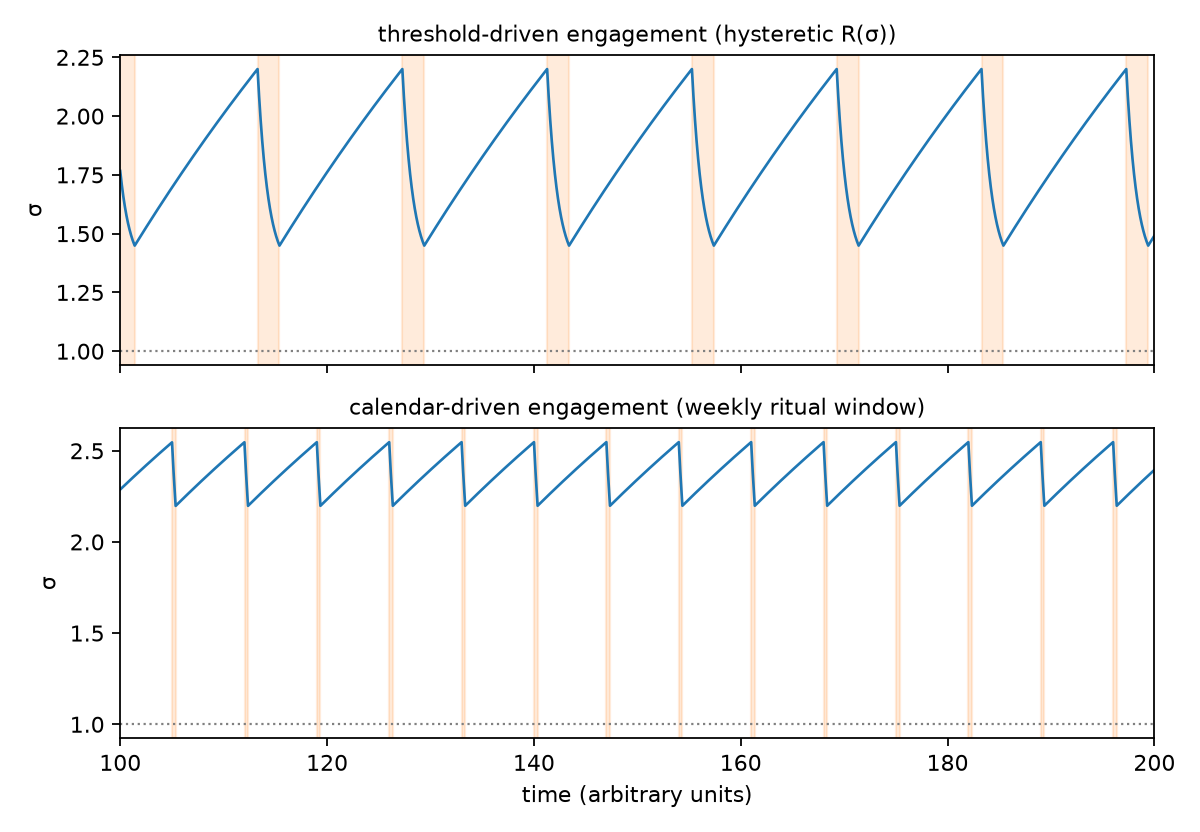
Threshold engagement. The believer seeks relief when the burden grows painful and disengages when relief is felt: R switches 0 → 1 when σ rises to a threshold θ_hi, and 1 → 0 when σ falls to θ_lo < θ_hi. The hysteresis is psychological realism, not mathematical convenience — a confession is sought under pressure and ends when the pressure lifts, not at an instant. That guilt actually drives engagement is not merely assumed: in the one daily-diary study we are aware of that measures the coupling, confessional prayer was predicted by prior guilt — “confession by guilt,” in the study’s own summary of its typology results — with the coupling hypothesized in advance (Newman, Nezlek, & Thrash, 2023; b = .12, p < .001, N = 350 with 4,437 daily reports). Two cautions travel with the coefficient: the guilt measure’s first item is “repentant,” so criterion and predictor are not fully independent; and the study’s construct is confessional prayer, not sacramental confession. The same study supplies the switch’s other face: higher well-being predicted less next-day confession. The evidence is correlational and modest; it is also the shape the policy assumes.
Calendar engagement. The believer engages on the system’s schedule — weekly office, annual obligation — so R is a periodic forcing set by the institution. Lateran IV’s canon 21 is this policy’s documentary anchor: cadence written into law, with a publication requirement attached (“let this salutary decree be published frequently in the churches”) that doubles as an α·S mandate.
Real practice mixes the two, scheduled observance plus guilt-triggered extra engagement, and §5.1 turns that mixture into a prediction.
2.5 What the Model Does
Three results, each a conditional derivation from §§2.2–2.4; formal details and numerical verification are in the computational supplement (§2.6).
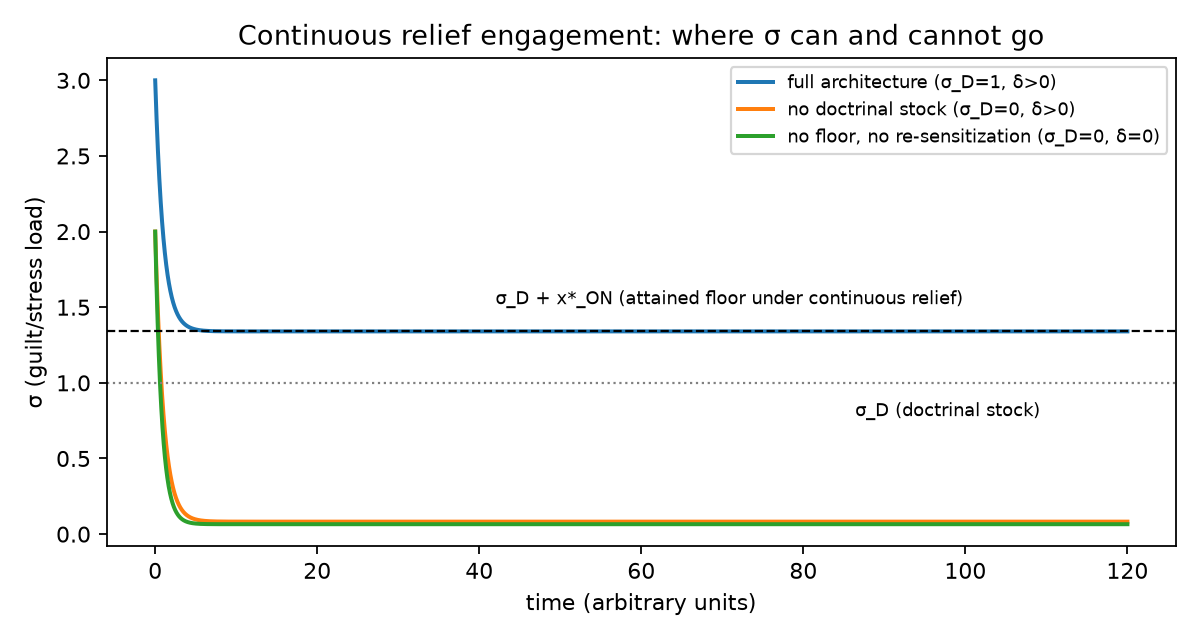
Result 1 — the floor. Suppose the believer engages relief continuously (R ≡ 1) — the limiting best case for relief. The episodic component then converges to
x*_ON = (α·S + δ·σ_D) / (λ + γ − δ) > 0,
so σ converges to σ_D + x*_ON: strictly above the doctrinal component, by a margin the reactivation term inflates. Unlimited relief-seeking does not merely fail to clear the installed condition — it maintains a standing overshoot above it. The converse conditions locate the assumption doing the work: with σ_D = 0 and δ > 0, σ falls to a small environment-set residue; with σ_D = 0 and δ = 0 (the autonomy-supporting architecture of this series’ clinical taxonomy: Paper 1.4, §2.3) it falls further still. A guilt state near zero is dynamically available; the doctrinal specification is what forecloses it. The claim “σ = 0 is unreachable” is therefore true given the tradition’s own stated rules, and false without them; the model keeps the two facts separate, and the separation is the point.
Result 2 — the oscillation. Under threshold engagement, with σ_D + x*_ON < θ_lo (relief episodes can terminate) and the off-phase equilibrium above θ_hi (accumulation always reaches the threshold), the system has a unique attracting periodic orbit: slow accumulation to θ_hi, fast relief to θ_lo, repeat. For this piecewise-linear hybrid system the result follows from the monotone contraction of the cycle’s return map, and the supplement’s runs land on the orbit to numerical precision from any tested start. The orbit is a relaxation oscillation in structure (slow charge, fast discharge), and we note the construction’s kinship with the threshold-gated terms of the panic model cited in §1.3; the timescale separation (accumulation over days and weeks, relief in an hour) is stated here as an assumption, as that literature states its own. Under calendar engagement the same dynamics entrain to the ritual frequency, with amplitude set by the accumulation between observances. Oscillation, in this model, is thus a joint property of the architecture and an engagement policy, which is what makes it observable: policies differ measurably across communities (§5).
Result 3 — the jammed regime. The threshold policy has a failure mode the model produces unbidden. If σ_D + x*_ON ≥ θ_lo (high generation, high installed component, or weak net relief), a relief episode can never attain the relief that would end it: engagement, once begun, does not terminate, and the believer settles into continuous relief-seeking at a burden the relief cannot lower further. The boundary between the cycling and jammed regimes is analytic (the supplement plots it), and crossing it converts periodic observance into something clinically recognizable: relief sought without end because the end state is unreachable. We mark the interpretation, not just the mathematics: the resemblance to compulsive reassurance-seeking and scrupulous confession (relief that sustains the need for itself; §3.2) is an interpretive mapping, offered as such; the clinical phenomenology and its outcomes belong to this series’ clinical paper (Paper 1.4) and to the disorder literatures, not to this model. If confession does not operate by this mechanism in believers, the jammed regime remains a model behavior with no clinical referent, and nothing in §§2–4 changes.
2.6 The Computational Supplement
The simulation program proposed in this paper’s own planning was run for this revision; code (seeded), outputs, and figures are in the project archive, and two figures are reproduced here. The deterministic runs verify Result 1 to thirteen decimal places against the closed-form floor and land Result 2’s orbit with period variation at floating-point noise. An agent-based run implements the population version: 2,000 agents with parameters drawn from broad illustrative distributions, plus one addition beyond the deterministic model — a tolerance ceiling at which an agent exits in despair, the outcome §4.3 discusses. The population sorts into the model’s three regimes (cycling, 58% of the run’s agents; jammed continuous engagement, 42%; despair-exit, none at baseline) — proportions that mean nothing empirically (the parameters are invented) and one thing structurally: the regimes coexist at realistic-looking parameter spreads, and dependency load (fraction of time engaged) tracks the installed component and the generation rate in the way the propositions say it must. The classifier’s cutoffs are conventions; the three-regime structure itself is not an artifact of them, since Result 3’s boundary is analytic. The perturbation runs are reported in §4.3. Every number from these runs carries the same caveat: the supplement exhibits the model’s conditional structure; it is not evidence about believers.
3. Structural Isomorphism with Other Dependency Architectures
3.1 The Template
The guilt-redemption loop instantiates a general template:
- Persistent condition: a state of deficit the participant carries, installed or discovered, not resolvable by the participant alone.
- Distress: the condition generates ongoing aversive load.
- Mediated relief: the system provides the relief channel — monopolistically, or as the strongly preferred option.
- Reactivation: the relief process renews the condition’s salience or its substance.
- Net balance: relief exceeds reactivation per episode, keeping the participant in the viable range.
This series’ mechanism paper offered the family resemblance among religious, addictive, coercive-relational, and financial versions of this template as an observation of common form (Paper 1.2, §2.4); the sections below give each instance its evidence, at the strength the evidence has. For the template’s home case, the two-verb description of confession — an institution that causes what it cures — is Tentler’s (1977), from the standard history of the institution, before any of the dynamical vocabulary existed.
3.2 Reassurance and Safety Behaviors
The clinically closest relative, and the only one with experimental evidence for the reactivation term, is the anxiety-maintenance cycle of safety behaviors and reassurance-seeking. The cognitive account holds that safety-seeking behavior maintains anxiety precisely because it prevents the disconfirmation of threat beliefs: the feared outcome never gets to fail to happen on its own (Salkovskis, 1991). For compulsive checking, the theory names “a self-perpetuating mechanism” whose elements include “paradoxical increases” in responsibility and in perceived probability of harm, and “the absence of a certain end to the threat” (Rachman, 2002): a clinical-vocabulary statement of this paper’s reactivation term and unreachable terminus, published before this model. The experimental support is direct: repeated checking causes memory distrust in analogue paradigms, “rather than reducing doubt, checking fosters doubt” (van den Hout & Kindt, 2003, three experiments in healthy volunteers); and in patients with panic disorder, dropping safety behaviors during exposure produced greater reductions in catastrophic beliefs and anxiety than maintaining them (Salkovskis, Clark, Hackmann, Wells, & Gelder, 1999). Reassurance-seeking itself is documented as frequent and elevated across OCD and anxiety disorders (Kobori & Salkovskis, 2013), with its motives and content mapped in clinical groups (Parrish & Radomsky, 2010).
| Guilt-redemption loop | Safety-behavior cycle |
|---|---|
| Doctrinal condition (unresolvable by the believer) | Threat belief (shielded from disconfirmation) |
| Guilt accumulation | Anxiety and doubt |
| Confession/absolution (relief) | Checking, reassurance (relief) |
| Reactivation: relief rehearses the condition; the terminus is uncertifiable | Reactivation: checking fosters doubt; no certain end to the threat |
| Cadence set by threshold and calendar | Intensity and duration escalate with responsibility and threat multipliers |
The mapping earns one sentence of care: the experimental results concern threat beliefs and memory confidence, not religious guilt; they show that the mechanism (relief that maintains its own demand) exists and can be produced in a laboratory. Whether confession operates by the same mechanism in believers is what §5’s designs would test.
3.3 Addiction
The addiction cycle supplies the template’s formal ancestry. Opponent-process theory described, in 1974, affective dynamics in which the counteracting process grows with use and decays with disuse (Solomon & Corbit, 1974) — reactivation as a law of affect. Its modern descendant, the allostatic model, describes dependence as counteradaptive processes that “fail to return within the normal homeostatic range,” producing “a chronic deviation of reward set point” (Koob & Le Moal, 2001; the negative-reinforcement reformulation is Baker, Piper, McCarthy, Majeskie, & Fiore, 2004, and the neurocircuitry synthesis Koob & Volkow, 2016). A baseline that relief resets rather than restores is this model’s floor, in another literature’s vocabulary.
| Guilt-redemption loop | Addiction cycle |
|---|---|
| Doctrinal condition (permanent by rule) | Allostatic state (persistent after dependence) |
| Guilt/shame | Withdrawal, negative affect |
| Confession/redemption | Substance use (negative reinforcement) |
| Reactivation and uncertifiable terminus | Tolerance and withdrawal (opponent-process) |
| Ongoing engagement | Ongoing use |
One asymmetry separates the two columns. The neuroadaptations of dependence are persistent, not permanent: dopamine-transporter losses in methamphetamine abusers partially recover with protracted abstinence (Volkow et al., 2001), and lifetime remission from dependence is the majority outcome across substances in population data (Lopez-Quintero et al., 2011). The addict’s baseline is empirically stubborn; the believer’s is permanent by rule. Where the neurochemical floor erodes given time and abstinence, the doctrinal floor is maintained by texts that do not decay — which is the difference between a scar and a statute.
3.4 Abusive Relationships
Walker’s (1979) account of the battering cycle describes three phases (tension-building, acute battering, and loving contrition) whose relief phase binds the victim to the source of the tension. Two qualifications bound the row. The cycle is a common pattern, not a universal one: in the follow-up study’s own data, tension-building preceded battering in 65% of cases and contrition followed in 58% (Walker, 1984, as reported by Schuller & Vidmar, 1992). And the operative binding variable, on the mechanism-level account, is not cyclicity but intermittency: traumatic bonding theory locates the attachment in intermittent good–bad treatment under power asymmetry (Dutton & Painter, 1981, 1993) — relief delivered by the source of the harm, unpredictably, which is the template’s third and fourth elements fused. The structural parallel to the loop stands at that mechanism level; the model imports nothing further from a literature whose subject matter is its own.
3.5 Debt Servitude
The financial instance can be given real numbers. In the payday-lending record, over 80% of loans are renewed within fourteen days of the prior loan; half of all loans sit in sequences of ten or more; and in more than 80% of multi-loan sequences the final loan is the same size as or larger than the first; the borrowing does not amortize (Consumer Financial Protection Bureau, 2014). On the behavioral side, the mere presence of a minimum-payment figure anchors partial repayments downward (removing it raised average partial repayments from 23% to 40% of the balance) while leaving the proportion who pay in full unchanged (Stewart, 2009): the architecture shapes the size of the relief installment, not the decision to escape. And the legal definition of the template’s terminal form turns on the model’s own variable: debt bondage, in the 1956 Supplementary Convention’s definition, is pledged service whose “length and nature are not respectively limited and defined” — indefiniteness as the criterion (quoted as a definitional parallel; nothing here equates religious practice with servitude).
The tradition’s own historical instance routes through §2.2’s third leg, and the routing matters. The account that indulgences addressed was the temporal punishment remaining after absolution, Trent’s own arrears term, not sin and not guilt (Swanson, 2007, is the standard corrective to the purchase-of-forgiveness caricature); the late-medieval indulgence economy was a market in the very residue the justification decree guarantees. Luther’s objection, as §2.2 records, was that the instrument let the debtor feel discharged — the loop short-circuited, not overpriced.
| Guilt-redemption loop | Debt architecture |
|---|---|
| Doctrinal condition; uncertifiable terminus | Principal that does not amortize; undefined term |
| Guilt accruing | Interest accruing |
| Confession; satisfaction; (historically) indulgences | Partial repayment; rollover |
| Arrears by rule (temporal punishment) | Balance persists by structure |
| Cadence legislated | Payment schedule contractual |
3.6 What the Isomorphisms Show
The dependency is a property of the architecture, not the content: spiritual guilt, threat belief, withdrawal, attachment, and compound balances are five different substances running one template. Two boundaries keep the conclusion inside its evidence. First, none of these architectures captures everyone — the abuse cycle fits two-thirds of its cases, payday capture holds about half the borrowers, dependence mostly remits, and §4.4’s exits are real; the template describes a capture tendency whose strength is parameter-dependent, which is what the model formalizes. Second, the isomorphism licenses no intent inference in any direction: the payday sequence data and the conciliar canons are both architecture descriptions, and §6.1 takes up what architecture alone can and cannot say about design.
4. Attractor Analysis
4.1 The Attractor
In the model’s terms, the architecture’s operating point is an attractor of the coupled (σ, R) dynamics: the periodic orbit of Result 2 in the cycling regime, the continuous-engagement equilibrium of Result 3 in the jammed regime, and, in the limiting case of unbroken engagement, the floor of Result 1. Perturbations within the basin (doubt episodes, lapses in practice, external distraction) decay back to the operating point: accumulated guilt rebuilds the pressure to engage, and the engagement policy does the rest. How large a perturbation escapes (the basin’s boundary) is the subject of §4.3.
4.2 The Basin
Three features of the architecture widen the basin, and the third is the deepest.
Early installation. The doctrinal component enters at initiation — for hereditary membership, at an age before evaluation is possible — so σ > 0 precedes any capacity to examine the claim that σ > 0. This is the entry-time installation the collective model treats as σ_baseline’s defining property (Paper 1.2, §2.2), individualized.
Social embedding. Exit carries social cost, and the community is not only a penalty at the boundary but a driver inside it: guilt is at its strongest in communal relationships (Baumeister et al., 1994), so the embedded believer’s α is higher — the environment itself generates the load. The exit-cost record and its scope conditions are this series’ clinical paper’s territory (Paper 1.4, §§2.3, 4.1) and are cited, not rebuilt.
Epistemic closure. The architecture discourages the evaluations that would shrink the basin, and the discouragement is documented at three registers. In the tradition’s own texts: “Trust in the LORD with all thine heart; and lean not unto thine own understanding” (Prov. 3:5, KJV); “The heart is deceitful above all things, and desperately wicked: who can know it?” (Jer. 17:9, KJV) — the believer’s own judgment pre-discredited as an instrument. Stronger, the outside evaluator is disqualified as such: “the god of this world hath blinded the minds of them which believe not” (2 Cor. 4:4, KJV), “the natural man receiveth not the things of the Spirit of God: for they are foolishness unto him: neither can he know them” (1 Cor. 2:14, KJV). Doubt arriving from inside is deceit; doubt arriving from outside is blindness; disconfirming feedback is classified before it is heard. In the tradition’s law, §2.2’s second leg: the certainty that would end the loop is forbidden under anathema, closure not as rhetoric but as canon. And in the clinical mechanism: safety behavior maintains threat belief by preventing disconfirmation (Salkovskis, 1991), the same structure produced behaviorally. The corpus reads the textual layer the same way and further in: doubt itself arrives pre-labelled as the adversary’s voice (its exhibit is Bunyan’s memoir, where the temptation “to question the being of god … is the worst”: J, ch. I, n. 4, quoting Bunyan); verification of the system’s claims is, in its phrase, “primevally foreclosed” (K, ch. V; the closure stated across chs. I–II as well); and the specific reasoning that would identify the system’s source is walled off by named sins whose function the corpus states as that foreclosure (K, ch. IV, n. 13). Three registers, one structure: the loop protects the premise that keeps the loop running.
4.3 Escape Perturbations
The model admits four escape routes, and both the population runs and the exit literature say the same thing about them: alone, each is weaker than it looks.
P1 — releasing the doctrinal component. If the believer comes to reject the installed condition (not merely propositionally but at the felt level), then σ_D → 0 and the floor of Result 1 collapses. In the population runs this cuts the dependency load by an order of magnitude (mean fraction of time engaged falls from .48 to .037) while leaving the cycle largely intact: 92% of agents still cycle, because the environment still generates guilt and the policy still answers it. Rejecting the doctrine, while remaining inside the guilt-generating environment, changes what the cycle carries, not whether it turns.
P2 — relief failure. If relief stops working (γ → 0) while generation continues, σ climbs without remedy; the model’s outcome, with a tolerance ceiling added for the purpose, is exit through despair — in the runs, universally so. The architecture’s own interest lies in keeping relief effective; the failure mode belongs to its pathology, and its human face (the exhausted scrupulant, the burned-out penitent) to the clinical literature.
P3 — alternative relief without reactivation. A relief channel carrying no δ term (therapeutic processing, secular community, self-compassion practice) lowers σ without rehearsing the condition. In the runs its distinctive effect is on the jammed regime: continuous engagement drops from 42% of agents to 16%, because an exit from the unattainable-relief trap now exists.
P4 — leaving the generation environment. Reducing α·S (practically, disengaging from the community and media that generate the load) is, in the runs, the strongest single perturbation (96% of agents quiet — a classification of engagement, not a measure of well-being; §4.4’s residuals are off-model). The result converges with the exit literature’s own ranking, where alternative community is the best-supported protective factor (Paper 1.4, §4.3), and with this model’s social scope limit: the α-reduction is the individual-level shadow of a social process the collective model owns (Paper 1.2).
Combination. Full escape — low σ, no cycling, no despair — occurs in the runs only under combined perturbations, and the one pre-registered longitudinal study of religious deidentification trajectories reports the same conjunction in the field: deidentification “is likely to occur when growing doubt is combined with disengagement from religious practices over time” (Watanabe & Todd, 2025). In the model’s terms: the doctrinal release and the engagement withdrawal must co-occur; either alone leaves the structure standing.
4.4 The Deconversion Trajectory
What does the model predict for a believer under sustained, combined perturbation? Read as a conditional derivation (the model’s path, not a documented universal), the state variable passes through five recognizable stretches: stable cycling; perturbation onset with shrinking amplitude; an irregular transition as competing relief channels and a weakening floor interact; escape, with σ declining toward the alternative-relief equilibrium; and residuals: conditioned responses that outlast the architecture that installed them, whose mechanics (extinction as new learning over intact old learning) and whose four-part decomposition of what exit actually requires are this series’ individual-level paper’s account (Paper 1.3, §§5.4, 7.2).
The empirical record constrains the derivation at three points, and we state the constraints. The exit literature describes deconversion as a process in phases (Hardy & Taylor, 2024; the stage-model ancestry runs through role-exit theory, Ebaugh, 1988), but it does not underwrite this particular five-stage path: the stages above are the model’s, and no published stage model matches them one-to-one. Longitudinal data contradict the first stretch as a general picture: religiosity typically declines for years before deconversion (Bleidorn, Lenhausen, Schwaba, & Hopwood, 2024; Chen & Streib, 2025), so stable pre-exit cycling describes at most a subset. And trajectory heterogeneity is the field’s own headline, four distinct doubt trajectories in the one pre-registered classification (Watanabe & Todd, 2025); the model’s path is one member of a family whose distribution is an open empirical question. The distress that attends exit has its own scope structure (real and substantial in high-demand and clinical samples, absent as a general well-being effect in population panels), and that record, with its mediators, is presented in this series’ clinical paper (Paper 1.4, §4.1; clinical description: Winell, 1993, 2011, cited as such; the research reviews: Streib, 2021).
5. Quantitative Predictions
Each prediction names what would count against it.
5.1 Cycle Frequency
The two engagement policies make different, jointly testable predictions. Under calendar dominance, guilt time-series should show spectral power at the ritual cadence (weekly where observance is weekly, annual where it is annual), with amplitude growing in the gap between observances. Under threshold dominance, frequency should track the generation rate α·S, and engagement should be predicted within-person by preceding guilt — the coupling for which the daily-diary record already shows the sign (Newman et al., 2023, with §2.4’s caveats). Deviations from pure cadence (extra engagement following guilt spikes) measure the threshold component’s share. The instrument exists: experience-sampling and ambulatory assessment are standard for such symptom-dynamics questions (Trull & Ebner-Priemer, 2013; the method’s classic validation is Csikszentmihalyi & Larson, 1987), and field-scale moral experience sampling is feasible (Hofmann, Wisneski, Brandt, & Skitka, 2014). We are not aware of any experience-sampling study of confession cadence and guilt dynamics; the nearest existing work is the prayer-typology study above. Against it: no spectral peak at cadence in calendar-dominant communities, or no within-person guilt→engagement coupling, would count against the respective policy components; a negative guilt→engagement coupling would count against the policy model as such.
5.2 Amplitude and Architecture
Oscillation amplitude should track the architecture’s generation intensity: communities with high-α environments (frequent guilt-focused preaching and examination practices) should show larger within-person guilt swings than low-α communities of the same tradition, and the doctrinal component should separate traditions in mean level rather than swing. The strictness and intensity constructs, and the clinical correlates of guilt-installing architectures, are measured territory this series assigns to its clinical paper (Paper 1.4, §§2.2–2.3, with its instruments discussion); the prediction here is the dynamical signature, not the outcome claim. Against it: equal guilt amplitude across architecture intensities, within tradition and person-controlled, would count against the α·S structure.
5.3 Deconversion Difficulty
Exit difficulty should scale with basin depth: installed-component strength, embedding (which raises α and the social boundary), and the reactivation parameter; and, the model’s sharper edge, single-route exits should fail in the specific ways §4.3 derives (doctrinal release without environment change leaving the cycle turning; alternative relief without doctrinal release un-jamming but not freeing). The combined-perturbation requirement is already consistent with the one trajectory classification in the record (Watanabe & Todd, 2025). Against it: frequent, durable single-perturbation exits (doctrinal rejection alone producing full disengagement at scale, with embedding held) would count against the basin structure.
6. Discussion
6.1 Intent Is Irrelevant
Nothing in §§2–4 requires malice anywhere in the system. The dependency is produced by the architecture’s stated rules operating on ordinary affect dynamics: a permanent component, a restricted relief operator, a reactivating engagement, a legislated cadence. Operators who believe the doctrine and love their flock run the same equations as cynics would; the compound-interest analogy holds — a payment structure produces debt dependency whatever the lender feels. This is why the paper draws no design inference in either direction. An architecture this effective can arise by selection among cultural variants without any designer, and the same architecture contains episodes of documented deliberate engineering of particular mechanisms; the record underdetermines the mixture, and this series says so where the evidence lives (Paper 2.1, §§1.2, 7.3) and confronts the strong design question on its own terms in the capstone (Paper 5.1, §2.2). What the model adds to that conversation is discipline: dependency-production is evidence of architecture, and architecture alone is evidence of neither intention nor its absence.
6.2 Generality and Its Limits
The template of §3.1 is content-free, and instances of parts of it are everywhere. The full configuration is rarer than the rhetoric of “everything is a cult” suggests, and the differences sit where the model says to look.
Islam is the instructive comparison, because it shares the mandate-and-exclusivity pairing (Paper 2.1, §4.1) while differing on this paper’s central variable. The Qur’anic structure has no counterpart to the inherited baseline: Adam repents and is forgiven, no soul bears another’s burden, and the anthropology runs on fiṭra, an innate sound disposition (the doctrinal record and its sources are presented at Paper 2.1, §4.1). Repentance (tawba) is correspondingly a high-frequency, completable act — the tradition’s own exemplar performs it, by its report, a hundred times a day — and in one strand of the early tradition the ideal penitent is defined by the forgetting of sins (al-Junayd’s position, as treated in Khalil, 2018): reactivation itself renounced as a spiritual goal, where the Tridentine text leaves the disposition standing “for us to wrestle with.” The model’s derived contrast is therefore about the floor, not the rate: a loop without a permanent installed component supports genuine per-cycle termination (σ returning to the neighborhood of zero after completed repentance) at any cadence. High-frequency repentance with a reachable terminus and guilt-cycling above an unreachable floor are different dynamical objects, whatever their surface resemblance. One further asymmetry bounds the model’s reach: the Qur’anic relief relation is direct and reciprocal, not institutionally mediated, and a model whose relief operator is a mediated service describes the mediated case. We rank nothing: these are structural coordinates, and the traditions’ clinical profiles are an empirical matter for instruments this series does not yet have (Paper 1.4).
Secular instances vary in how much of the template they carry. The self-help cycle has a named literature: “false hope syndrome,” the cycle of failed self-change attempts interpreted so as to license renewed attempts (Polivy & Herman, 2002), supplies condition, relief, reactivation-by-interpretation, and repeat, with the industry as the relief vendor. The wellness sector’s commercial mechanism (monetizing crises its promotion “may deepen, rather than alleviate”) has a recent scholarly anchor (Karreman, Zenone, Maani, & Hawkins, 2026), but a documented cycle structure does not yet exist in that literature, and we say so rather than assert one.
The open question. Whether any other living system instantiates the full configuration — permanent doctrinal component, restricted and mediated relief, reactivating engagement, legislated cadence — is a question this paper deliberately leaves open. Answering it needs the comparative instruments of this series’ clinical taxonomy and bears directly on the capstone’s question of how singular this architecture is; both are assigned elsewhere (Papers 1.4 and 5.1).
6.3 Therapeutic Implications
The model organizes, without adding to, the exit literature’s own conclusions. Addressing the doctrinal component (P1) targets the floor but not the cycle; alternative, non-reactivating relief (P3) specifically reaches the jammed regime; community and environment change (P4) is where the measured record puts the largest effect (Paper 1.4, §4.3); and residuals should be expected and normalized as conditioning, not read as evidence the doctrine was true (Paper 1.3, §5.4). The model’s one genuinely clinical suggestion is diagnostic: the three regimes look different in time-series — cycling, continuous engagement, and climbing distress under failing relief — and matching intervention to regime (P1+P4 for cycling, P3 for jamming, urgent support under P2 conditions) is a testable triage the equations make explicit.
6.4 Limitations
The model’s parameters are calibrated to nothing; every quantitative statement in this paper is structural. The state is a scalar that aggregates distinct moral emotions (§2.1). The engagement policy is an idealization: real relief-seeking is noisier than a threshold with hysteresis, though the daily-diary record supports its sign. The population runs add a despair ceiling the deterministic model lacks, and contain no social coupling at all: the collective dynamics that share and renew stress across hosts are the mechanism paper’s layer (Paper 1.2), and nothing here substitutes for it. Measurement is owed before any of §5 can be tested — the instruments that would capture shared, cyclically renewed guilt do not yet exist (Paper 1.2, §8.1 states the debt). And one cautionary precedent belongs on the record: the one attempt we know of to fit nonlinear oscillator models to a dependency behavior (adolescent substance use) rejected them (Boker & Graham, 1998); a model of this family earns its keep when it survives that kind of test on its own subject, and ours has not yet been given the chance.
7. Conclusion
The guilt-redemption cycle can be modeled, and the model repays the effort with specificity. Given the architecture the tradition’s own documents specify — a disposition that cannot be removed, a terminus that cannot be certified, an arrears that survives each absolution, a cadence written into law — a believer’s guilt state acquires a floor it cannot pass, an oscillation whose period the engagement policy sets, and, past an analytic boundary, a jammed regime in which relief-seeking becomes continuous because its goal is unreachable. The same template, with different substances, runs the safety-behavior cycle that experimental psychology can produce on demand, the allostatic cycle of dependence, the intermittency bond of coercive relationships, and the non-amortizing loan sequence — architectures that differ in everything except structure, which is the respect in which this paper compares them.
The analysis is non-theological in both directions: it does not evaluate the doctrine’s truth, and it derives dependency from the architecture’s rules regardless of the intentions of those who designed, maintain, or participate in the system. Escape, on the same analysis, is not a mystery but a coordination problem: the floor and the cycle fall to different perturbations, and the record of those who leave says what the model says — it takes both.
What this paper hands the series is a working part: the formal loop whose fourth-century installation the historical case study documents (Paper 2.1) and whose thirteenth-century legislated cadence §2.2 quotes, that the collective model runs at population scale (Paper 1.2), that the clinical taxonomy scores architectures by (Paper 1.4), and that the capstone must weigh when it asks what kind of thing built this (Paper 5.1). The part is small, stated in full, and falsifiable at the joints named in §5 — which is what a formalization is for.
References
External literature (each entry carries a verification record in the project archive — journal articles at fetch level, several at full-text level; books at book level; primary texts quoted from named translations with witnesses recorded; entries print only archive-held fields)
- Baker, T. B., Piper, M. E., McCarthy, D. E., Majeskie, M. R., & Fiore, M. C. (2004). Addiction motivation reformulated: An affective processing model of negative reinforcement. Psychological Review, 111(1), 33–51. DOI 10.1037/0033-295X.111.1.33.
- Baumeister, R. F., Stillwell, A. M., & Heatherton, T. F. (1994). Guilt: An interpersonal approach. Psychological Bulletin, 115(2), 243–267. DOI 10.1037/0033-2909.115.2.243.
- Bayer, O. (2018). Luthers „simul iustus et peccator”. Kerygma und Dogma, 64(4), 249–264. DOI 10.13109/kedo.2018.64.4.249.
- Bleidorn, W., Lenhausen, M. R., Schwaba, T., & Hopwood, C. J. (2024). Psychological change before and after religious conversion and deconversion. Journal of Personality, 92(4), 1193–1210. DOI 10.1111/jopy.12881.
- Boker, S. M., & Graham, J. (1998). A dynamical systems analysis of adolescent substance abuse. Multivariate Behavioral Research, 33(4), 479–507. DOI 10.1207/s15327906mbr3304_3.
- Borsboom, D. (2017). A network theory of mental disorders. World Psychiatry, 16(1), 5–13. DOI 10.1002/wps.20375.
- Bryant, J. M. (2023). Decius & Valerian, Novatian & Cyprian: Persecution and schism in the making of a Catholic Christianity — Parts I and II. Athens Journal of History, 9(2), 125–158, 159–184. DOIs 10.30958/ajhis.9-2-1, 10.30958/ajhis.9-2-2.
- Chen, Z. J., & Streib, H. (2025). Characteristics, predictors and outcomes of religious deconversion: A cross-sectional and longitudinal analysis. International Journal for the Psychology of Religion, 36(1), 97–114. DOI 10.1080/10508619.2025.2520104.
- Consumer Financial Protection Bureau, Office of Research. (2014, March). CFPB data point: Payday lending (K. Burke, J. Lanning, J. Leary, & J. Wang). Consumer Financial Protection Bureau.
- Csikszentmihalyi, M., & Larson, R. (1987). Validity and reliability of the experience-sampling method. The Journal of Nervous and Mental Disease, 175(9), 526–536. DOI 10.1097/00005053-198709000-00004.
- Dutton, D. G., & Painter, S. L. (1981). Traumatic bonding: The development of emotional attachments in battered women and other relationships of intermittent abuse. Victimology, 6, 139–155.
- Dutton, D. G., & Painter, S. (1993). Emotional attachments in abusive relationships: A test of traumatic bonding theory. Violence and Victims, 8(2), 105–120. DOI 10.1891/0886-6708.8.2.105.
- Ebaugh, H. R. F. (1988). Becoming an Ex: The Process of Role Exit. University of Chicago Press.
- Hardy, S. A., & Taylor, E. M. (2024). Religious deconversion in adolescence and young adulthood: A literature review. Archive for the Psychology of Religion, 46(2), 180–203. DOI 10.1177/00846724241235176.
- Hofmann, W., Wisneski, D. C., Brandt, M. J., & Skitka, L. J. (2014). Morality in everyday life. Science, 345(6202), 1340–1343. DOI 10.1126/science.1251560.
- Karreman, N., Zenone, M., Maani, N., & Hawkins, B. (2026). The political economy of wellness: Commercial determinants of a burgeoning industry. The Milbank Quarterly, 104(2), 361–385. DOI 10.1111/1468-0009.70088.
- Khalil, A. (2018). Repentance and the Return to God: Tawba in Early Sufism. State University of New York Press.
- Kobori, O., & Salkovskis, P. M. (2013). Patterns of reassurance seeking and reassurance-related behaviours in OCD and anxiety disorders. Behavioural and Cognitive Psychotherapy, 41(1), 1–23. DOI 10.1017/S1352465812000665.
- Koob, G. F., & Le Moal, M. (2001). Drug addiction, dysregulation of reward, and allostasis. Neuropsychopharmacology, 24(2), 97–129. DOI 10.1016/S0893-133X(00)00195-0.
- Koob, G. F., & Volkow, N. D. (2016). Neurobiology of addiction: A neurocircuitry analysis. The Lancet Psychiatry, 3(8), 760–773. DOI 10.1016/S2215-0366(16)00104-8.
- Kuppens, P., Oravecz, Z., & Tuerlinckx, F. (2010). Feelings change: Accounting for individual differences in the temporal dynamics of affect. Journal of Personality and Social Psychology, 99(6), 1042–1060. DOI 10.1037/a0020962.
- Lopez-Quintero, C., Hasin, D. S., de los Cobos, J. P., Pines, A., Wang, S., Grant, B. F., & Blanco, C. (2011). Probability and predictors of remission from life-time nicotine, alcohol, cannabis or cocaine dependence: Results from the National Epidemiologic Survey on Alcohol and Related Conditions. Addiction, 106(3), 657–669. DOI 10.1111/j.1360-0443.2010.03194.x.
- Newman, D. B., Nezlek, J. B., & Thrash, T. M. (2023). The dynamics of prayer in daily life and implications for well-being. Journal of Personality and Social Psychology, 124(6), 1299–1313. DOI 10.1037/pspp0000454.
- Parrish, C. L., & Radomsky, A. S. (2010). Why do people seek reassurance and check repeatedly? An investigation of factors involved in compulsive behavior in OCD and depression. Journal of Anxiety Disorders, 24(2), 211–222. DOI 10.1016/j.janxdis.2009.10.010.
- Polivy, J., & Herman, C. P. (2002). If at first you don’t succeed: False hopes of self-change. American Psychologist, 57(9), 677–689. DOI 10.1037/0003-066X.57.9.677.
- Rachman, S. (2002). A cognitive theory of compulsive checking. Behaviour Research and Therapy, 40(6), 625–639. DOI 10.1016/S0005-7967(01)00028-6.
- Robinaugh, D. J., Haslbeck, J. M. B., Ryan, O., Fried, E. I., & Waldorp, L. J. (2021). Invisible hands and fine calipers: A call to use formal theory as a toolkit for theory construction. Perspectives on Psychological Science, 16(4), 725–743. DOI 10.1177/1745691620974697.
- Robinaugh, D. J., Haslbeck, J. M. B., Waldorp, L. J., Kossakowski, J. J., Fried, E. I., Millner, A. J., McNally, R. J., Ryan, O., de Ron, J., van der Maas, H. L. J., van Nes, E. H., Scheffer, M., Kendler, K. S., & Borsboom, D. (2024). Advancing the network theory of mental disorders: A computational model of panic disorder. Psychological Review, 131(6), 1482–1508. DOI 10.1037/rev0000515.
- Salkovskis, P. M. (1991). The importance of behaviour in the maintenance of anxiety and panic: A cognitive account. Behavioural Psychotherapy, 19(1), 6–19. DOI 10.1017/S0141347300011472.
- Salkovskis, P. M., Clark, D. M., Hackmann, A., Wells, A., & Gelder, M. G. (1999). An experimental investigation of the role of safety-seeking behaviours in the maintenance of panic disorder with agoraphobia. Behaviour Research and Therapy, 37(6), 559–574. DOI 10.1016/S0005-7967(98)00153-3.
- Schuller, R. A., & Vidmar, N. (1992). Battered woman syndrome evidence in the courtroom: A review of the literature. Law and Human Behavior, 16(3), 273–291. DOI 10.1007/BF01044770.
- Solomon, R. L., & Corbit, J. D. (1974). An opponent-process theory of motivation: I. Temporal dynamics of affect. Psychological Review, 81(2), 119–145. DOI 10.1037/h0036128.
- Stewart, N. (2009). The cost of anchoring on credit-card minimum repayments. Psychological Science, 20(1), 39–41. DOI 10.1111/j.1467-9280.2008.02255.x.
- Streib, H. (2021). Leaving religion: Deconversion. Current Opinion in Psychology, 40, 139–144. DOI 10.1016/j.copsyc.2020.09.007.
- Swanson, R. N. (2007). Indulgences in Late Medieval England: Passports to Paradise? Cambridge University Press.
- Tangney, J. P., & Dearing, R. L. (2002). Shame and Guilt. Guilford Press.
- Tentler, T. N. (1977). Sin and Confession on the Eve of the Reformation. Princeton University Press.
- Trull, T. J., & Ebner-Priemer, U. (2013). Ambulatory assessment. Annual Review of Clinical Psychology, 9, 151–176. DOI 10.1146/annurev-clinpsy-050212-185510.
- van den Hout, M., & Kindt, M. (2003). Repeated checking causes memory distrust. Behaviour Research and Therapy, 41(3), 301–316. DOI 10.1016/S0005-7967(02)00012-8.
- Volkow, N. D., Chang, L., Wang, G.-J., Fowler, J. S., Franceschi, D., Sedler, M., Gatley, S. J., Miller, E., Hitzemann, R., Ding, Y.-S., & Logan, J. (2001). Loss of dopamine transporters in methamphetamine abusers recovers with protracted abstinence. Journal of Neuroscience, 21(23), 9414–9418. DOI 10.1523/JNEUROSCI.21-23-09414.2001.
- Walker, L. E. (1979). The Battered Woman. Harper & Row.
- Walker, L. E. (1984). The Battered Woman Syndrome. Springer.
- Watanabe, S., & Todd, N. R. (2025). One trajectory does not fit all: Understanding religious deidentification with longitudinal patterns of religious doubt and engagement. International Journal for the Psychology of Religion, 36(1), 133–149. DOI 10.1080/10508619.2025.2521564.
- Wicks, J. (1983). Justification and faith in Luther’s theology. Theological Studies, 44(1), 3–29. DOI 10.1177/004056398304400101.
- Winell, M. (1993). Leaving the Fold: A Guide for Former Fundamentalists and Others Leaving Their Religion. New Harbinger Publications. (Reprinted 2006, Apocryphile Press.)
- Winell, M. (2011). Religious trauma syndrome [three-part series]. CBT Today, 39(2), 39(3), 39(4).
Primary and conciliar texts
- Council of Trent. Session V (1546), Decree concerning original sin, canon 5 [DS 1515]; Session VI (1547), Decree concerning justification, chapters IX, XIV, XV and canons 13, 14, 16. Quoted in the translation of H. J. Schroeder, Canons and Decrees of the Council of Trent (B. Herder Book Co., 1941); the public-domain Waterworth translation (Dolman, 1848) carries the same passages at Session V pp. 21–29 and Session VI pp. 30–53.
- Fourth Lateran Council (1215), canons 21 and 22. In H. J. Schroeder (Trans.), Disciplinary Decrees of the General Councils: Text, Translation, and Commentary (pp. 236–296). B. Herder Book Co., 1937 (public domain in the US).
- Luther, M. Lectures on Romans, at WA 56, 272, 17 (the simul formula, manuscript order), as presented in Wicks (1983); Luther’s indulgence caution as rendered in Wicks (1983).
- Supplementary Convention on the Abolition of Slavery, the Slave Trade, and Institutions and Practices Similar to Slavery, art. 1(a), done at Geneva 7 September 1956.
- Scripture quotations: Proverbs 3:5; Jeremiah 17:9; 2 Corinthians 4:4; 1 Corinthians 2:14 — King James Version (public domain; the KJV’s italics for translator-supplied words are omitted).
The project corpus (quotations per the project’s adjudicated witnesses; printed copies under inspection, Bern)
- Panakal, L. The Ancient Mother I: The Key to the bible. First ed. Vantage Press, New York, May 1993 (ISBN 0533104653); rev. Identity Publishers, Kiental, 1997 (ISBN 3-9520446-1-X). [K — cited by chapter; page numbers refer to the project’s manuscript reference copy]
- Panakal, L. The Ancient Mother II: The Judgement on christianity. First ed. Vantage Press, New York, April 1993 (ISBN 0533104165); rev. Identity Publishers, Kiental. Chapters III–VI per the printed Kiental copy (Theol Varia 8083); chapters I–II cited by chapter. [J]
- Panakal, L. (1998). Preview of the Ancient Mother Series of Treatises, Part I. Society of Friends of the Ancient Mother / Identity Publishers (25 pp.). [PRE]
The series
- Grünig, P., & Claude Fable (Anthropic). (2026). Memeplexes as Adaptive Cognitive Systems: A TAME-Integrated Framework for Understanding Ideological Agency. Paper 1.1 of this series (rev. 2, August 2026). Project archive. [cited as Paper 1.1]
- Grünig, P., & Claude Fable (Anthropic). (2026). Stress-Sharing as Cognitive Glue in Ideological Collectives: From Biological Morphogenesis to Cultural Cohesion. Paper 1.2 of this series (rev. 2, August 2026). Project archive. [cited as Paper 1.2]
- Grünig, P., & Claude Fable (Anthropic). (2026). Neurological Markers of Deep Belief Entrenchment: A Narrative Review of Identity-Fused Conviction Across Domains. Paper 1.3 of this series (rev. 2, August 2026). Project archive. [cited as Paper 1.3]
- Grünig, P., & Claude Fable (Anthropic). (2026). Religious Belief Systems and Mental Health Outcomes: A Structural Taxonomy Distinguishing Architecture from Content. Paper 1.4 of this series (rev. 2, September 2026). Project archive. [cited as Paper 1.4]
- Grünig, P., & Claude Fable (Anthropic). (2026). Christianity as a Case Study in Memeplex Self-Preservation: Two Millennia of Adaptive Response in a Complex Cultural System. Paper 2.1 of this series (rev. 2, September 2026). Project archive. [cited as Paper 2.1]
- Grünig, P., & Claude Fable (Anthropic). (2026). The Luciferian Hypothesis: A Scientific Reinterpretation of the Panakal Thesis. Paper 5.1 of this series (rev. 2, August 2026). Project archive. [cited as Paper 5.1]
Note: The computational supplement — seeded model code, full outputs, four figures, and the population runs — is archived in the project repository (paper-2-2-v2-model). This paper applies the framework of Papers 1.1 and 1.2, uses the architectural vocabulary of Paper 1.4, receives its historical record from Paper 2.1, and hands its open questions to Papers 2.3 (transmission architectures) and 5.1 (the design question).